
Economist Peter Schiff posted a strongly bullish outlook on December 27th on social platform X, predicting that silver will break through the historic $100 level next year. While acknowledging that the market may experience a sharp but brief correction, Schiff emphasized that “silver can easily pull back, but is unlikely to approach $50 again.” He believes that silver is affected by worsening fiscal deficits, expanding quantitative easing, a weakening dollar, and supply deficits.
The logic behind the $100 target and the $50 support line
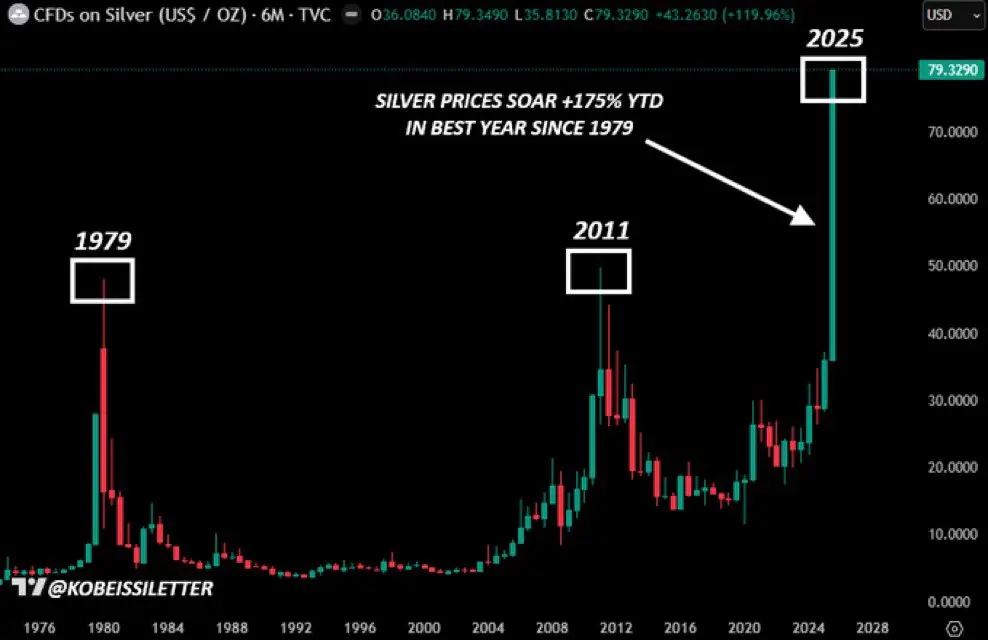
Peter Schiff’s forecast for silver prices is not baseless optimism but is based on an in-depth analysis of historical cycles and current market structures. In response to skeptics among financial experts, he stated: “Regardless of possible corrections, the price should break through $100 next year. This time is different.” The phrase “this time is different” is often seen as a warning sign in financial markets, but Schiff’s argument is that the current macro environment differs structurally from past silver bull markets.
The $50 level holds significant psychological and technical importance. Silver reached near $50 twice—once in 1980 and again in 2011—but both times experienced deep corrections lasting several years. Schiff believes that the current market context is fundamentally different from these two historical peaks. The 1980 high was mainly driven by speculative hoarding by the Hunt brothers, and the 2011 peak was a short-term response to post-financial crisis quantitative easing. The current silver bull market is built on more durable structural factors, including persistent supply deficits, irreversible growth in industrial demand, and a crisis of confidence in the global monetary system.
Schiff admits that “silver can easily pull back,” reflecting his realistic understanding of the metal’s extreme volatility. Silver’s price swings are typically 2 to 3 times those of gold, with potential weekly gains of 30% during bull markets, followed by rapid retracements. However, his judgment that it is “unlikely to approach $50 again” is based on fundamental changes in supply and demand. Unlike past cycles, current demand for silver is driven not only by speculation and safe-haven flows but also by structural needs from energy transition and technology industries—needs that will not disappear during price corrections.
Skeptics’ viewpoints are also worth noting. Some commentators say: “I can totally see silver breaking $100 and then correcting back to $50. I agree it’s unlikely to fall lower. Right now, I prefer buying gold or Bitcoin for long-term holding over speculative silver.” This perspective reflects rational investors’ caution about silver’s leveraged speculative nature. The silver market is much smaller than gold and more susceptible to large capital inflows and outflows, and leverage in ETFs and futures markets can cause sharp short-term volatility.
The perfect storm of fiscal deficits and monetary policy
Schiff links silver’s upside potential directly to deteriorating macroeconomic conditions. In another post, he explained: “Recession is bullish for gold and silver because it will lead to increased federal budget deficits, lower interest rates, expanded quantitative easing (meaning higher inflation), and a weakening dollar.” This view positions silver as a beneficiary of a failing monetary system rather than just an industrial metal.
The US federal budget deficit is projected to reach $1.7 trillion in fiscal year 2024, accounting for over 6% of GDP, well above historical averages. More concerning is that this deficit occurs before the economy has entered a recession. When economic slowdown occurs, automatic stabilizers (such as unemployment benefits and social welfare spending) will further increase deficits, and governments often exacerbate fiscal deterioration through additional stimulus plans. Historical experience shows that when government debt exceeds 100% of GDP and deficits continue to grow, currency devaluation and inflationary pressures are often unavoidable.
The expectation of lower interest rates provides a dual support for silver. First, lower rates reduce the opportunity cost of holding non-yielding assets like silver, making it more attractive relative to bonds. Second, rate cuts are often accompanied by increased money supply, which has historically been highly correlated with rising precious metal prices. During the Fed’s quantitative easing from 2020 to 2021, silver prices surged from $12 to nearly $30, exemplifying this mechanism.
A weakening dollar is another key catalyst. Silver is priced in USD; a depreciating dollar directly boosts silver prices in other currencies. More importantly, a weaker dollar often reflects global concerns about US fiscal sustainability, prompting capital flows into hard assets. When investors lose confidence in fiat currencies, precious metals become a natural alternative store of value.
Three pillars of supply-demand structure
Structural supply deficits intensify: Silver mining has failed to meet total demand for several years, with the gap filled by inventory depletion. Limited mine response capacity means that even if prices rise, new production takes 5 to 7 years to come online.
Industrial demand is price inelastic: Demand from solar panels, electric vehicles, 5G infrastructure, and electronics will not significantly decrease with rising prices, as silver costs constitute only a tiny fraction of end-product costs.
Potential explosion in investment demand: Compared to gold, silver’s investment demand share remains relatively low. Once a gold and silver bull market is established, retail and institutional shifts could trigger explosive growth in silver ETFs and physical demand.
Volatility risks and investment strategies
Schiff’s $100 target is exciting, but investors must face silver’s extreme volatility. In March 2020, silver plummeted from $18 to $12 within two weeks, then rebounded to nearly $30 over the next five months. Such rollercoaster price behavior is a severe test for sentiment and capital management.
Skeptics’ scenario of “breaking $100 and then correcting back to $50” is not impossible. The leverage and speculative nature of the silver market mean that rapid price increases can attract momentum traders and algorithmic trading, pushing prices into overbought territory. Once technical sell signals are triggered or macro conditions change abruptly, leveraged positions may be liquidated en masse, causing a waterfall decline. The 1980 silver crash from $50 to $10 exemplifies such extreme leverage liquidation.
For those wanting to participate in silver’s rise but worried about volatility, diversification and phased accumulation are key. Limiting silver to 5%–15% of a portfolio and avoiding heavy accumulation at single price levels can reduce risk. Additionally, participating through physical silver rather than leveraged ETFs or futures can lower forced liquidation risks. Combining gold and silver holdings can also maintain precious metals exposure while reducing overall volatility.
Disclaimer: The information on this page may come from third parties and does not represent the views or opinions of Gate. The content displayed on this page is for reference only and does not constitute any financial, investment, or legal advice. Gate does not guarantee the accuracy or completeness of the information and shall not be liable for any losses arising from the use of this information. Virtual asset investments carry high risks and are subject to significant price volatility. You may lose all of your invested principal. Please fully understand the relevant risks and make prudent decisions based on your own financial situation and risk tolerance. For details, please refer to
Disclaimer.
Related Articles
XRP Open Interest Drops 75%, But Stablecoin Fragmentation Intensifies XRP Bridge Demand
XRP open interest declined approximately 75%, indicating that leveraged traders are exiting the market, but stablecoin fragmentation may increase bridge demand for XRP. Evernorth Holdings' IPO application demonstrates that institutions still view XRP's long-term value positively. The overall market faces macroeconomic pressure, with weak short-term momentum structure.
MarketWhisper41m ago
Japanese Yen Rate Hike Hopeless? Japanese Bonds Collapse with "Yields at 27-Year High," Strait of Hormuz Conflict Strangling Japan's Economy
Japan's 10-year government bond yield rose to 2.32%, approaching a 27-year high, with markets concerned that geopolitical tensions will impact the economy and crypto markets. Trump's 48-hour ultimatum to Iran has sent energy prices soaring, and Japan's critical crude oil shipping routes face threats, potentially worsening inflation. The Bank of Japan faces a dilemma between rate hikes and economic recovery, while rising yields could trigger investor liquidations, impacting risk assets like Bitcoin.
動區BlockTempo1h ago
Pi Network Price Surge Outpaces Market, Protocol 20 Upgrade Boosts Market Confidence
Pi Network's recent price has risen to $0.198, outperforming the broader crypto market, primarily driven by capital rotation and the launch of a new token platform developed through Protocol 20 upgrades. Analysts point out that PI's gains reflect fundamental improvements rather than passive market influences. Going forward, PI's price movement will be affected by altcoin season indices and market sentiment, with $0.20 serving as resistance and $0.19 as support.
MarketWhisper1h ago
XRP Today's News: SOPR Approaching Historical Signal of 1, Bottom Signal Emerging
XRP has continued to underperform since the start of the year, failing to attract market capital, with current trading prices below major moving averages. SOPR and NUPL indicators show bottom signals, but these are only probabilistic characteristics. $1.51 serves as a near-term bullish-bearish dividing line, with breakouts potentially triggering a bullish rebound. The market maintains a cautious stance on XRP's short-term strong rebound, with the probability of returning to $2 at only 5%.
MarketWhisper1h ago
Bitcoin Falls Below $69,000, Derivatives Market Shifts to Defense, Downside Risks Intensify
10x Research analysis points out that Bitcoin has broken below $69,000, marking a shift in market structure. Traders have significantly adjusted positions, with increased futures liquidations and negative funding rates. Options capital flows are moving toward downside protection, signaling hedging demand against downside risks. Meanwhile, market expectations regarding rate increases are diverging from the Federal Reserve's rate-cutting guidance, which could impact risk asset performance.
GateNews2h ago
Hyperliquid Surpasses CME Pricing Status, On-Chain Commodity Trading Volume Breaks $173.4 Billion
Hyperliquid's HIP-3 board has achieved billion in trading volume over the past 7 days, primarily driven by WTI crude oil contracts, demonstrating strong market activity. Powered by the US-Iran conflict, the platform's 24/7 trading functionality has made it an important source for price discovery, replacing traditional exchanges. As Hyperliquid adapts to CFTC regulations, it aims to maintain financial neutrality, but how to balance compliance requirements with the advantages of decentralized trading remains a challenge.
MarketWhisper2h ago


