

Trade
Basic
Futures
Futures
Hundreds of contracts settled in USDT or BTC
Options
HOT
Trade European-style vanilla options
Unified Account
Maximize your capital efficiency
Demo Trading
Futures Kickoff
Get prepared for your futures trading
Futures Events
Participate in events to win generous rewards
Demo Trading
Use virtual funds to experience risk-free trading
Earn
Launch
CandyDrop
Collect candies to earn airdrops
Launchpool
Quick staking, earn potential new tokens
HODLer Airdrop
Hold GT and get massive airdrops for free
Launchpad
Be early to the next big token project
Alpha Points
NEW
Trade on-chain assets and enjoy airdrop rewards!
Futures Points
NEW
Earn futures points and claim airdrop rewards
Investment
Simple Earn
Earn interests with idle tokens
Auto-Invest
Auto-invest on a regular basis
Dual Investment
Buy low and sell high to take profits from price fluctuations
Soft Staking
Earn rewards with flexible staking
Crypto Loan
0 Fees
Pledge one crypto to borrow another
Lending Center
One-stop lending hub
VIP Wealth Hub
Customized wealth management empowers your assets growth
Private Wealth Management
Customized asset management to grow your digital assets
Quant Fund
Top asset management team helps you profit without hassle
Staking
Stake cryptos to earn in PoS products
Smart Leverage
NEW
No forced liquidation before maturity, worry-free leveraged gains
GUSD Minting
Use USDT/USDC to mint GUSD for treasury-level yields

More

From start to giving up, why I stopped doing Web3 payments.
2025-12-23 09:51
The Year of the New Token's Demise
2025-12-23 08:41
Trending Topics
View More11.15K Popularity
19.61K Popularity
13.65K Popularity
6.92K Popularity
94.69K Popularity
Hot Gate Fun
View More- MC:$0.1Holders:10.00%
- MC:$3.56KHolders:10.00%
- MC:$3.56KHolders:10.00%
- MC:$3.56KHolders:10.00%
- MC:$3.6KHolders:10.00%





Pin
Over 70% of SOL is pledged. Why did Solana fail to take off with liquidity staking?
Author: Aleks Gilbert, DL News; Compiler: Felix, PANews
Liquidity staking is the largest sub-circuit of Ethereum, accounting for the largest proportion, and on other blockchains, the share of collateral used in DeFi protocols is growing rapidly.
In the Solana ecosystem, developers and investors also hope the same.
Ethereum, Solana, and other blockchains that rely on proof-of-stake technology have users lock (or stake) their tokens to realize a certain amount of revenue.
These tokens are required for the complex but critical work of ordering and validating transactions on a blockchain that uses proof-of-stake technology.
Although staked tokens are effectively locked, the liquid staking protocol issues redeemable derivative tokens at a 1:1 ratio, allowing users to take advantage of blockchain staking yields (5% for Ethereum, 7% for Solana) ) while using them on other DeFi protocols to gain additional profits. This is called “liquidity pledged derivatives” (LSD), but the term has not been actively mentioned by project parties since then, possibly fearing regulatory scrutiny.
Over 70% of Solana’s SOL tokens are delegated to individuals, businesses, and protocols that use them to order and validate transactions. However, less than 3% of them were delegated to Liquid Staking Token (LST) projects.
According to Ben Chow, founder of the Solana protocols Meteora and Jupiter, only 3% of the more than $9 billion in staked SOL is LST. “We have done a lot of work to increase the adoption rate of LST and unlock this capital, which will greatly improve TVL and transaction volume.”
Jito Labs CEO Lucas Bruder agrees. “This is a huge opportunity to unlock the remaining 97% of staking on the network. I don’t think any LST protocol has figured out the right marketing and narrative yet, and we’re excited to try and find out.”
If this changes, it could dramatically alter the DeFi ecosystem on Solana. But that’s easier said than done.
low risk
According to data compiled by Hildobby, an anonymous data analyst at venture capital firm Dragonfly, ethereum switched to proof-of-stake technology (PoS) about a year ago, and only one-fifth of all ETH (about 26 million) is staked.
This is trivial compared to other blockchains that have used proof-of-stake technology from the beginning, such as Solana.
But the difference is mobility.
On Ethereum, one-third of tokens are delegated to the liquidity staking protocol Lido. In total, nearly 40% of ETH has been deposited into Ethereum’s many liquidity staking protocols, according to Elias Simos of research firm Rated.
Meanwhile, less than 3% of SOL is deposited into Solana’s liquidity staking protocol, according to Solana Compass data.
According to the data platform Spire, among Solana’s “large stakers”, 1,651 people have staked at least 5,000 SOL, of which only 152 hold liquid staking tokens.
In May, Solana co-founder Anatoly Yakovenko vented his frustrations on Twitter (now known as X). “SOL represents a very small percentage of liquidity staking and DeFi,” he wrote. “We need an industry-wide effort to change that.”
“Additional Risk”
A survey of SOL stakers revealed two reasons for the relatively low usage, according to Alex Cerba, a core contributor to liquidity staking protocol Marinade.
Marinade is the largest liquidity staking protocol in the Solana ecosystem and issues the liquidity staking token mSOL.
Marinade is Solana’s largest liquidity staking protocol as measured by total cryptocurrency deposit value
The first is the potential tax issue of staking. When a user deposits SOL and receives liquid staking tokens, is this a taxable event? When exactly do they pay taxes on gains from staking tokens?
Second, Solana was built to make staking simple, efficient, and risk-free. But stakers have not always believed that the extra benefits that Solana DeFi can bring are worth the effort and risk, because it requires entrusting millions of dollars to a third-party built protocol, which has certain risks.
Cerba said in the survey: "I can’t get the corresponding return in DeFi, because in order to obtain 9% annualized return rate, I need to take additional risks in mSOL. And I only need to pledge to get 7% annualized return without any smart contract risk.”
Messari research analyst Kel Eleje agrees. Kel Eleje said that validators who represent the interests of users are usually free. Additionally, users can withdraw their stakes within two days, compared to two weeks for those holding ETH. “It essentially feels like liquidity staking with a slightly lower risk profile,” Eleje said. To this end, Marinad recently released its own version of Solana’s built-in quality annotation service – Marinade Native. We hope that people who are already staking SOL will be able to use it and eventually transition to using Marinade for liquidity staking. This summer saw a surge in the number of new liquidity staking protocols Jito and BlazeStake, according to data from DefiLlama.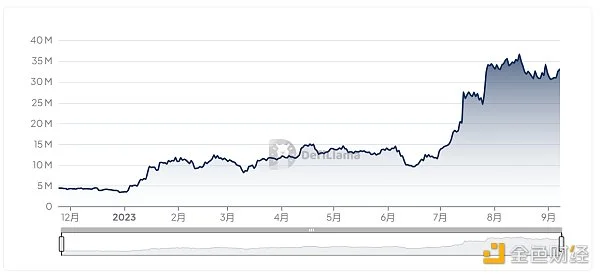
Liquid staking protocol Jito has taken off this summer
Eleje attributes this growth to airdrop speculation and the popularity of its liquid staking tokens on MarginFi, a lending protocol that is also growing in popularity.
But Bruder said users may be attracted by the innovation. “When you look at the usage of jitoSOL in DeFi, you will find that the usage is much higher than other LSTs.”
Ethereum “a bit ahead”
Liquid staking protocol BlazeStake is growing rapidly this summer
If another 4% of staked SOL is staked through protocols like Marinade or Jito, then the total value of cryptocurrencies in Solana DeFi will double. But Cerda isn’t sure Solana is ready. “Some people look at this a little naively because they only see so much money flowing into DeFi as an opportunity. Additionally, there are currently quite few places where you can deposit large amounts of DeFi funds on Solana.” Solana DeFi needs to grow to be able to handle the large volume Liquid tokens, which creates a chicken-and-egg problem. You also need the operation of the DeFi protocol, and have more use cases and larger volumes in order to basically absorb all the capital. And these are where Ethereum leads.