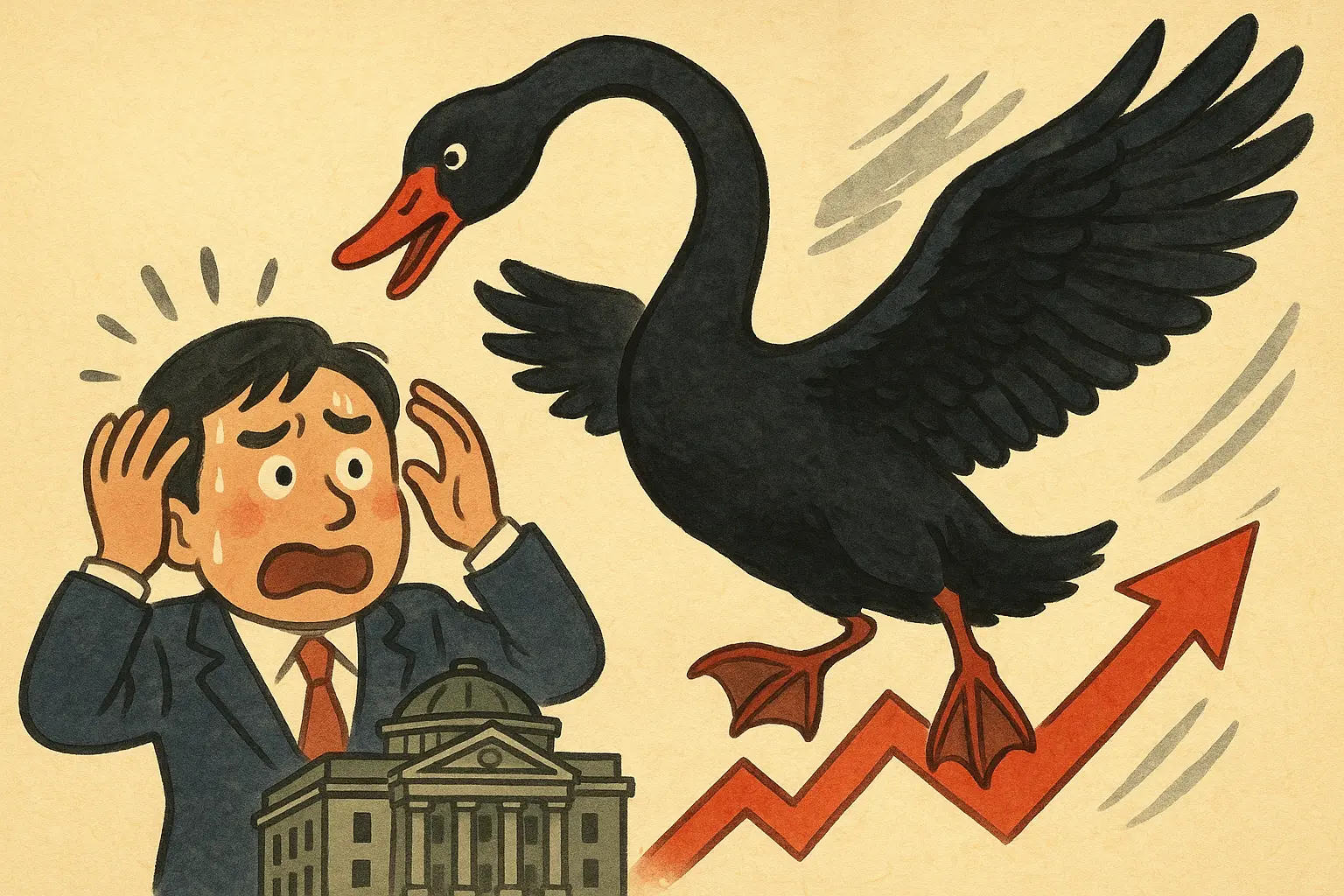
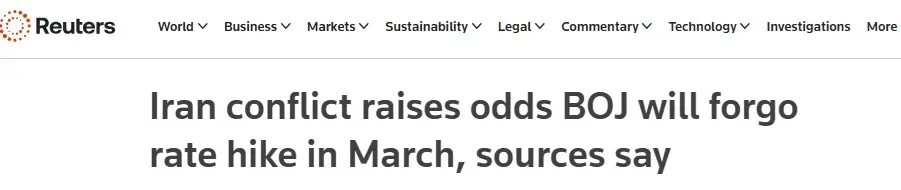
Reuters, on March 3, 2026, citing multiple sources, reported that the recent market volatility triggered by the US-Iran conflict has significantly increased the likelihood that the Bank of Japan will hold off on rate hikes at its March 18-19 meeting; after Nara Igami did not signal a hawkish stance, the probability of a rate hike in March dropped from about 10% to just around 5%. Several sources stated, “The BOJ is finding it increasingly difficult to raise rates.”
The Transmission Logic of the Middle East “Black Swan” to Japan’s Monetary Policy
Japan is one of the world’s major economies heavily dependent on imported fuel. The outbreak of Middle East conflict directly impacts in two ways: first, rising oil prices increase import costs, potentially driving overall inflation through energy price hikes; second, if the conflict persists, it will damage export prospects and suppress consumer investment, delaying economic recovery.
Several informed sources familiar with the BOJ’s decision-making told Reuters that policymakers need more time to assess the economic impact of this geopolitical crisis. One source noted that although rising oil prices could temporarily boost inflation expectations, if the conflict continues, its negative effects on the economy may outweigh the inflationary benefits, making rate hikes less justifiable.
The only factor currently likely to prompt the BOJ to act in March is a significant decline in the yen. After the US launched strikes on Iran, demand for safe-haven dollars surged, and the yen approached a critical psychological level of 160. Sources said that if the yen depreciates sharply, it could force the BOJ to raise interest rates to support the exchange rate and prevent further import inflation pressures.
Market Pricing and Analyst Interpretations
BOJ Vice Governor Nara Igami did not signal any imminent policy adjustments in a public speech on Monday. This silence has become an important reference point for the market—during previous tightening cycles, BOJ officials typically issued hawkish signals in advance to avoid surprising the market.
Senior strategist Katsutoshi Inadome of Sumitomo Mitsui Trust Asset Management said, “If the BOJ is considering a rate hike in March, Igami should have given some hints. He didn’t, which convinces me that the BOJ will forgo a rate increase this month.” He added that the next possible rate hike is most likely in April, especially if the yen continues to weaken.
Key Data on BOJ Rate Hike Expectations
- March Rate Hike Probability: Dropped to about 5% after Igami’s comments (previously around 10%)
- April Rate Hike Probability: About 60% of market participants see the meeting on April 27-28 as the more likely timing
- Reuters Survey: Most economists expect the BOJ to raise rates to 1% before the end of June 2026
- Key Yen Level: The yen is approaching 160 against the dollar; a sharp break could compel the BOJ to act
- Ueda Kuroda’s Position: In a February 26 interview with Yomiuri Shimbun, he left open the possibility of a March or April hike but emphasized that the decision depends on upcoming data
Frequently Asked Questions
What is the direct link between the BOJ’s pause in March rate hikes and the Middle East conflict?
The Middle East conflict influences Japan’s monetary policy through two pathways: rising oil prices and deteriorating economic outlook. Japan needs to balance inflation pressures with economic growth risks. When the situation is uncertain, it tends to adopt a wait-and-see approach, acting only after more data is available. Sources indicate that the impact of this crisis depends on how long the war continues.
Why could the yen approaching 160 actually prompt a rate hike in March?
A continued yen depreciation increases import costs (including energy and food), raising domestic inflation and threatening the effectiveness of previous inflation control measures. If the yen falls below key support levels like 160, the secondary inflationary pressures from currency depreciation could force the BOJ to raise rates early to support the exchange rate, even if the macro environment isn’t ideal.
How do changes in BOJ rate hike expectations affect the cryptocurrency market?
BOJ rate hikes usually lead to yen appreciation, which can trigger a “yen carry trade” unwinding—funds borrowed in low-interest yen to invest in higher-yield assets like Bitcoin are forced to be repaid, impacting crypto markets. If the BOJ pauses in March, this pressure may temporarily ease, helping to maintain liquidity in risk assets.
Disclaimer: The information on this page may come from third parties and does not represent the views or opinions of Gate. The content displayed on this page is for reference only and does not constitute any financial, investment, or legal advice. Gate does not guarantee the accuracy or completeness of the information and shall not be liable for any losses arising from the use of this information. Virtual asset investments carry high risks and are subject to significant price volatility. You may lose all of your invested principal. Please fully understand the relevant risks and make prudent decisions based on your own financial situation and risk tolerance. For details, please refer to
Disclaimer.
Related Articles
CryptoQuant Analyst: In March, the U.S. CPI month-over-month increase hit a record high; if the U.S.-Iran conflict continues or forces the Federal Reserve to raise interest rates
CryptoQuant analyst Darkfost noted that although March CPI recorded the largest month-over-month increase, core CPI remained stable, indicating that U.S. inflation has not fully spread yet. Attention should be paid to upcoming PCE data. If the Iran-Iraq conflict continues, inflation could evolve into a systemic risk and affect economic growth, and the Federal Reserve may need to continue raising rates to respond.
GateNews14h ago
Hassett: The Strait of Hormuz could be opened within two months, and the Federal Reserve still has room to cut rates
Gate News message: On April 10, U.S. National Economic Council Director of the White House, Hassett, said the Strait of Hormuz could be reopened within two months. In addition, Hassett said the Federal Reserve still has room to cut interest rates, and this outlook will be very solid.
GateNews04-10 13:25
Reuters: The market is pricing in expectations that the U.S. Federal Reserve will keep interest rates unchanged throughout 2026
Gate News, April 10, according to Reuters, the market continues to price in expectations that the Federal Reserve will keep interest rates unchanged throughout 2026.
GateNews04-10 13:06
CME Data: The probability that the Federal Reserve will keep interest rates unchanged in April is 98.4%
Gate News message: On April 10, according to CME "FedWatch" data, before the CPI data is released, the probability that the Federal Reserve will raise rates by 25 basis points in April is 1.6%, while the probability of keeping rates unchanged is 98.4%. Looking ahead to June, the probability of cumulative rate cuts of 25 basis points is 1.5%, the probability of keeping rates unchanged is 96.8%, and the probability of cumulative rate hikes of 25 basis points is 1.7%.
GateNews04-10 12:31
Federal Reserve’s Daly: If the Iran conflict is resolved and oil prices fall, a rate cut “is not out of the question”
Gate News, on April 10, Daly, the president of the Federal Reserve Bank of San Francisco, said that if the Iran conflict is resolved quickly and oil prices fall, a rate cut is “not impossible.” She also noted that the likelihood of a rate hike is lower than the likelihood of cutting rates or keeping interest rates unchanged.
GateNews04-10 12:06
Banking firms such as Australia and New Zealand Banking Group (ANZ) and Goldman Sachs maintain a bullish outlook for gold, with a year-end target price as high as $5,800
Banks such as Australia and New Zealand Banking Group (ANZ) and investment banks like Goldman Sachs predict that gold may rebound in the long term, mainly driven by central bank demand, geopolitical uncertainty, and expectations that the Federal Reserve will cut interest rates. ANZ expects the gold price to reach $5,800 by year-end, while Goldman Sachs maintains a $5,400 outlook, saying that central bank gold purchases will be a support factor.
GateNews04-10 11:45


