The measures seek to fully integrate crypto exchanges into the established financial system and protect the identity information of the institution’s customers. The Central Bank states that this will promote “transparency, comparability, and predictability of information provided to the market.”
Brazil Issues Resolution Including Crypto Brokerages to Comply With Bank Secrecy Laws
Brazil is moving to integrate crypto exchanges into its financial ecosystem.
The National Monetary Council and the Central Bank of Brazil recently approved Resolution No. 5,280, which brings new compliance rules for virtual asset service providers in the country.
The resolution, which states that virtual asset service providers (VASPs) will be considered financial institutions under the Brazilian Bank Secrecy Act, seeks to establish an equivalent regulatory treatment for all exchanges operating in the local financial system and the mechanisms needed to protect it.
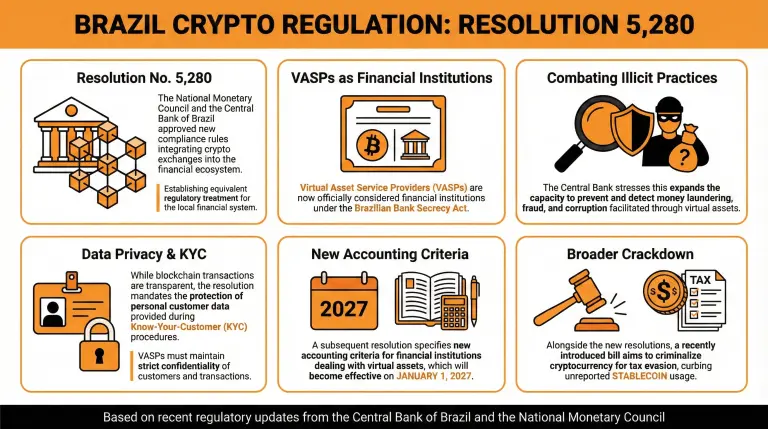
The Central Bank of Brazil stressed that this move “expands the capacity to prevent, detect, and combat illicit practices—such as money laundering, fraud, corruption, and other irregularities—that may be facilitated through the use of virtual assets.”
While blockchain transactions are transparent, given the nature of these structures, experts like Tiago Severo stressed that the identification and personal data of customers, provided when completing Know-Your-Customer (KYC) procedures, is what this resolution seeks to protect.
At the same time, it increases the responsibility of these institutions, which will have to take into account already established provisions regarding the confidentiality of their customers and their transactions.
In a subsequent resolution, the two institutions also approved a new resolution that specifies the accounting criteria that financial institutions dealing with virtual assets must follow.
The central bank states that regulatory clarity will contribute to investor confidence, assigning a clearer role to VASPs about the duties these institutions should fulfill.
The bank secrecy measure is already being applied, while the new accounting rules for financial institutions are set to become effective on January 1, 2027.
Recently, a bill criminalizing cryptocurrency for tax evasion was introduced into Congress, aiming to curb the usage of stablecoins for unreported payments and transactions.
FAQ
- What recent resolution has Brazil approved regarding crypto exchanges?
Brazil approved Resolution No. 5,280, integrating crypto exchanges into its financial ecosystem as virtual asset service providers.
- How does Resolution No. 5,280 affect virtual asset service providers (VASPs)?
VASPs will now be classified as financial institutions under the Brazilian Bank Secrecy Act, requiring compliance with new regulations.
- What is the goal of this regulatory change by the Central Bank of Brazil?
The aim is to enhance the detection and prevention of illicit practices, including money laundering and fraud, associated with virtual assets.
- When will the new accounting rules for financial institutions dealing with virtual assets take effect?
The new accounting criteria for financial institutions will become effective on January 1, 2027.
Disclaimer: The information on this page may come from third parties and does not represent the views or opinions of Gate. The content displayed on this page is for reference only and does not constitute any financial, investment, or legal advice. Gate does not guarantee the accuracy or completeness of the information and shall not be liable for any losses arising from the use of this information. Virtual asset investments carry high risks and are subject to significant price volatility. You may lose all of your invested principal. Please fully understand the relevant risks and make prudent decisions based on your own financial situation and risk tolerance. For details, please refer to
Disclaimer.
Related Articles
U.S. banks question the White House’s stablecoin yield report, concerned about the risk of deposit outflows
U.S. banks are questioning a White House stablecoin yield report, arguing that it overlooks the impact of stablecoins on deposit outflows, which could lead to higher financing costs and reduced local lending. The two sides are currently negotiating an agreement on the Senate bill, and a ban on paying stablecoin interest is the focus of the dispute.
GateNews5m ago
Banking industry questions the White House’s stablecoin report, allegations that the crisis of community bank deposit outflows was deliberately avoided
The American Bankers Association criticizes the White House’s research framework in its stablecoin report, saying it overlooks the risk of deposit outflows that could be triggered by prohibiting stablecoin yield. The White House report says the ban will have only a minimal impact on bank lending, increasing it by just $2.1 billion, but the ABA believes this issue’s framework fails to reflect the risks that would actually harm community banks and support the local economy. This dispute is also tied to the current cryptocurrency regulatory legislative efforts, shaping the future development of stablecoins and the competitive landscape for banks.
MarketWhisper19m ago
U.S. lawmakers push crypto tax policy reforms again, and the $200 small-amount tax exemption threshold is removed
U.S. House members recently introduced the “Protecting American Rights Through Interoperable Value and Yield” Act (PARITY Act), aiming to reform cryptocurrency tax policies, remove the $200 exemption threshold, and introduce wash sale rules, clearly distinguishing different types of trading activity. The bill’s legislative progress remains unclear, but it is expected to draw attention in future tax debates, and the industry is actively pushing to include the relevant provisions in new legislation.
MarketWhisper25m ago
Encourage innovation! U.S. judges ban Arizona’s regulation of prediction markets and halt the prosecution of Kalshi
A U.S. federal district court ruled that Arizona is barred from using gambling laws to prosecute the prediction market platform Kalshi, finding that the Commodity Futures Trading Commission has exclusive jurisdiction. The ruling affects the boundary between state and federal authority in regulating financial markets, while Kalshi insists its business falls under financial products rather than traditional gambling. Rulings on prediction markets vary from state to state, and the Trump family has also expressed support for prediction markets.
CryptoCity46m ago
People’s Daily criticizes chaos in financial media outlets, calling out virtual currency referral activities by name
Gate News updates. On April 14, People’s Daily published an article titled “Disrupting the capital markets: these irregularities by finance-and-economics self-media accounts need to be on high alert,” which singled out and criticized certain accounts that drive users to virtual-coin trading by publishing false yield information such as “one hundredfold coins” and “making millions every month trading coins.” The article cites a notice previously issued by eight departments, including the People’s Bank of China, emphasizing that business activities related to virtual currencies constitute illegal financial activities. The article states that accounts and platforms suspected of providing referral traffic and technical services for illegal virtual currency trading may violate laws and regulations and could threaten financial security and anti–money laundering efforts.
GateNews1h ago
Can bypass Financial Supervisory Commission (FSC) rules to buy crypto with credit cards? ODC pushes a Wallet Pro service for buying crypto with U.S. debit cards
OdinDentis (Odinting?) launched the OwlPay and Wallet Pro services, focusing on B2B cross-border payments. By combining stablecoin technology with international financial systems, it showcases its fintech transformation. Through its partnership with MoneyGram, Wallet Pro enables cross-border transfers of stablecoins purchased with cash, and operates in the U.S. market. The company’s overseas model bypasses Taiwan’s strict regulation and, under the new draft law, challenges the market competition landscape; in the future, it will affect local operators’ compliance strategies.
CryptoCity1h ago


