At CaptainAltcoin, we don’t like writing about wars.
Our focus has always been crypto, stocks, metals, and global macro trends that affect markets. But when geopolitics becomes one of the dominant forces driving volatility across Bitcoin, oil, gold, and equities, it cannot be ignored. Right now, escalating tensions between the U.S., Israel, and Iran are market catalysts.
And the data shows the fear is spreading fast.
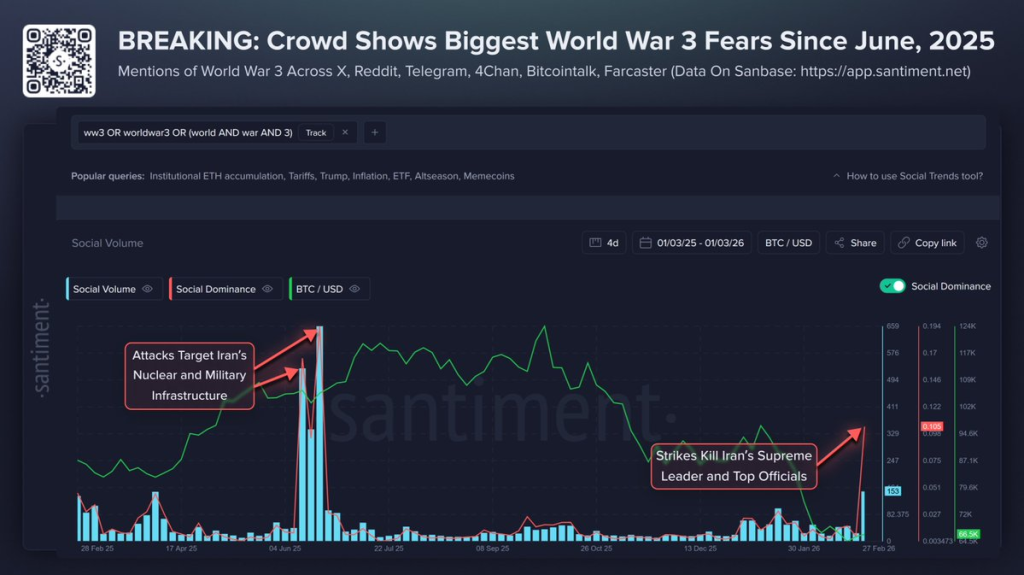
Blockchain analytics firm Santiment reported that crypto social media is discussing the prospect of World War 3 at the highest level since June 2025. Their chart tracks mentions of “WW3” and related phrases across platforms including X, Reddit, Telegram, 4Chan, Bitcointalk, and Farcaster.
The spike is sharp and unmistakable.
The previous major peak came between June 13 and June 24, 2025, when Israel launched strikes on Iranian nuclear and military sites. That 12-day direct conflict saw U.S. involvement in intercepting Iranian attacks and conducting additional strikes on Iranian nuclear facilities. Iran retaliated with missile and drone strikes, including attacks on a U.S. base in Qatar. A ceasefire was eventually reached on June 24.
Now, the conversation is surging again.
Beginning February 28, 2026, the U.S. and Israel carried out coordinated strikes across Iran, targeting military infrastructure and leadership sites. Iran responded with missile and drone attacks on Israel and U.S. military installations across the Gulf region. Unlike last year’s conflict, this round remains ongoing.
Source: X/@santimentfeed
Santiment’s chart shows social volume bars spiking dramatically alongside these developments. Social dominance (the share of crypto discussions centered on this topic) also jumped. The timing aligns directly with confirmed military escalations and news reports about high-profile leadership casualties and retaliatory strikes.
In simple terms, crypto traders are paying attention.
Historically, extreme spikes in fear-driven keywords often coincide with sharp market reactions. Bitcoin and Ethereum tend to experience increased volatility when geopolitical uncertainty rises. Gold and oil frequently react in tandem. The current wave of “World War 3” mentions reflects anxiety about broader global escalation, not just localized conflict.
The memory of June 2025 still lingers in market psychology. Back then, volatility surged across asset classes before cooling after the ceasefire. Now, with conflict ongoing and no resolution in sight, social media users are framing the situation as a possible precursor to a much wider global confrontation.
Whether that fear proves justified remains to be seen.
But from a market perspective, sentiment extremes matter. When online discussion around global war reaches its highest level in months, it signals that traders are bracing for instability.
And in markets, fear spreads faster than facts.
Read also: Strait of Hormuz Freeze: Oil Tankers Turn Back as War Risk Insurance Vanishes Overnight
Disclaimer: The information on this page may come from third parties and does not represent the views or opinions of Gate. The content displayed on this page is for reference only and does not constitute any financial, investment, or legal advice. Gate does not guarantee the accuracy or completeness of the information and shall not be liable for any losses arising from the use of this information. Virtual asset investments carry high risks and are subject to significant price volatility. You may lose all of your invested principal. Please fully understand the relevant risks and make prudent decisions based on your own financial situation and risk tolerance. For details, please refer to
Disclaimer.
Related Articles
Israel Defense Minister Says Removing Enriched Uranium from Iran Is Precondition for Ending Conflict
Israeli Defense Minister Katz announced that Israel's military actions, including the "12-Day War" against Iran in 2025, have dismantled Iran's nuclear program. The U.S. and Israel demand the removal of enriched uranium as a condition to cease regional military operations.
GateNews30m ago
IMF cuts its 2026 global economic growth forecast to 3.1%, with Middle East hostilities being the main drag
Gate News message, April 14, the International Monetary Fund (IMF) released its latest edition of the World Economic Outlook report, lowering its forecast for global economic growth in 2026 by 0.2 percentage points to 3.1%. The report notes that the fighting in the Middle East has significantly affected the current momentum of global economic growth. If the fighting and high oil prices continue for longer, this year global economic growth will fall to 2.5% or even lower.
GateNews2h ago
Nauru appoints crypto entrepreneur Dadvan Yousuf as Commissioner for International Trade, driving a digital asset strategy
Nauru appoints cryptocurrency entrepreneur Dadvan Yousuf as its Commissioner for International Trade to advance a digital asset strategy, attract global investment, strengthen cooperation with virtual service providers and technology companies, and help position Nauru as a virtual asset hub.
GateNews5h ago
Reuters: The U.S.-Iran delegation will hold talks in Pakistan later this week
Gate News message, April 14, Reuters reported, citing sources, that U.S. and Iranian delegations will hold talks in Islamabad, the capital of Pakistan, later this week.
GateNews8h ago
Nigel Farage invests 2 million pounds in Bitcoin, becoming the UK’s first openly holding MP
Reform UK leader Nigel Farage bought Bitcoin with roughly £2 million, becoming the first sitting member of Parliament to publicly disclose an investment of this size. The move highlights his party’s support for cryptoassets and could spark debate about the impact on the UK’s crypto policy and potential conflicts of interest. Farage invested via Stack BTC, strengthening his dual political and financial endorsement.
MarketWhisper9h ago
U.S. banks question the White House’s stablecoin yield report, concerned about the risk of deposit outflows
U.S. banks are questioning a White House stablecoin yield report, arguing that it overlooks the impact of stablecoins on deposit outflows, which could lead to higher financing costs and reduced local lending. The two sides are currently negotiating an agreement on the Senate bill, and a ban on paying stablecoin interest is the focus of the dispute.
GateNews10h ago


