The bill, introduced by Federal Deputy Tabata Amaral, amends the current regulation and establishes the crime of cryptocurrency tax evasion, aiming to curb the rising volume of remittances and settlement alternatives using dollar proxies, including stablecoins.
Brazil Aims To Criminalize Undeclared Stablecoin Transactions In New Bill
Brazil is taking measures to tighten its grip on rising volumes of crypto outflows, especially those involving stablecoins, by imposing penalties on undeclared cryptocurrency transactions.
Bill 746/2026, introduced by Federal Deputy Tabata Amaral, explicitly defines the crime of cryptocurrency tax evasion, getting stablecoin exchanges outside a gray zone classified as a loophole by some regulators and government officials.
The crime of foreign currency tax evasion is defined in Brazilian regulation as “carrying out an unauthorized exchange operation, with the purpose of promoting the evasion of foreign currency from the country.”
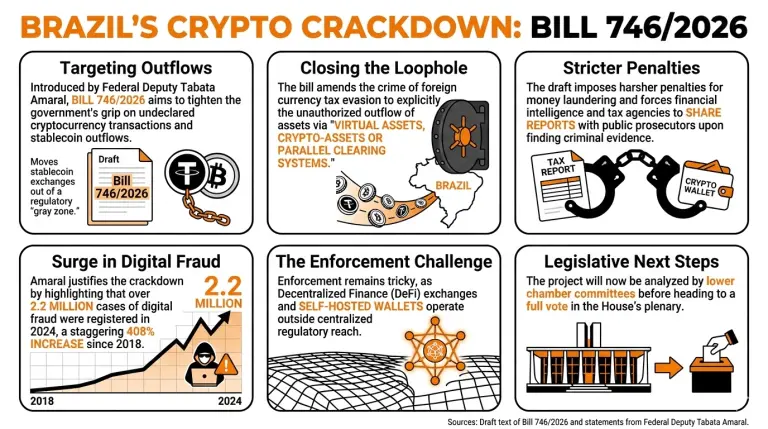
The new bill proposes to amend part of this definition, including a new paragraph that extends this crime to “anyone who, in any capacity, promotes, without legal authorization, the outflow of currency or foreign exchange abroad, or maintains undeclared deposits abroad, including through the use of virtual assets, crypto-assets or parallel clearing systems.”
The draft also imposes harsher penalties for money laundering involving crypto assets, forcing financial intelligence units and tax agencies to share reports with the public prosecution if they identify criminal evidence.
Amaral justifies these changes by stating that economic crime is transforming in Brazil, highlighting that during the last decade, crime has migrated to include digital and crypto assets, partnering with corporate structures to obfuscate money laundering and tax evasion crimes.
Over 2.2 million cases of digital fraud were registered in 2024, an increase of 408% since 2018. Amaral states that this growth has been “fueled by the feeling of anonymity and the difficulty of tracking virtual assets.”
As with other measures targeting crypto assets, its degree of applicability will be key, as decentralized finance exchanges and self-hosted wallets might be outside regulatory reach, given that they are not managed by centralized authorities that could deliver information about their owners.
The project will now be analyzed by the committees in the lower chamber. If approved, it will be directed for a full vote in the House’s plenary.
FAQ
- What measures is Brazil taking to address crypto outflows?
Brazil is introducing Bill 746/2026 to impose penalties on undeclared cryptocurrency transactions, particularly focusing on stablecoins.
- What does Bill 746/2026 define as tax evasion?
The bill specifies that crypto tax evasion includes unauthorized exchange operations aimed at evading foreign currency regulations, extending this to virtual assets.
- What penalties does the new bill propose?
It introduces harsher penalties for money laundering involving crypto assets and mandates financial intelligence units to report findings to public prosecution.
- Why are these regulations necessary, according to Deputy Amaral?
Amaral highlights a significant rise in digital fraud, with over 2.2 million cases reported in 2024, driven by the anonymity of virtual assets and their growing use in economic crimes.
Disclaimer: The information on this page may come from third parties and does not represent the views or opinions of Gate. The content displayed on this page is for reference only and does not constitute any financial, investment, or legal advice. Gate does not guarantee the accuracy or completeness of the information and shall not be liable for any losses arising from the use of this information. Virtual asset investments carry high risks and are subject to significant price volatility. You may lose all of your invested principal. Please fully understand the relevant risks and make prudent decisions based on your own financial situation and risk tolerance. For details, please refer to
Disclaimer.
Related Articles
Senator Warren Presses Musk on X Money Risks, Citing Stablecoin Concerns and Regulatory Gaps
Senator Elizabeth Warren has asked Elon Musk for details on X Money, a payments feature for X, raising concerns about stablecoin risks, regulatory issues, financial stability, and data privacy, with a response due by April 21, 2026.
GateNews24m ago
South Korea’s Ministry of Economy and Finance announces a pilot for a “Blockchain Treasury,” launching in Sejong City in the fourth quarter
On April 16, the Ministry of Economy and Finance of South Korea announced that the “pilot project to use blockchain digital currency to execute treasury funds” has been selected as the regulatory sandbox program hosted by the National Affairs Coordination Office for 2026. According to the Ministry of Economy and Finance’s notice, the pilot program allows government agencies to use blockchain “deposit tokens” to execute part of their commercial promotion expenses, replacing the current government procurement card. The plan is to prioritize launching in Sejong City in the fourth quarter of 2026, and expand the scope afterward based on an assessment of the results.
MarketWhisper36m ago
Bitcoin Core Developers Propose BIP-361 to Freeze 1.7M Early BTC Against Quantum Computing Threats
BIP-361, proposed by co-authors including Jameson Lopp, aims to secure early Bitcoin by migrating 1.7 million coins from weak P2PK addresses to stronger formats, allowing 3-5 years for users before freezing untransferred coins. Community responses vary significantly.
GateNews1h ago
U.S. Tax Day: Bitcoin Daily Payments Involve Hundreds of Pages of Filing Documents
A report from the Cato Institute states that the United States requires reporting capital gains tax for every Bitcoin transaction, which would increase the reporting burden. The report recommends either eliminating the capital gains tax or raising the exemption threshold in the “Virtual Currency Tax Fairness Act” to about $80k to ease the tax burden on small transactions.
MarketWhisper3h ago
Gate Daily Report (April 16): Tether may have purchased 951 BTC; Virginia enacts crypto property law
Bitcoin continues to rise, reaching $74,630. Tether uses its profits to buy 951 bitcoins. Virginia passes an unclaimed property law, requiring idle cryptocurrency to be transferred to the state government. U.S. stocks are driven by tech stocks, and the S&P 500 index hits a new high. Crypto market dynamics show that investors are paying attention to geopolitical conditions and U.S. monetary policy.
MarketWhisper4h ago
Kalshi Launches Parental Portal and AI Verification to Combat Underage Misuse of Prediction Market
Kalshi is introducing a parental portal for identity verification and selfie authentication to prevent minors from bypassing age restrictions. This follows scrutiny over its compliance with prediction market regulations amid ongoing lawsuits.
GateNews5h ago


