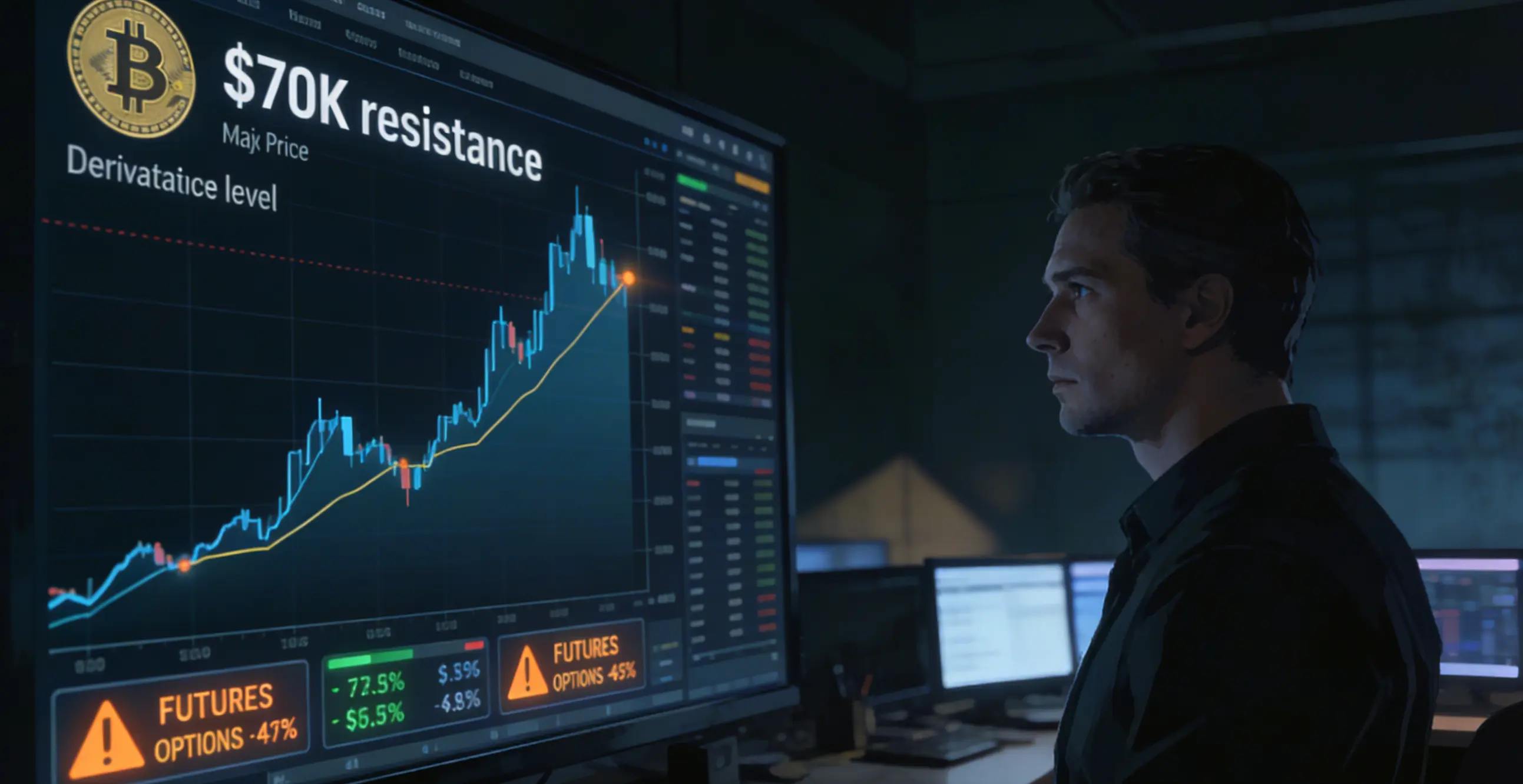
 Bitcoin briefly retested the $70,000 level on February 26, 2026, recovering from a low of $62,500 earlier in the week, driven by $764 million in net inflows to U.S.-listed spot Bitcoin ETFs over two days.
However, derivatives market data continues to signal persistent caution, with Bitcoin futures premiums pinned at 2%—well below the 5% neutral threshold—and put options trading at a 14% premium relative to calls, indicating that professional traders remain focused on hedging downside risk despite the price recovery.
Futures Premium Reflects Lack of Bullish Conviction
The annualized premium for Bitcoin futures relative to spot markets stood at 2% on February 26, remaining firmly below the 5% level typically associated with neutral market conditions. According to market data, bullish momentum in futures has been largely absent since January 31, when Bitcoin surrendered the $85,000 support level after holding it for over nine months.
The persistent discount in futures premiums suggests that institutional and professional traders are not deploying leveraged bullish positions at scale, even as spot prices have rebounded approximately 12% from Tuesday’s lows. This divergence between spot price action and futures market positioning indicates that the recovery lacks broad-based conviction among derivatives participants.
Options Market Skew Points to Continued Fear
Data from the Bitcoin options market further reinforces the cautious outlook. Put (sell) options traded at a 14% premium compared to equivalent call (buy) instruments on Thursday, significantly outside the neutral range of -6% to +6% that typically characterizes balanced market sentiment.
While this skew metric has improved from the 28% “panic” levels recorded on Tuesday, the recovery to $70,000 has done little to shift the defensive positioning of options traders. The persistent put premium suggests that professional market participants continue to prioritize protection against downside moves rather than positioning for upside breakouts.
ETF Inflows Provide Support Amid Broader Concerns
U.S.-listed spot Bitcoin ETFs recorded $764 million in net inflows over two days, partially offsetting the $1.2 billion in outflows seen during the previous eight trading days. These large movements are typically attributed to institutional activity, suggesting that institutional buyers have stepped in to provide support when prices dip below $65,000.
The ETF inflows have helped stabilize market sentiment and contributed to the price recovery, but have not translated into renewed confidence within the derivatives markets. This disconnect highlights the complex dynamics currently shaping Bitcoin’s price action, with spot demand coexisting alongside cautious derivatives positioning.
Explanations for Persistent Price Weakness
Several theories have emerged to explain Bitcoin’s 32% decline over the preceding seven weeks, which began following the October 10, 2025 market crash that eliminated $19 billion in leveraged positions across the cryptocurrency sector. That volatility coincided with President Donald Trump’s announcement of increased import tariffs on Chinese goods.
Binance compensation and market integrity concerns — Following the October crash, Binance reportedly provided $283 million in compensation to users affected by liquidations attributed to internal oracle pricing errors, system latency, and asset transfer degradation. Binance co-founder Changpeng “CZ” Zhao has refuted allegations that the exchange intentionally triggered the October 2025 crash.
Quantum computing security fears — Concerns over quantum computing’s potential impact on Bitcoin network security have intensified after Jefferies strategist Christopher Wood removed Bitcoin from his “Greed & Fear” model portfolio in January, citing potential long-term security risks. In response, developers have drafted BIP-360, a proposal focused on advancing post-quantum cryptography on the Bitcoin network.
Jane Street lawsuit and trading activity — Recent claims linking quantitative trading firm Jane Street to Bitcoin’s lackluster performance gained momentum after Terraform Labs’ court-appointed administrator sued the company, alleging insider trading related to transactions that accelerated the collapse of the Terra Luna ecosystem in May 2022. Jane Street’s recent 13-F filing disclosed significant holdings in BlackRock’s iShares Bitcoin Trust ETF and various Bitcoin mining companies. However, Julio Moreno, head of research at CryptoQuant, noted that such activity is typical for delta-neutral strategies and does not necessarily indicate directional bearish positioning.
Broader risk-aversion environment — The 5% decline in Nvidia shares on February 26 following strong earnings suggests a growing risk-averse sentiment among investors that extends beyond cryptocurrency markets. This broader macro caution may partially explain why Bitcoin struggles to reclaim the $75,000 level despite positive company-specific news and ETF inflows.
FAQ: Understanding Bitcoin’s Derivatives Market Signals
Q: What does the Bitcoin futures premium tell us about market sentiment?
A: The futures premium—the difference between futures prices and spot prices—reflects the cost of carrying leveraged long positions. A premium below 5% indicates weak demand for leveraged bullish exposure and suggests professional traders are not confident in sustained upside. The current 2% premium is well below neutral levels and has persisted since late January.
Q: Why is the put-call skew important for understanding Bitcoin’s outlook?
A: The put-call skew measures the relative demand for put options (bearish bets) versus call options (bullish bets). A positive skew above 6% indicates traders are paying a premium for downside protection, reflecting fear and defensive positioning. The current 14% skew, while improved from 28% earlier in the week, remains elevated and suggests continued caution.
Q: How have Bitcoin ETF inflows affected the market despite derivatives caution?
A: Spot Bitcoin ETFs have recorded significant inflows, including $764 million over two days, providing support at lower price levels and helping drive the recovery toward $70,000. However, these inflows appear to come from different market participants than those active in derivatives, creating a disconnect where spot buying coexists with cautious futures and options positioning.
Q: What are the main theories explaining Bitcoin’s recent price weakness?
A: Explanations include: the October 2025 crash and subsequent deleveraging; concerns over quantum computing’s long-term security implications for Bitcoin; the Jane Street lawsuit and speculation about institutional trading activity; and broader risk-averse sentiment in financial markets, exemplified by Nvidia’s post-earnings decline despite strong results.
Disclaimer: The information on this page may come from third parties and does not represent the views or opinions of Gate. The content displayed on this page is for reference only and does not constitute any financial, investment, or legal advice. Gate does not guarantee the accuracy or completeness of the information and shall not be liable for any losses arising from the use of this information. Virtual asset investments carry high risks and are subject to significant price volatility. You may lose all of your invested principal. Please fully understand the relevant risks and make prudent decisions based on your own financial situation and risk tolerance. For details, please refer to
Disclaimer.


