As the Year of the Horse begins, the “Prediction Market ETF” track is already entering intense competition. In this era where traditional investing and speculative forecasting intersect, and the financial landscape is rapidly evolving, major ETF issuers are pushing boundaries through innovative products linked to prediction markets. On the 17th, ETF issuers Bitwise Asset Management and GraniteShares each submitted a series of prospectuses to the U.S. Securities and Exchange Commission (SEC) for “prediction market-style exchange-traded funds (ETFs)” focused on U.S. election outcomes.
On Tuesday, Bitwise filed a prospectus introducing its new ETF series called “PredictionShares,” which includes six prediction market ETFs listed on NYSE Arca. GraniteShares also submitted a prospectus on Tuesday, launching six similar funds structured around U.S. election results.

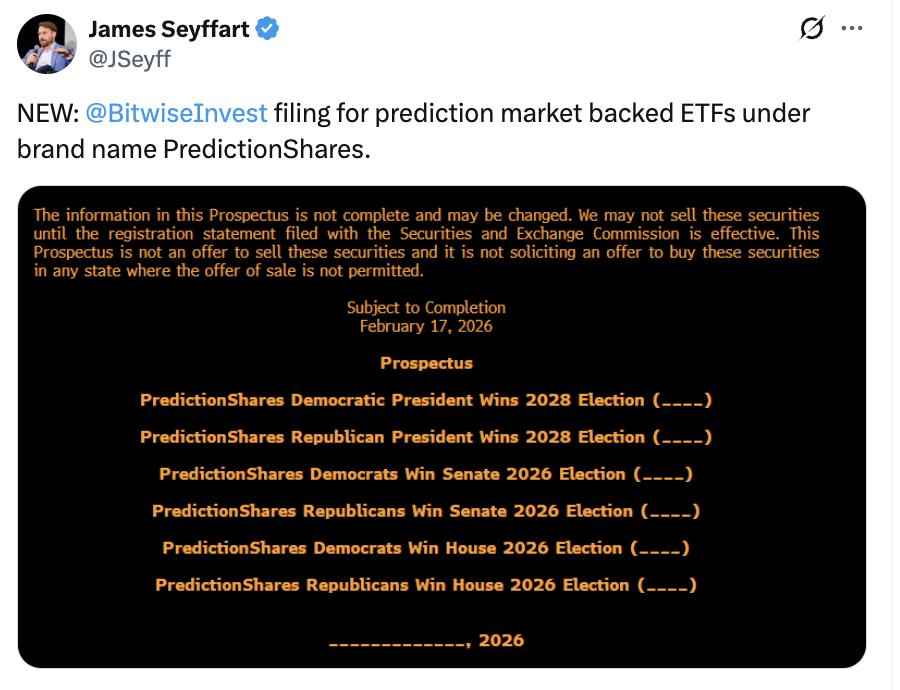 This move follows Roundhill Investments’ application on the 14th, which Bloomberg ETF analyst Eric Balchunas called a “prediction market ETF race.”
These ETFs aim to give investors exposure to “binary event contracts” traded on regulated exchanges—essentially bets on future events—thereby blending finance, politics, and speculation.
Evolution of Prediction Markets and Their ETFs
Prediction markets are decentralized platforms where participants buy and sell contracts based on the likelihood of specific future events, such as election outcomes or economic indicators. These markets aggregate collective intelligence through trading, often producing more accurate forecasts than traditional polls. In the cryptocurrency space, platforms like Polymarket leverage blockchain technology to create transparent, tamper-proof betting on real-world outcomes—from presidential elections to sporting events—popularizing this concept.
The appeal of prediction markets lies in their efficiency: contract prices reflect the market’s implied probability of an event occurring. For example, a contract trading at $0.60 suggests a 60% chance of the predicted outcome. Historically, these markets originated from academic research and early platforms like the Iowa Electronic Markets, but their popularity has exploded with the integration of cryptocurrencies, allowing anonymous participation and global access.
Now, ETF issuers are financializing these concepts, transforming them into accessible, regulated products. Unlike direct crypto bets on platforms like Polymarket, these ETFs invest in binary event contracts listed on exchanges regulated by the Commodity Futures Trading Commission (CFTC). Each fund commits to investing at least 80% of its assets in these contracts (e.g., the Democratic Party winning the 2028 presidential election), paying $1 if the event occurs and $0 if not. The remaining assets can be held in cash or short-term government bonds. This structure turns probability forecasts into tradable asset classes, potentially attracting institutional investors seeking diversification without the complexities of direct cryptocurrency trading.
Roundhill pioneered this trend by applying for ETFs linked to the outcomes of presidential, Senate, and House elections, using swaps or direct holdings of “event contracts” for exposure. Bitwise’s “PredictionShares” series and GraniteShares’ similar products quickly followed, proposing six funds listed on NYSE Arca: targeting whether Democrats or Republicans will win the 2028 presidential race, and control of the Senate or House in 2026.
Bloomberg’s Seyffart notes this is part of the broader “ETF-ization of everything” trend, emphasizing how these products securitize prediction market assets and open new investment channels.
This is not the first time these issuers have ventured into event-based ETFs. Roundhill previously applied for all-or-nothing ETFs using flexible trading options (FLEX Options), such as betting on the S&P 500 reaching 10,000 points by 2030. Leading crypto index fund provider Bitwise, with over 40 products, recently expanded into strategy ETFs for tokens like Bittensor (TAO) and Sui, combining direct holdings and indirect exposure. GraniteShares, known for leveraged single-stock ETFs, pursues high-volatility strategies, including 2x long and short funds on crypto-related stocks like MicroStrategy (MSTR) and Riot Platforms (RIOT).
These applications build on a trend where the volatility and innovation of cryptocurrencies are packaged into familiar ETF formats, potentially bridging traditional finance (TradFi) and decentralized finance (DeFi).
Community Reactions and Broader Impact on the Crypto Ecosystem
Crypto communities on X (formerly Twitter) are both excited and cautiously optimistic, viewing these applications as bullish signals for mainstream adoption of prediction markets. Renowned ETF analyst Eric Balchunas tweeted: “The race has begun… Roundhill’s application on Friday sparked a prediction market ETF competition. GraniteShares and Bitwise are also in the game.” The post garnered significant engagement, with discussions about the potential for “new alpha-generating products.”
Overall, discussions on X portray these ETF applications as a step toward the “financialization” of crypto concepts, with users praising Roundhill’s swap-based structure for avoiding the net asset value (NAV) erosion common in options-based ETFs. Sentiment is generally positive, seeing this as validation of prediction markets’ role in forecasting and hedging, though SEC approval remains a regulatory hurdle.
These ETF applications highlight the convergence of crypto and traditional finance, potentially injecting liquidity into prediction markets and enhancing their forecasting power. For the crypto community, this means easier access to event-based speculation without operating on decentralized exchanges. If approved, these products could attract billions in assets, similar to how spot Bitcoin ETFs revolutionized crypto investing.
However, challenges remain: binary contracts are heavily regulated, and the SEC’s stance on crypto-related products continues to evolve. As Balchunas notes, “This is not the first application of this kind, and I highly doubt it will be the last.” As the 2026 midterms and 2028 presidential election approach, these ETFs could become tools for hedging political risks, further blurring the lines between markets and geopolitics.
Bitwise, GraniteShares, and Roundhill’s push into prediction market ETFs marks a maturation in the crypto space, where innovation meets regulation. As community reactions suggest, this could herald a new era of “alpha” in investing, but success depends on navigating SEC approval processes.
Disclaimer: The information on this page may come from third parties and does not represent the views or opinions of Gate. The content displayed on this page is for reference only and does not constitute any financial, investment, or legal advice. Gate does not guarantee the accuracy or completeness of the information and shall not be liable for any losses arising from the use of this information. Virtual asset investments carry high risks and are subject to significant price volatility. You may lose all of your invested principal. Please fully understand the relevant risks and make prudent decisions based on your own financial situation and risk tolerance. For details, please refer to
Disclaimer.
Related Articles
Buenos Aires Court Orders Polymarket Blocked in Argentina
A Buenos Aires court has ordered the blocking of the prediction market platform Polymarket, citing it as an unauthorized online betting system. Access restrictions and app removals are mandated, highlighting rising regulatory scrutiny on such platforms.
Decrypt34m ago
New Address invests $38,700; predicts that Extended's first-day FDV will exceed $300 million
On March 17th, PolyBeats detected that a new address on Polymarket invested $38,700 to buy the option "Extended's FDV exceeds $300 million on its first day of listing," with a current probability of 36%. Extended is a non-custodial perpetual futures exchange based on Starknet, with core mechanisms including unified margin and multi-asset collateral. It previously raised $6.5 million in funding in April 2024.
GateNews47m ago
"Revise or I'll kill you" - Polymarket Gambler Issues Death Threats to Israeli Journalist After Losing $900,000
Israeli journalist Fabian received death threats after reporting on Iranian missiles landing. Losers who bet $14 million on prediction market Polymarket became dissatisfied, even fabricating screenshots to apply pressure. The incident reveals potential risks of prediction markets, suggesting that financial incentives may lead to illegal behavior and increased manipulation phenomena.
動區BlockTempo1h ago
When Coverage Becomes a Betting Game: Israeli War Correspondent Faces Death Threats from Polymarket Bettors
An Israeli journalist covering Iran's attack faced death threats from Polymarket bettors after reporting details that affected approximately $20 million in wagers, raising concerns about press freedom and public safety. The incident highlights the potential risks of prediction markets exerting pressure on media coverage and has sparked discussions about relevant regulations.
ChainNewsAbmedia1h ago
Argentina Completely Blocks Polymarket! Accused of Operating Without KYC, Government Suspected of "Inflation Data" Insider Trading
A judge in Buenos Aires, Argentina ordered the blocking of crypto prediction market platform Polymarket on March 16, 2026, due to unusual betting activity that occurred 15 minutes before official inflation data was released, raising insider trading concerns. The platform was accused of operating without authorization and lacking identity verification among other legal violations. The court ordered the website to be shut down and related applications to be removed from app stores, but as of that afternoon it remained normally accessible.
動區BlockTempo1h ago


