Bitcoin enters 2026 after a challenging year, having retreated from its October peak above $125,000. Meanwhile, gold and silver delivered standout performances, reaching multi-decade highs. With precious metals trading near record levels and Bitcoin in a consolidation phase, analysts see stronger relative upside for BTC in the year ahead.
(Sources: LSEG)
Bitcoin’s Cycle Dynamics Point to Extended Upside
The April 2024 halving cut daily issuance in half, historically igniting major rallies 12–18 months later. While 2025 featured an early surge followed by correction, many view this as part of an evolving, liquidity-driven cycle influenced by institutional participation.

(Sources: RIVER)
Consensus targets for 2026 range from $135,000 to $250,000, with notable calls from Fundstrat ($200K–$250K), J.P. Morgan (~$170K), and Bernstein/Standard Chartered ($150K–$170K). From current levels around $87,000–$88,000, this suggests potential gains of +50% to +180%—with a base case around +100–150%.
Key drivers include resumed ETF inflows (over $100B in assets), corporate treasury adoption, regulatory progress, and scarcity from limited remaining supply (~1.5M BTC by late 2026).
Gold’s Strong 2025 Momentum Faces Moderation
Gold posted one of its best years since 1979, gaining around 70–74% to levels near $4,530/oz, propelled by central bank purchases, geopolitical uncertainty, and de-dollarization trends.
International outlooks remain positive but measured: major banks target $4,600–$5,000 on average, with some stretching to $5,500–$6,000. From current prices, this implies +2% to +10% base case, up to +20–30% in bullish scenarios.
After extreme gains and elevated positioning (highest monthly RSI since 1980), analysts anticipate consolidation or mild pullbacks rather than another parabolic move.
Silver’s Explosive Run Likely to Cool
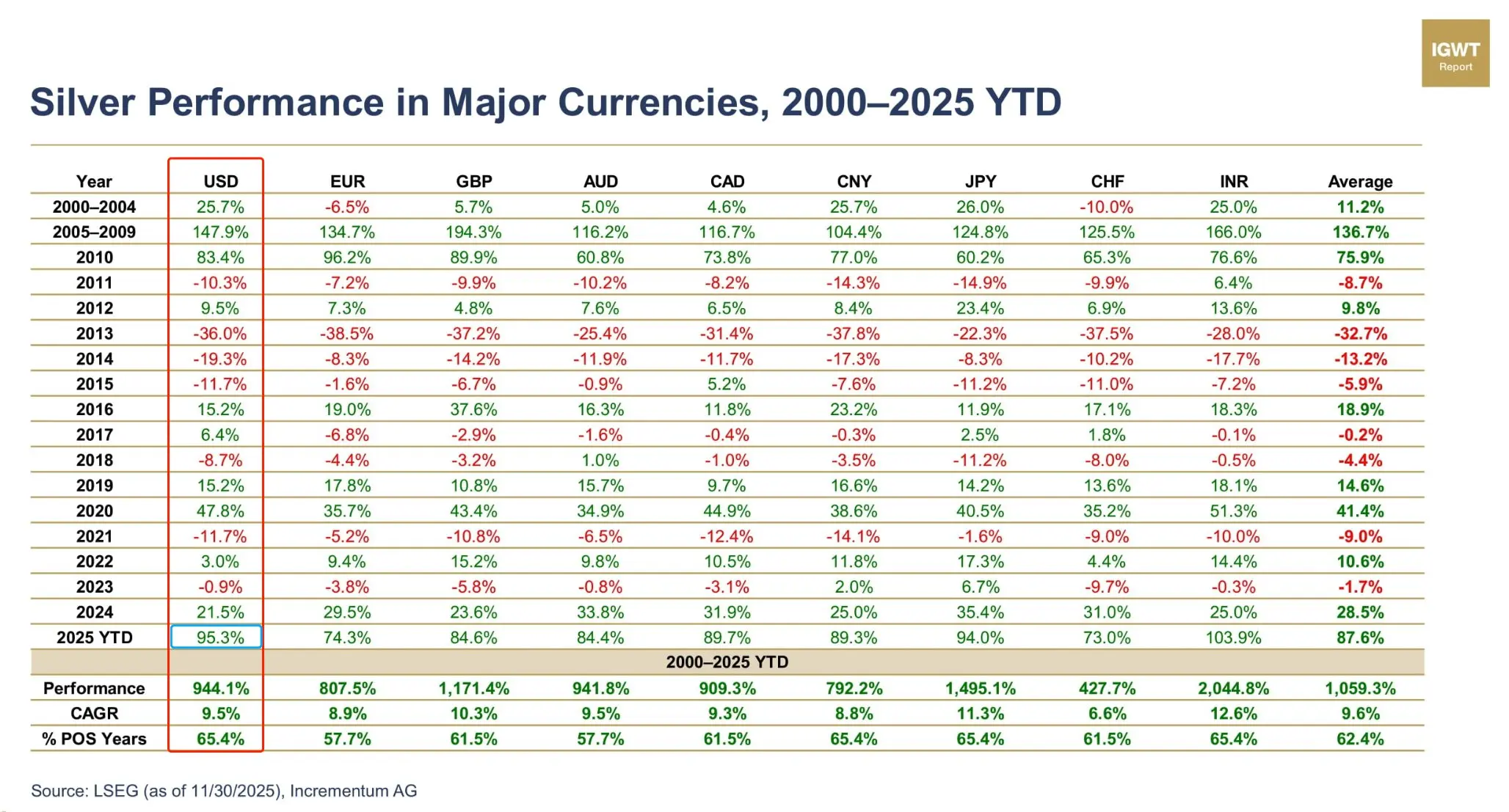
Silver outperformed dramatically in 2025, surging 150–170% to $77–$79/oz on industrial demand from solar, EVs, and AI data centers, plus safe-haven buying.
Forecasts for 2026 center on $56–$80 averages (~$60–75), reflecting ongoing deficits but caution after the parabolic advance. Returns from current levels: -10% to +10% base, potentially +20–35% if industrial growth accelerates.
Many expect silver to enter a digestion phase following its outsized rally, limiting explosive follow-through.
Comparative Advantages Favor Bitcoin
Bitcoin benefits from fixed supply dynamics and post-halving cycle extension, contrasting with metals’ annual production increases.
Risk-on recovery—lower rates, equity correlation—typically boosts BTC sharply, while metals may consolidate after 2025 extremes. Capital rotation from overbought precious metals into undervalued Bitcoin could widen the performance gap.
Defensive scenarios (recession, tighter policy) favor metals, but baseline macro improvement tilts toward BTC leadership.
2026 Verdict: Bitcoin Poised for Superior Returns
Cycle positioning, valuation reset (BTC lagging YTD while metals hit peaks), and analyst consensus support Bitcoin achieving stronger percentage gains in 2026—around +80–150% base case versus +10–20% for gold and silver.
While precious metals retain safe-haven appeal, their 2025 dominance leaves less room for outsized moves. Bitcoin’s combination of scarcity, institutional momentum, and historical patterns positions it for relative outperformance as risk appetite potentially returns.
Disclaimer: The information on this page may come from third parties and does not represent the views or opinions of Gate. The content displayed on this page is for reference only and does not constitute any financial, investment, or legal advice. Gate does not guarantee the accuracy or completeness of the information and shall not be liable for any losses arising from the use of this information. Virtual asset investments carry high risks and are subject to significant price volatility. You may lose all of your invested principal. Please fully understand the relevant risks and make prudent decisions based on your own financial situation and risk tolerance. For details, please refer to
Disclaimer.
Related Articles
BTC Falls 0.50% in 15 Minutes: Large Position Transfers and Long Liquidations Trigger Cascading Decline
On March 19, 2026, from 04:00 to 04:15 (UTC), the BTC price declined by 0.50% within the short-term window, with an amplitude of 0.68%, and a price range of 70,729.6 to 71,214.1 USDT. Market attention significantly increased, with spot and derivatives trading volumes expanding simultaneously. Short-term activity became more active, and market sentiment turned slightly cautious.
The main driver of this movement was the transfer of approximately 2,800 BTC from large on-chain holdings to exchange hot wallets between 04:05 and 04:10, which triggered large sell-offs in the spot market. Liquidity pressure rose, directly pushing the price down.
GateNews9m ago
Data: BTC breaks through $74,643, with the liquidation strength of major CEX short positions reaching $1.842 billion
Gate News reports that on March 19, according to Coinglass data, if BTC breaks through $74,643, the cumulative short liquidation intensity across mainstream CEX will reach $1.842 billion. Conversely, if BTC falls below $67,727, the cumulative long liquidation intensity across mainstream CEX will reach $1.172 billion.
GateNews12m ago
ETF Absorbs Over $1.1 Billion Yet Struggles to Rescue the Market? Powell and Oil Prices Team Up to Put Pressure On, Bitcoin Breaks Key Support
Despite Bitcoin ETF inflows of $1.16 billion, Bitcoin price pulled back to $71,000, declining over 4%. Analysts attribute the pullback to interest rate expectations and inflation pressures, while ETF inflows indicate that institutions view Bitcoin as a long-term asset. The weakness in U.S. equities has also impacted the crypto market.
GateNews59m ago
Gold and Bitcoin decline simultaneously by 3.6% and 4.6%, respectively, as the global market faces stagflation shocks.
On March 19, escalating geopolitical conflicts and hawkish Federal Reserve policies exposed global markets to stagflation pressures driven by oil. Rising oil prices, coupled with declining equities and metals, also impacted cryptocurrencies. Macroeconomic dynamics revealed intensifying energy tensions and widespread risk-averse sentiment across markets.
GateNews1h ago


