Bitcoin price action continues to stagnate ahead of the Federal Reserve’s final policy decision of the year (Fed). However, the underlying market structure reveals a completely different reality.
Despite low volatility, on-chain data shows investors are realizing losses of nearly $500 million per day, leverage in the futures market has dropped sharply, and nearly 6.5 million BTC are in an unrealized loss state. These signals resemble the late stages of previous contraction cycles more than a normal accumulation phase.
This “restructuring” is unfolding just as the Fed enters a critical inflection point in monetary policy. After reducing the balance sheet by about $2.4 trillion, bank reserves have reached a sensitive low zone, while the overnight SOFR lending rate has repeatedly approached the policy ceiling.
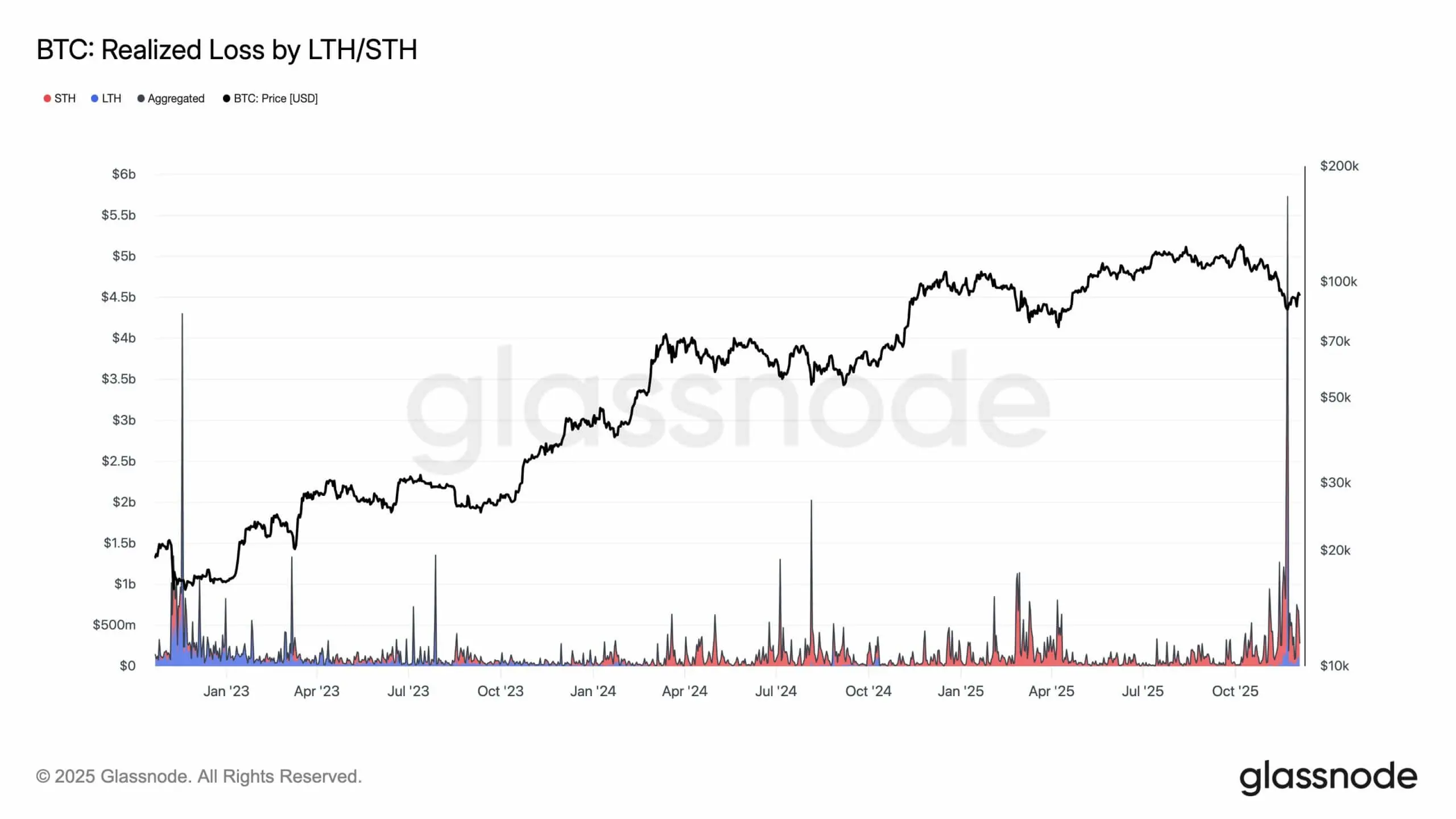 Actual Bitcoin loss levels | Source: Glassnode## Liquidity Turning Point
According to the Financial Times, the quantitative tightening program (QT) officially ended on December 1, closing out the Fed’s multi-year liquidity withdrawal phase.
From here, the most important signal in this week’s FOMC meeting is not the already-priced-in 25 basis point rate cut, but the next balance sheet strategy – especially the plan to shift to Reserve Management Purchases (RMP).
Evercore ISI forecasts this program could start as soon as January 2026, with a scale of about $35 billion per month in Treasury bill purchases. Reinvesting from MBS to short-term assets will gradually increase bank reserves again, equivalent to a balance sheet expansion of over $400 billion per year.
While the Fed does not call this easing, in essence, RMP marks the first liquidity expansion impulse since QT began – a factor to which Bitcoin is typically more sensitive than interest rate changes.
At the same time, US M2 money supply has reached a record $22.3 trillion, surpassing the 2022 peak – a sign the liquidity cycle may be reversing.
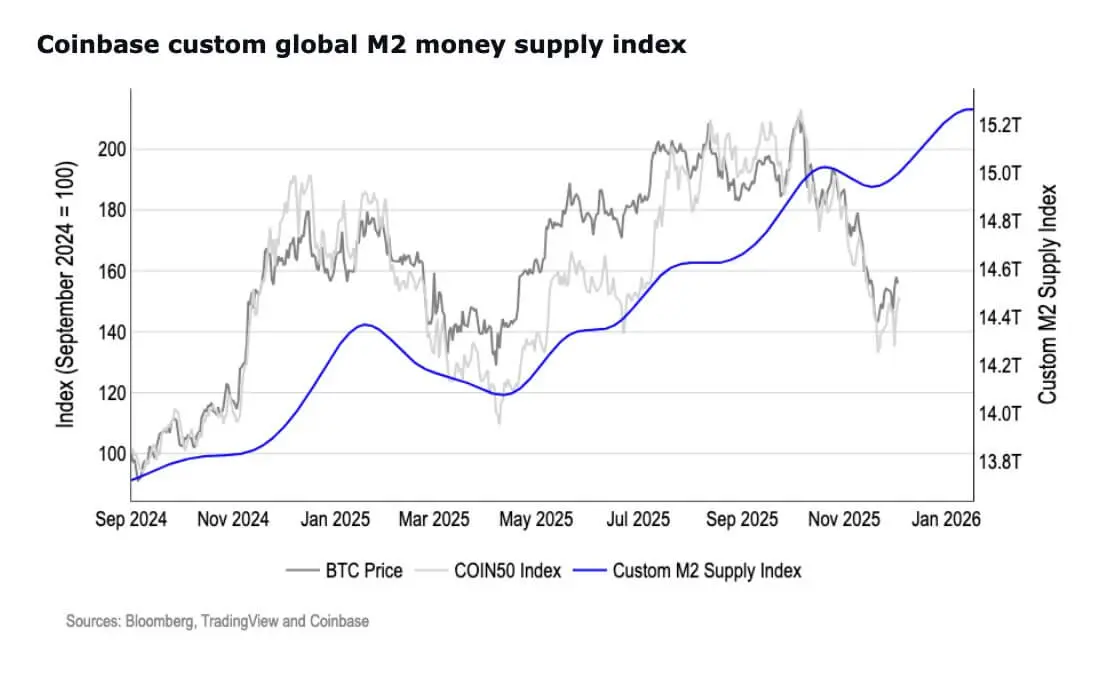 US M2 money supply | Source: Coinbase## “Macro Trap” and Labor Market Pressure
The driver forcing the Fed to pivot comes from employment data:
- Non-farm payrolls have declined in 5 of the last 7 months.
- Hiring pace, job openings, and voluntary quit rates are all down.
- The “soft landing” narrative is therefore harder to defend.
Although inflation has fallen, it remains above target, while maintaining a “higher for longer” policy is increasingly costly. Thus, how Chair Powell describes the labor market, bank reserves, and RMP timing will shape 2026 expectations.
For Bitcoin, this leads to two scenarios:
- If the Fed confirms the start of reserve rebuilding → the market may believe current prices deviate from policy direction → breaking the $92,000–$93,500 zone could trigger momentum liquidity flows.
- If the Fed adopts a cautious stance → BTC could remain in or return to the $75,000–$82,000 range – an area that has previously generated strong demand.
Signs of “Capitulation” in the Bitcoin Market
Meanwhile, on-chain data shows a quiet restructuring:
- Short-term holders continue to sell on price weakness.
- Mining profit margins are shrinking as production costs approach $74,000.
- Mining difficulty has seen its sharpest drop since July 2025, indicating weak miners are exiting.
However, this pressure is accompanied by supply squeeze signals:
- Large wallets have accumulated about 45,000 BTC over the past week.
- BTC balances on exchanges continue to fall.
- Stablecoin inflows are rising again – a sign that money is waiting to re-enter.
Bitwise notes Bitcoin inflows are slowing, with 30-day Realized Cap growth down to just 0.75% per month, reflecting a balance between profit-taking and loss-cutting. This is the kind of “calm” often seen before the market forms a sustainable bottom.
Technical View
Bitcoin is currently trapped between two key zones:
- Above $93,500 → opens the way to $100,000, $103,100 (short-term holder cost basis), and long-term MAs.
- Below $82,000–$75,000 → an area that has absorbed heavy selling multiple times before.
The phenomenon of Bitcoin and gold moving in opposite directions shows investors are rotating capital based on liquidity expectations, not just changing risk appetite.
If Powell confirms reserve rebuilding is the next phase of the policy cycle, capital is likely to return quickly to assets that benefit from easier liquidity conditions – and Bitcoin typically reacts the fastest.
Thach Sanh
Disclaimer: The information on this page may come from third parties and does not represent the views or opinions of Gate. The content displayed on this page is for reference only and does not constitute any financial, investment, or legal advice. Gate does not guarantee the accuracy or completeness of the information and shall not be liable for any losses arising from the use of this information. Virtual asset investments carry high risks and are subject to significant price volatility. You may lose all of your invested principal. Please fully understand the relevant risks and make prudent decisions based on your own financial situation and risk tolerance. For details, please refer to
Disclaimer.
Related Articles
CFTC clarifies cryptocurrency margin rules: BTC and ETH capital deduction rate of 20%, permitting investment in the derivatives market
The U.S. Commodity Futures Trading Commission (CFTC) recently released an FAQ clarifying the rules for using cryptocurrencies as margin in derivatives markets, specifically setting capital deduction rates of 20% for Bitcoin and Ethereum and 2% for stablecoins. The pilot program will be limited to three coin types in the first three months, after which it will expand to additional cryptocurrencies and relax reporting requirements. Qualifying crypto assets may be used as margin, marking a gradual acceptance of blockchain assets within the U.S. financial system.
動區BlockTempo21m ago
Major CEX and DEX funding rates fully turned negative, BTC down 1.93%, ETH down 2.18%
On March 22, Bitcoin reported $69,275.33, down 1.93% in 24 hours; Ethereum reported $2,103.95, down 2.18%. The market is broadly bearish, with shorts dominating. Funding rates are universally negative, indicating that shorts need to pay fees to longs.
GateNews47m ago
Polymarket predicts that the probability of Bitcoin falling to $65,000 in March has increased to 49%.
Gate News, on March 22, as Bitcoin briefly dropped below $69,000, the prediction probability of "Bitcoin falls to $65,000 in March" on the Polymarket prediction market rose to 49%. Additionally, the probability of predicting Bitcoin falling to $60,000 is 16%, and the probability of predicting it rising to $80,000 is 12%.
GateNews1h ago
Bitcoin Options Signal Concern Even as ETF Outflows Remain Relatively Low
Bitcoin price (BTC) maintained a sideways trend around the 70,000 USD level during Friday's trading session, after failing to reclaim the previous 75,000 USD milestone. This movement coincides with two consecutive sessions recording net capital outflows from U.S. spot Bitcoin ETF funds, thereby reversing the trend.
TapChiBitcoin1h ago
Bitcoin Mining Difficulty Adjusts Down 7.76% to 133.79T, Creating Second-Largest Decline This Year
Bitcoin mining difficulty declined by 7.76% to 133.79 T on March 21, marking the second-largest drop this year. JPMorgan Chase analysts forecast that Bitcoin mining costs have fallen to $77,000, still above spot prices. An increasing number of mining companies are redirecting infrastructure toward AI computing power. Core Scientific plans to sell its Bitcoin holdings in 2026 to fund AI expansion, while Bitdeer has liquidated its Bitcoin position. Multiple companies are formulating diversification strategies.
GateNews1h ago


