


Futures
Access hundreds of perpetual contracts
TradFi
Gold
One platform for global traditional assets
Options
Hot
Trade European-style vanilla options
Unified Account
Maximize your capital efficiency
Demo Trading
Introduction to Futures Trading
Learn the basics of futures trading
Futures Events
Join events to earn rewards
Demo Trading
Use virtual funds to practice risk-free trading
Launch
CandyDrop
Collect candies to earn airdrops
Launchpool
Quick staking, earn potential new tokens
HODLer Airdrop
Hold GT and get massive airdrops for free
Launchpad
Be early to the next big token project
Alpha Points
Trade on-chain assets and earn airdrops
Futures Points
Earn futures points and claim airdrop rewards


More





US-Iran War March 2026: Hormuz Closure, Power Plant Ultimatum, and the Global Energy Crisis Deepens
#USIranWarUpdates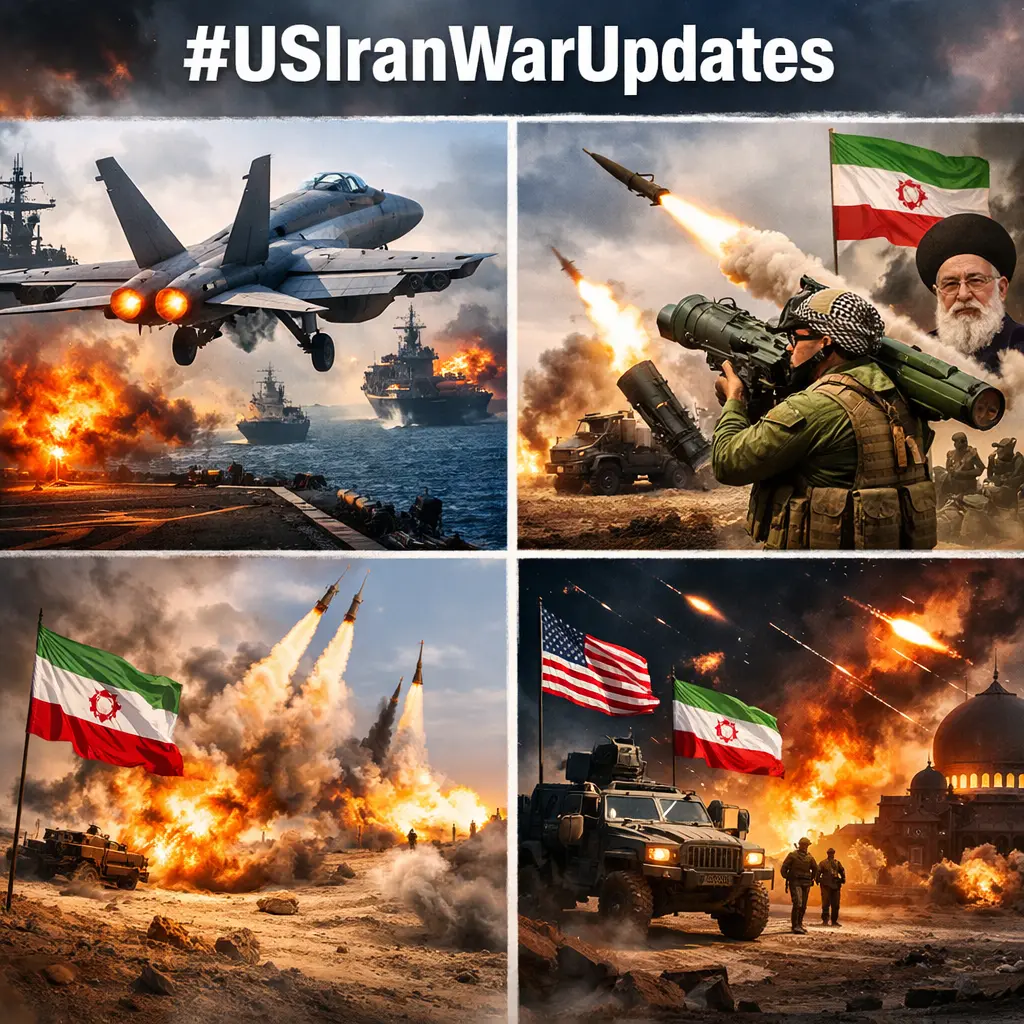 March 23, 2026: The Full Picture
How It Started
The conflict that now defines global markets and geopolitics in early 2026 did not begin with a gradual escalation. It began with a single devastating strike. On February 28, 2026, the United States and Israel launched coordinated military operations against Iran, targeting the country’s top leadership and military command structure in a surgical and catastrophic opening salvo. The strike killed Supreme Leader Ayatollah Ali Khamenei and approximately 40 of Tehran’s most senior military commanders simultaneously. The speed, scale, and precision of the attack shocked the world. Iran had been in nuclear negotiations with the Trump administration at the time — talks that were abruptly shattered by the strikes, which came without public warning.
The immediate Iranian response was to do the one thing its military still had the capacity and the will to do after losing its leadership in a single day: close the Strait of Hormuz. The world’s most important oil shipping chokepoint — through which approximately 20% of all global oil and liquefied natural gas typically transits — was effectively shut down. Within days, the consequences for global energy markets were catastrophic.
The Strait of Hormuz: The Economic Weapon
Four weeks into the conflict, the Strait of Hormuz remains effectively closed to normal commercial traffic. The consequences have been staggering. Oil prices have surged more than 40% since the war began on February 28, reaching above $112 per barrel — the highest level since mid-2022. Year-to-date, oil is up nearly 70%. The International Energy Agency has described the disruption as “the largest supply disruption in the history of the global oil market” — a statement that puts the current situation in a category beyond any previous oil crisis, including the 1973 Arab embargo and the 1979 Iranian Revolution.
Daily oil exports from the Middle East have fallen by at least 60% since the start of the war. Only a trickle of Iranian and Chinese tankers have managed to pass through the strait, operating through an IRGC-managed so-called “safe corridor” — a mechanism that effectively gives Iran and its allies selective control over who gets through and who does not. The IEA moved to release 400 million barrels of emergency strategic reserves — the largest such release in the organization’s 50-year history — but acknowledged that supply measures alone cannot offset disruptions of this magnitude. The agency’s advice to consumers has been striking in its bluntness: work from home, drive slower, and do not use gas cookers.
What makes the Strait closure particularly alarming as a long-term issue is the signaling coming from Iranian leadership about its permanent future status. Iran’s Parliament Speaker stated publicly that “the Strait of Hormuz situation won’t return to its pre-war status.” An Expediency Council member said there will be a “new regime for the Strait of Hormuz” following the war, suggesting Iran intends to use its geographic position to impose fees on vessels and selectively block Western shipping even after hostilities formally end. The new Supreme Leader — Mojtaba Khamenei, son of the slain Ayatollah — issued his first public statement declaring that Iran will “extract reparations from the enemy” and will seize or destroy American and Israeli assets. This is not the language of a side preparing to concede.
The Military Situation: Week Four
After four weeks of fighting, the military balance has shifted dramatically in favor of the US-Israeli coalition in terms of air dominance. The US Department of Defense has reported that Iranian missile and drone attacks are down approximately 90% from the intensity seen in the early days of the war — a reflection of the degradation of Iran’s launch infrastructure, targeting systems, and command-and-control networks. US and Israeli forces claim to dominate the skies over Iran, and Israeli strikes have continued hitting targets in Tehran even as the conflict enters its fourth week.
The deployment picture tells you how seriously the US is treating this. Approximately 2,500 Marines and three warships have been deployed to the Iranian coast. British bases, including Diego Garcia in the Indian Ocean, have been made available to US bombers for operations targeting Iranian forces threatening the Strait. The breadth of the coalition footprint reflects the scale of the operation.
But the war has spread well beyond Iran’s borders. Iranian missile strikes have hit central Tel Aviv, causing civilian casualties and infrastructure damage. Israeli PM Netanyahu — who publicly backed the US strikes as a joint operation, stated “we do it together, in confidence” — has vowed to “topple the Iranian regime” and escalate the campaign against Hezbollah in Lebanon, where Israeli strikes have destroyed bridges over the Litani River and hit civilian infrastructure. Iran has struck Persian Gulf neighbors: drone attacks have hit US bases in Iraq, including Victory Camp, and interceptions of Iranian projectiles have been reported in Saudi Arabia, Kuwait, and the UAE. A drone crashed inside the US Embassy compound in Baghdad. Iran even attempted a missile strike on Diego Garcia — the joint US-UK Indian Ocean base — revealing the extended range of Iran’s remaining missile capabilities.
Iran has also hit joint US-UK bases elsewhere, and ballistic missile strikes have struck the Israeli cities of Arad and Dimona — the latter a site of significant symbolic and strategic sensitivity given its nuclear associations. Latin American heads of state have publicly criticized US actions, reflecting the geopolitical fractures the conflict is creating beyond the immediate region.
Trump’s 48-Hour Ultimatum and the Power Plant Threat
On March 22— day23 of the conflict — President Trump issued a 48-hour ultimatum directly to Iran: fully reopen the Strait of Hormuz or face strikes on Iranian power plants. The language used was characteristically direct: Trump threatened to “obliterate” Iran’s energy infrastructure if the waterway was not cleared. Iran’s response was equally uncompromising — Tehran stated that fully reopening the Strait would require a ceasefire and a formal guarantee from the United States not to strike Iran in the future. That is a demand the Trump administration has not offered.
Iran also threatened to keep the strait closed indefinitely if the US followed through on the power plant threat — a counter-escalation posture that effectively dares the US to strike, knowing that doing so would further entrench Iranian resolve and potentially trigger retaliatory action against energy infrastructure across the Gulf region. The calculus on both sides is dangerous: the US cannot accept indefinite Strait closure without catastrophic economic consequences, and Iran cannot reopen it without something to show its domestic audience in exchange.
The Oil “Jujitsu” — Washington’s Economic Countermeasures
One of the more creative and revealing elements of the US response has been Treasury Secretary Scott Bessent’s use of Iranian oil against Iran itself. In a move described as a “narrowly tailored, short-term authorization,” the Trump administration granted a30-day sanctions waiver on the purchase of Iranian oil currently stranded at sea on tankers. The waiver is estimated to release approximately 140 million barrels of oil into global markets, providing a temporary supply cushion intended to bring oil prices down from their historic highs.
The strategic logic is clever: by releasing stranded Iranian oil, the US simultaneously eases the domestic economic pain of high energy prices while depriving Iran of the full leverage its Strait closure was meant to generate. If Iranian oil is flowing to market anyway — via US-authorized transactions — then the Strait blockade becomes partly self-defeating from Tehran’s perspective. Bessent framed the move explicitly as using Iran’s own oil inventory against the regime’s economic leverage, hence the “jujitsu” framing that has circulated in policy circles. Oil prices briefly eased after Trump floated the possibility of “winding down” military efforts, suggesting the market is sensitive to any signal of de-escalation.
The Political Endgame: Talks, Fatigue, and the Question of an Exit
As the war enters its fourth week, the first serious signals of a potential off-ramp are beginning to emerge — tentatively and without any formal framework. The Trump administration has reportedly begun internal discussions about resuming negotiations with Iran, one day after Trump himself said he was considering “winding down” military efforts. The signals are contradictory: the48-hour ultimatum and power plant threats come from the same administration that is quietly exploring diplomatic channels. This kind of simultaneous escalation and back-channel diplomacy is a classic negotiating posture, but it creates enormous uncertainty for markets and regional actors trying to read US intentions.
Iran’s Foreign Ministry has set out its conditions: ceasefire first, then a non-strike guarantee, then Strait reopening. Iran’s new supreme leader has set a retributive tone that makes an immediate capitulation politically impossible. Khamenei’s chosen successor is reportedly being assessed by some analysts as potentially more pragmatic — someone who might offer Trump the kind of face-saving deal that ends the war without requiring either side to admit defeat. Whether that pathway is real or wishful thinking remains to be seen.
What This Means for Markets and Crypto
The economic consequences of the US-Iran war are already severe and broadening. Oil above $112 is a tax on every economy in the world that imports energy — which is most of them. Aluminum prices have surged as Iranian supply chains are disrupted. Shipping insurance costs have exploded. Global trade routes are being restructured in real time as importers scramble for alternative supply routes. The IEA’s advice to slow down driving and turn off gas cookers reflects the reality that this is not a localized supply shock — it is a systemic disruption to the global energy order.
For Bitcoin and crypto markets, the conflict functions as a constant source of short-term volatility and a longer-term macroeconomic headwind. BTC dropped below $69,000 in minutes when Trump’s power plant threat hit social media — a direct demonstration of how geopolitical risk now transmits instantly into crypto prices. The sustained uncertainty also keeps the Fear and Greed Index depressed, limits risk appetite, and creates an environment in which institutional allocators are cautious about adding risk exposure, even when the fundamental case for Bitcoin remains constructive.
The longer-term picture is more nuanced. A prolonged war that keeps oil prices elevated, strains government budgets, and injects monetary stimulus into the system to cushion the economic blow could ultimately be constructive for Bitcoin as an inflation hedge and an asset outside the traditional financial system. If central banks respond to the energy-driven inflation with liquidity provision rather than rate hikes — a choice forced on them by the growth risk of the oil shock — that macro backdrop historically benefits Bitcoin. But that dynamic takes months to play out, while the short-term pain of uncertainty and risk-off behavior is immediate.
The Bottom Line
The US-Iran war is now the single largest geopolitical risk factor in the global economy. It began with a decapitation strike that killed Iran’s supreme leader, triggered the most consequential oil supply disruption in history, and has now spread into a multi-front conflict involving Iran, Israel, Hezbollah, proxy forces in Iraq and the Gulf, and potentially broader regional actors. Four weeks in, neither side is in a position to claim clear victory or accept clear defeat. The US dominates the air but cannot reopen a waterway. Iran cannot stop the strikes but can keep the world’s most important oil chokepoint closed. The 48-hour ultimatum on power plants, Iran’s counter-threat, and the quiet back-channel diplomacy all point to a conflict approaching a decision point — one that will either escalate dramatically or begin a painful, face-saving negotiation toward de-escalation. The world, and the markets, are watching every development in real time.