The institution reported that argt, a peso-linked stablecoin, constitutes a security, subject to the regulatory regime for capital markets for these instruments. The stablecoin, issued by Twin Finance and listed by Belo, offered up to 32% APR.
Regulator Classifies Argentine Peso Stablecoin as a Security, Blocks Operations
The Argentine equivalent of the SEC, the CNV, executed the first measure against a stablecoin linked to the national fiat currency, the Argentine peso.
On March 12, the institution issued a resolution ordering the suspension of the listing, offering, and intermediation of argt, stating that the token was classified as a security offered to investors without complying with the rules established for these assets.
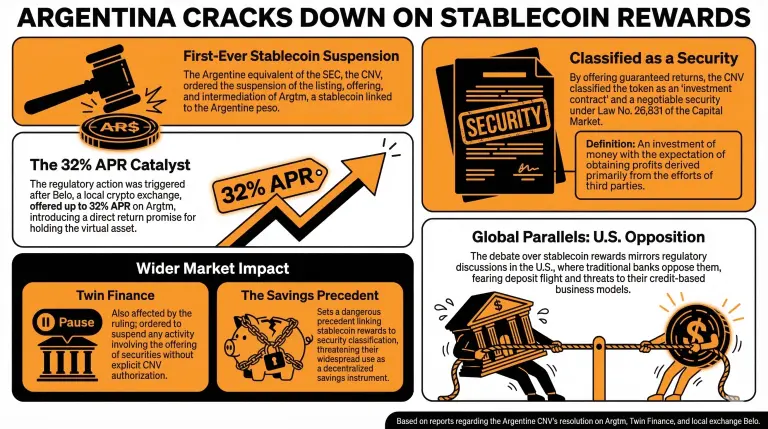
The action comes after Belo, an exchange that listed the stablecoin, offered up to 32% in APR, introducing a return promise linked to holding the virtual asset. As a consequence, the CNV assessed that this would make it “fall under the figure of an investment contract included in the definition of negotiable security provided for in article 2 of Law No. 26,831 of the Capital Market, which results in its classification as a negotiable security subject to the public offering regime.”
The institution clarified that when these assets meet the criteria of an investment contract, “an investment of money in a joint venture with the expectation of obtaining profits derived primarily from the efforts of third parties,” it can be considered a security, and will be subject to the compliance regime described for these assets.
The action also affects Twin Finance, which will have to suspend any activity, including the offering of securities, without the CNV’s authorization.
The development sets a precedent in Argentina, linking the offering of rewards for holding a stablecoin to its classification as a security, closing the potential savings use case for these instruments in the future, with no regulation tackling this issue.
The subject of stablecoin rewards is also being discussed in the U.S., as banks have opposed it, alleging that it could fuel deposit flight from the financial system and affect their credit intermediation-based business model.
FAQ
- What recent action did Argentina’s CNV take regarding a stablecoin?
The CNV suspended the listing and intermediation of argt, classifying it as a security being offered without regulatory compliance.
- Why was argt classified as a security?
The token was categorized as a security because it was linked to an investment contract promising up to 32% APR for holding the virtual asset.
- What implications does this resolution have for Twin Finance?
Twin Finance must halt all activities involving the stablecoin, including offering securities, without prior authorization from the CNV.
- What broader impact does this decision have on stablecoin offerings in Argentina?
This action sets a precedent by linking rewards for holding stablecoins to their classification as securities, potentially limiting their use for savings in the country.
Disclaimer: The information on this page may come from third parties and does not represent the views or opinions of Gate. The content displayed on this page is for reference only and does not constitute any financial, investment, or legal advice. Gate does not guarantee the accuracy or completeness of the information and shall not be liable for any losses arising from the use of this information. Virtual asset investments carry high risks and are subject to significant price volatility. You may lose all of your invested principal. Please fully understand the relevant risks and make prudent decisions based on your own financial situation and risk tolerance. For details, please refer to
Disclaimer.
Related Articles
Polymarket and Kalshi Face Setbacks as Prediction Markets Confront Legitimacy Questions - Unchained
This week, major prediction market platforms Polymarket and Kalshi faced significant backlash, highlighting the divide between regulatory approval and public acceptance. Polymarket withdrew controversial betting markets after public outcry, while Kalshi's contract offerings were banned in Nevada, stressing the industry's legitimacy challenges.
UnchainedCrypto57m ago
Korea’s FSC requires exchanges to set up an asset reconciliation system every 5 minutes, to be deployed by the end of May
The Korea Financial Services Commission requires all cryptocurrency exchanges to set up a system to verify assets every 5 minutes, and to complete it by the end of May. It found that some exchanges’ verification frequency is insufficient and that there are defects in their trading circuit breaker mechanisms; all exchanges are required to publish their asset balances and submit to audits. The regulatory measures stem from an operational mistake at an exchange in February.
GateNews3h ago
China orders Apple to pull Dorsey's Bitchat, the messaging app used during Iran protests
Apple removed Bitchat, a decentralized messaging app by Jack Dorsey, from its China App Store at China's request, citing regulatory violations. Despite this, the app remains available globally and has seen over three million downloads.
CoinDesk4h ago
Russia Moves to Formalize Cryptocurrency Market With New Legislation
Russia's State Duma has introduced three bills to regulate cryptocurrency transactions, allowing limited access for non-qualified investors. The legislation mandates tax reporting and penalties for illegal use, aiming to create a structured digital asset market while predicting closures of non-compliant exchanges.
Coinpedia5h ago
Figure Lianchuang: A certain CEX sent an incorrect tax notice and obstructed the passage of the CLARITY Act
Figure co-founder Mike Cagney recently received a 1099-MISC tax form from a certain CEX Custody showing last year’s income of $1,600, but the account’s assets are only $10. He is dissatisfied with the customer service’s runaround and criticized the exchange for blocking the passage of the CLARITY Act, arguing that the industry no longer needs to care about his views.
GateNews7h ago
Apple pulls Jack Dorsey's Bitchat from China at Beijing’s request
Bitchat, a decentralized peer-to-peer messaging app developed by Block CEO Jack Dorsey, has been removed from Apple’s App Store in China for allegedly violating its internet service regulations.
In an X post on Sunday, Dorsey shared a screenshot from Apple’s app review team informing him that Bitc
Cointelegraph8h ago


