作者:PolkaWorld
The launch of Celestia has attracted a lot of attention from the industry and has also led to a boom in “modular blockchain”. Recently, NEAR Blockchain also announced that it will launch the NEAR DA data availability layer, making a foray into the modular blockchain space.
So what exactly is the recent rise of “modular blockchains”? Is Polkadot a modular blockchain, and what is the difference between the two?
What are “modular blockchains” such as Celestia?
The “modular blockchain” we are discussing here refers to Celestia, Avail, EigenDA, etc., which are modular blockchains in the context of the Ethereum ecosystem.
The concept corresponding to “modular blockchain” is “monolithic blockchain”.
The core responsibilities of blockchain are generally divided into four parts:
Execution: Supports the execution of transactions and enables deployment and interaction with smart contracts.
Data Availability: Guarantee the availability of transaction data.
Consensus: The content and order of permitted transactions.
Settlement: Used to complete transactions, resolve disputes, validate proofs, and bridge between different execution layers.
In a monolithic blockchain, these responsibilities are all performed by a single chain, such as Bitcoin and Ethereum, which are representatives of monolithic blockchains. But this creates a problem of poor scalability and high expense.
![]()
Transaction flow on the monolithic chain, source: Euromoney
As a result, the concept of modular blockchain came into being, and its core idea is to separate different responsibilities and outsource them to specialized independent layers (modules), so as to make the main chain more scalable and less expensive.
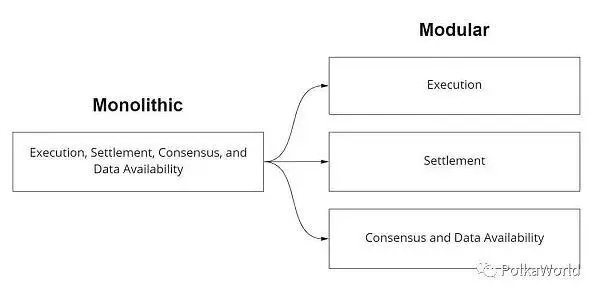
Comparison of monolithic and modular blockchains, source: Celestia
For example, ZK Rollup, Optimistic Rollup, etc., outsource the execution layer, while Celestia and Avail outsource the data availability (DA) layer.
In addition to external solutions, Ethereum itself is also looking to improve scalability through Proto-Danksharding technology (EIP-4844).
To sum up, in the context of the Ethereum ecosystem, “modular blockchain” is a technical solution born to improve the scalability of Ethereum. It separates the execution layer, data availability layer, etc., of the blockchain into different “modules”.
Is Polkadot a modular blockchain?
We also hear a lot about the concept of “modular blockchains” in Polkadot, but this is not quite the same as modularity mentioned above.
Polkadot is a heterogeneous multi-chain system consisting of a relay chain and multiple heterogeneous parachains. The Relay Chain is responsible for maintaining consensus and security across the network, while parachains can focus on their respective applications and performance. Cross-chain data transfer and interoperability between parachains can be achieved through XCM.
![]()
Polkadot 架构,来源:mercuryo
As a result, Polkadot can achieve a level of scalability, i.e., as parachains increase, so does the network’s throughput. The asynchronous support technology being developed can further improve scalability, allowing Polkadot’s parachain block time to reach 6 seconds, which can support thousands of parachains.
In other words, Polkadot has largely solved the bottleneck of scalability through a multi-chain (or sharding) architecture, which is why we rarely discuss solutions to improve scalability such as rollups and DA layers in the Polkadot ecosystem.
But Polkadot is indeed a pioneer in modular blockchains.
Polkadot’s architecture is modular
From the above description, it is not difficult to see that the architecture of Polkadot itself embodies the idea of modularity.
The Relay Chain is responsible for security and consensus, and each parachain can focus on building what it is good at, for example, the KILT parachain focuses on identity, the HydraDX parachain focuses on DEX, and each parachain is actually a module. Parachains in the ecosystem can interact with other parachains by sending cross-chain messages (XCM) to use the functions provided by other parachains (modules).
Polkadot is also working on a plan to “minimize relays”, stripping some of the functions of the relay chain and decentralizing it to multiple “system parachains”, so as to reduce the burden on the relay chain and allow the relay chain to better focus on consensus and security. At present, Polkadot has put the functions of assets and on-chain collectives on the system parachain, and will also put the functions of governance, pledge, and transfer into the system parachain in the future. Here, each system parachain is a “module” in a blockchain, and minimizing relays is to improve the scalability of the Polkadot blockchain through modularity.
Modular blockchain development framework: Substrate
Polkadot’s Substrate Framework is a modular open-source framework for developing blockchains, which provides highly flexible and customizable modules that allow developers to design the logic of the blockchain according to their needs.
Modules in Substrate are called pallets, and they are predefined functional modules. Therefore, Substrate is like a “blockchain Lego”, allowing developers to use existing modules to quickly build a blockchain that meets their own needs, greatly reducing the threshold for blockchain development. Developers can also develop their own pallets to facilitate quick integration with other chains.
The following diagram lists some of the pallets included in the Substrate framework:
![]()
Substrate Pallets(模块),来源:Substrate 文档
There are many more Pallets that offer a variety of rich features, and the number of Pallets is constantly growing, so you can check out the latest Pallets here:
Recently, Parity merged Substrate with the Polkadot and Cumulus codebases to form the Polkadot SDK. The Polkadot SDK is a blockchain software development kit for developing the Polkadot network, which allows developers to easily create their own parachains, enabling innovation and customization of the blockchain.
So is it possible for Polkadot to launch a DA layer?
Theoretically, Polkadot could also decouple data availability and provide it as a separate DA layer, thus expanding the larger market. However, this is something that needs to be discussed and decided by the Polkadot community and developers, and has been hotly discussed by some community members in the Polkadot forum:
Alternatively, you can take advantage of the modular development of the Polkadot SDK to develop a data availability blockchain. In fact, people are already doing it. Polygon’s data availability blockchain, the Avail project, was developed using Polkadot’s Substrate framework and uses the same GRANDMA + BABE consensus as Polkadot.
Summary
Modular blockchain is a technical solution that separates the different responsibilities of the blockchain and hands it over to a special independent module, which is an important direction for the evolution of blockchain technology.
In the Ethereum ecosystem, modular blockchains are mainly proposed for the scalability of Ethereum, such as Celestia, Avail, etc.
In the Polkadot ecosystem, modular blockchain is the essential feature of Polkadot, which realizes blockchain innovation and customization through a multi-chain architecture and a modular development framework Substrate.


