According to a financial services company NYDIG, the recent similarity between Bitcoin and US software stocks mainly stems from both being influenced by macroeconomic factors, rather than reflecting any structural convergence.
Over the past week, Bitcoin (BTC) has risen alongside US software company stocks, leading to speculation that this cryptocurrency is becoming a proxy for the tech sector. However, Greg Cipolaro, NYDIG’s Director of Research, dismissed this view in a report on Friday.
“Although the price charts of Bitcoin and software stocks look quite similar when normalized, concluding that they have converged structurally or that they are both influenced by trends like artificial intelligence (AI) or quantum risk is an overstatement,” Cipolaro stated.
He emphasized that this simultaneous rally “may reflect both assets being affected by the current macro environment, specifically risk-sensitive assets with long maturities and liquidity concerns, rather than evidence of a structural convergence between Bitcoin and software stocks.”
Bitcoin Price: “Mostly Not Driven by the Stock Market”
The correlation between Bitcoin and software stocks has increased significantly over the past 90 days, since Bitcoin hit a record high above $126,000 in early October. However, Cipolaro pointed out that the correlation between Bitcoin and major indices like the S&P 500 and Nasdaq also rose during the same period, indicating “this change is not limited to the software sector.”
Nevertheless, even with the increased correlation between Bitcoin and these stocks, Cipolaro noted that “most of Bitcoin’s price volatility still cannot be explained by the stock market.”
Based on statistical analysis, he said only about 25% of Bitcoin’s price fluctuations can be explained by its correlation with the stock market, while at least 75% are influenced by external factors outside traditional equity indices.
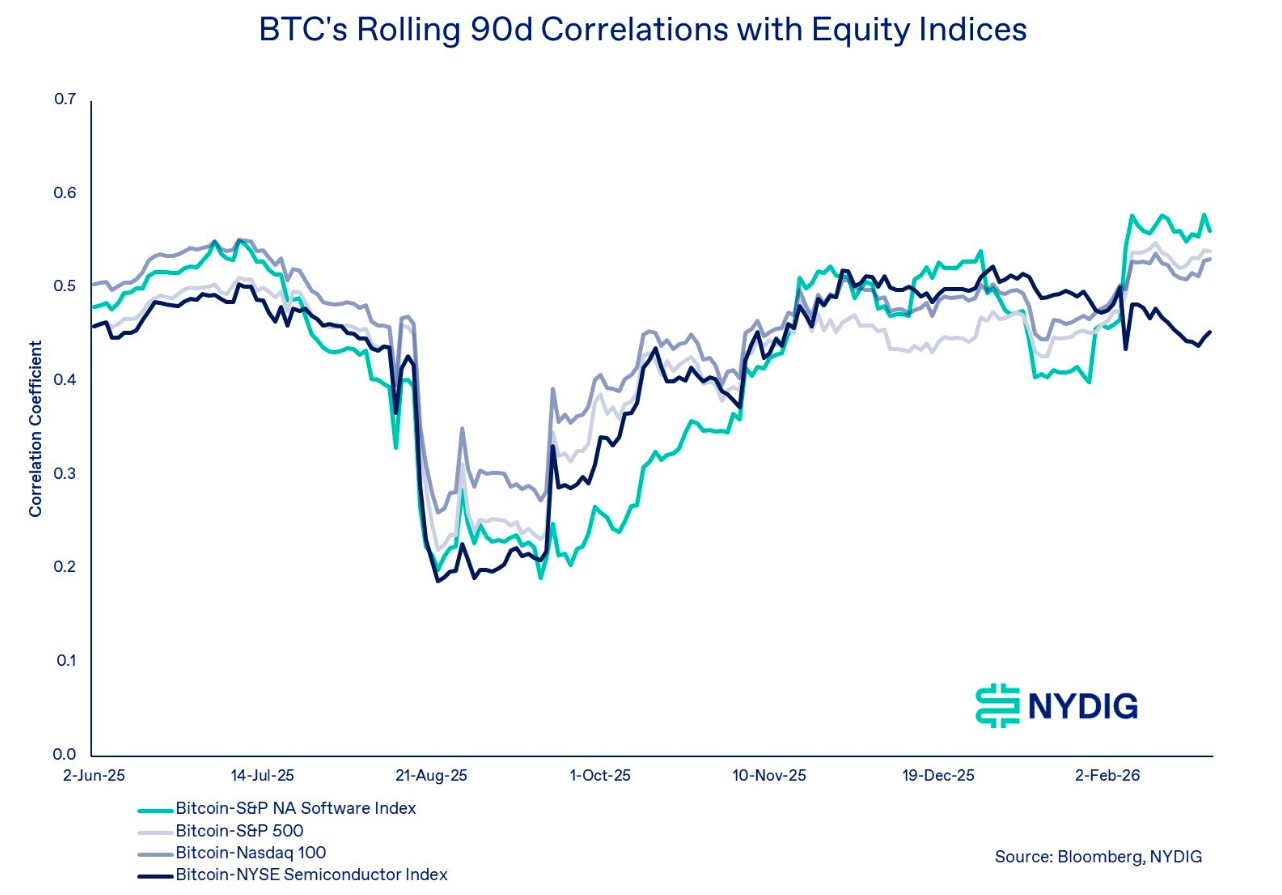 The correlation between Bitcoin and major indices over a continuous 90-day period | Source: NYDIG Cipolaro also observed that Bitcoin does not seem to be valued as a hedge against macroeconomic changes. This explains “the ongoing disappointment that Bitcoin does not ‘behave like gold,’ despite being called ‘digital gold.’”
Instead, he pointed out that investors are allocating assets based on risk curves, rather than buying Bitcoin with a “clear and distinct monetary thesis.”
However, Cipolaro affirmed that Bitcoin possesses an independent market structure and economic drivers, with factors such as network activity, widespread adoption trends, and policy and regulatory developments all making Bitcoin different from traditional assets.
“This difference reinforces Bitcoin’s role as a diversification tool,” he said. “Although the correlation between Bitcoin and the stock market is high, it’s not enough to fully determine Bitcoin’s returns.”
Disclaimer: The information on this page may come from third parties and does not represent the views or opinions of Gate. The content displayed on this page is for reference only and does not constitute any financial, investment, or legal advice. Gate does not guarantee the accuracy or completeness of the information and shall not be liable for any losses arising from the use of this information. Virtual asset investments carry high risks and are subject to significant price volatility. You may lose all of your invested principal. Please fully understand the relevant risks and make prudent decisions based on your own financial situation and risk tolerance. For details, please refer to
Disclaimer.


