
X has not banned crypto advertising but has strengthened paid partnership labels and disclosure mechanisms to increase transparency in marketing rules. Europe, America, and Australia still strictly prohibit financial promotions.
Community panic stems from misreading information; X clarifies there are no new bans
Recently, rumors about X completely banning cryptocurrency ads and paid promotions have been circulating widely within the crypto Twitter community. Many influencers (KOLs) and investors worry this will lead to a wave of account suspensions, signaling the end of the golden age of crypto marketing.
However, based on in-depth tracking and comparison with historical records, this controversy is a misunderstanding caused by policy transparency updates. In fact, X did not issue any new bans against the crypto industry on March 1, 2026. The restrictions related to paid partnerships involving cryptocurrencies have existed since June 2024. The current changes focus on technical labeling management and disclosure requirements aimed at enhancing platform content transparency.
Looking back at historical archives, X’s policy webpage as early as 2024 already listed cryptocurrencies, loans, investment services, and other financial products as categories not eligible for paid partnership promotions. The recent panic was mainly triggered by statements from X product lead Nikita Bier and the launch of a new paid partnership label on the platform.
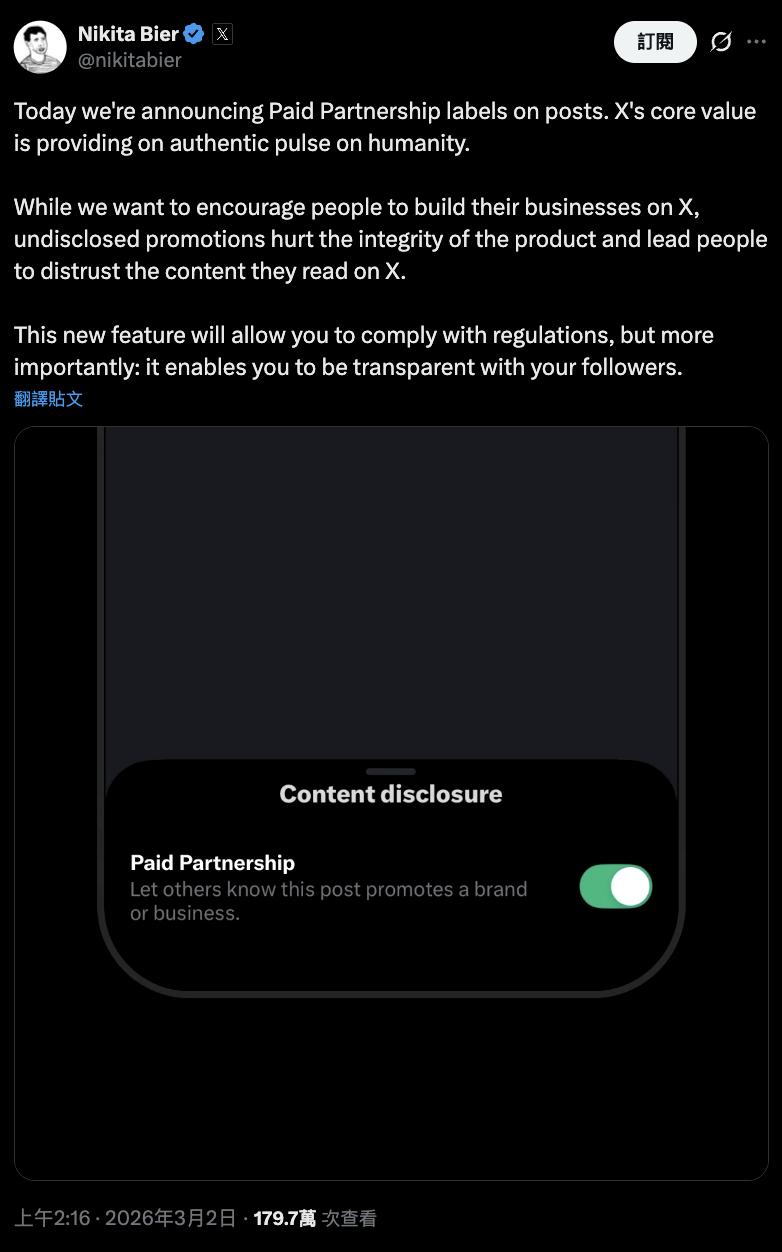
Image source: X/@nikitabier X Introduces New Paid Partnership Label
While some analysts like DeFi Ignas suggest that X may be adjusting its advertising policies to remove certain financial products from banned lists, the current official terms indicate a conditional open approach. For most users, this change signifies that X is seriously enforcing existing compliance requirements, mandating all paid content creators to use official tools for labeling, thus shifting away from the previous ambiguous marketing practices.
Advertising policies and paid partnerships are now decoupled, with a new transparent labeling system
The core of this policy update is transparency. Product lead Nikita Bier stated that undisclosed promotions damage the platform’s integrity and erode user trust. To address this, X officially launched the paid partnership label feature.
According to the latest regulations, content creators must enable the relevant disclosure toggle in the post interface when publishing any sponsored, compensated, or incentivized content. Once enabled, the post will automatically display a “Paid Partnership” label at the top. This mechanism ensures followers can clearly distinguish between genuine opinions and content with commercial agreements. It helps users comply with regulations and maintain honesty and transparency with their audience.
X’s definition of paid partnerships is broad. Besides direct cash rewards, the policy also covers several specific commercial behaviors:
- Gifts or free services provided by brands;
- Any form of physical contribution or non-monetary compensation;
- Sales commissions earned through affiliate links or discount codes;
- Commercial agreements such as acting as a brand ambassador.
X emphasizes that this paid partnership policy for creators is separate from the traditional X Ads policy. This means some sensitive content prohibited in creator posts might be allowed within officially approved advertising campaigns.
This dual-track management approach reflects X’s attempt to balance user experience with ad revenue. Creators are responsible for ensuring their promotional content complies with all applicable laws, including FTC guidelines on endorsements and testimonials.
Regulatory boundaries remain clear; financial promotions are still strictly banned in Europe, America, and Australia
Although X’s global policies seem to be gradually relaxing restrictions on financial promotions, the platform maintains strict firewalls in certain jurisdictions. According to region-specific terms published officially, content creators in the EU, UK, and Australia still face absolute bans on promoting financial products and services.
This list includes loans, investment services, cryptocurrencies, and buy-now-pay-later (BNPL) schemes. This means that even if X’s overall policy relaxes, influencers and KOLs must ensure their content does not reach users in these heavily regulated regions, or they risk legal and platform penalties. Especially in the UK, all commercial posts must be clearly and prominently disclosed.
In addition to financial products, X’s banned promotion list also includes sensitive industries such as adult products, alcohol, dating services, prescription drugs, medical devices, tobacco, and weapons. The update also extends bans to weight loss products and political or social issues.
This indicates that after multiple misinformation crises, X is strengthening content quality control. For creators violating policies, X has implemented tiered penalties. First-time offenders may be asked to remove posts and face temporary read-only restrictions; repeated or severe violations could lead to permanent account bans.
This strict enforcement approach has unsettled many long-time crypto influencers who often operate near legal boundaries. Anyone can report violations via the official reporting form, and reporters do not need an X account.
Marketing landscape faces major overhaul; community debates transparency pros and cons
Reactions within the crypto community to X’s transparency policy are polarized. Supporters believe that mandatory paid partnership labels help clean up spammy prediction market content and AI-generated posts, allowing valuable projects to stand out.
Notable analyst Benjamin Cowen pointed out that this policy will force 90% of crypto KOLs to find new business models. He believes it will end the practice of influencers pretending to genuinely like a project while secretly dumping tokens on followers. This marks the end of the unregulated, trust-based marketing methods of the past. Transparency and proper labeling will become core to successful crypto marketing on X.
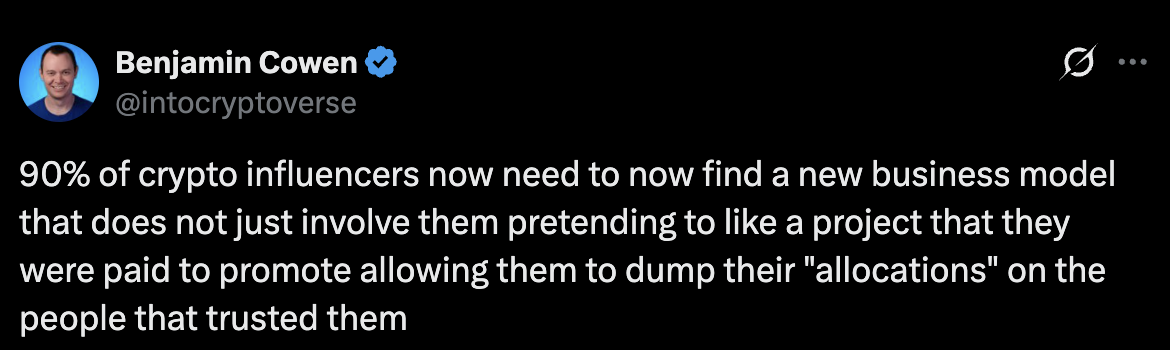
Image source: X/@intocryptoverse Benjamin Cowen states that this policy will force 90% of crypto KOLs to seek new business models
However, there are also strong concerns. Some analysts like Rune argue that, in practice, it’s difficult for the platform to distinguish between genuine personal recommendations and undisclosed paid promotions. He worries this could lead to widespread misjudgments against the crypto community, causing users to self-censor their investment sharing out of fear of violating rules.
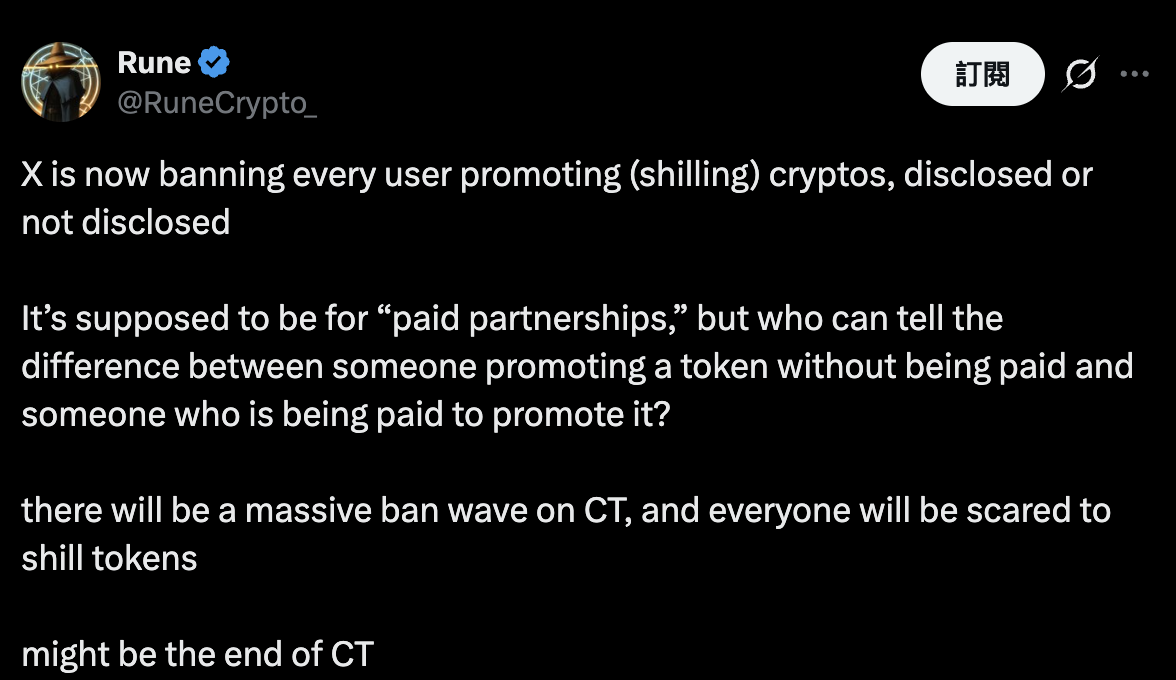
Image source: X/@RuneCrypto_ Rune believes that, in practice, it’s hard for the platform to tell whether a user is making a genuine recommendation or conducting undisclosed paid promotion
Despite market volatility, Elon Musk’s plans for X’s transformation remain unaffected. Musk previously announced that X Money, its payment system, will enter testing within two months, initially in the US before expanding globally. Additionally, X plans to introduce Smart Cashtags, allowing users to view and trade stocks and cryptocurrencies directly on the platform. As X evolves into a full-featured “Everything App,” marketing in the crypto industry is shifting from reckless growth to compliance and disclosure, which is now an irreversible trend.
Further reading
X platform’s payment system X Money completes internal testing! Musk: Limited external testing in 2-3 months
Smart Cashtags coming soon—Musk aims to enable 600 million users to buy stocks and cryptocurrencies on X


