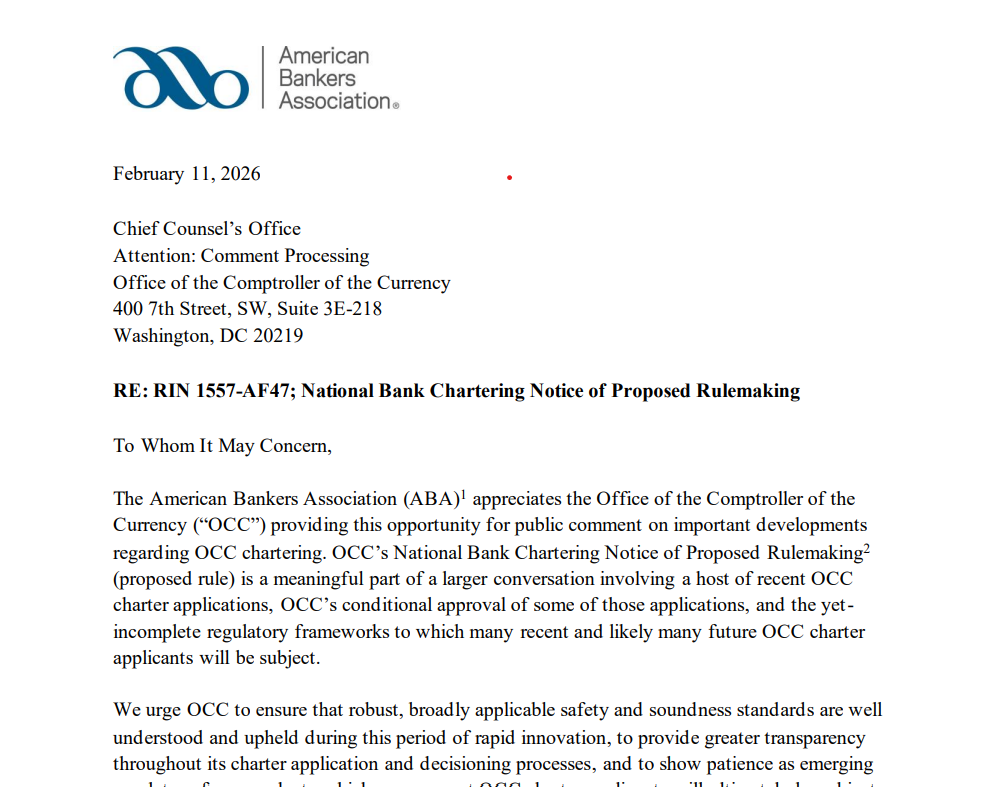
The American Bankers Association (ABA) has urged the Office of the Comptroller of the Currency (OCC) to slow down the approval process for national trust bank licenses for crypto and stablecoin companies until the regulatory environment under the GENIUS Act becomes clearer. The association warns that national trust charters could be used to circumvent SEC or CFTC registration and review, even though these activities would normally trigger securities or derivatives regulation.
ABA’s Three Main Objections and True Motivations
(Source: American Bankers Association)
In a Wednesday comment letter, the ABA outlined three primary objections. First is regulatory uncertainty. The ABA states that until all regulatory obligations for these institutions—including the upcoming rules under the GENIUS Act—are fully clarified, the OCC should not advance related applications. This reason appears reasonable on the surface; indeed, approving new licenses amid regulatory ambiguity could pose legal risks. But in reality, it’s a delaying tactic. When the GENIUS Act will pass, its specific provisions, and the implementation details remain highly uncertain. Using this as a pretext to indefinitely delay approval effectively bans crypto companies from obtaining licenses.
Second are safety and operational risks. The association warns that uninsured, digital asset-focused trust companies could raise unresolved issues around safety, soundness, operations, and disposition—particularly regarding customer asset segregation, conflicts of interest, and cybersecurity. These concerns have some merit; custody of digital assets does face unique risks (such as private key management and hacking). But the question is: are these risks unmanageable for crypto trust companies? Firms like Fidelity and BitGo have deep experience in crypto custody, with security standards and risk management that may rival traditional banks.
Third is the risk of regulatory arbitrage. The report warns that national trust charters could be used to evade SEC or CFTC registration and review, even though their activities would normally trigger securities or derivatives regulation. This concern is somewhat valid. If crypto firms obtain OCC bank charters, they might claim to be “banks” rather than “securities brokers” or “commodity dealers,” attempting to sidestep SEC and CFTC oversight. Without safeguards, such regulatory arbitrage could create loopholes.
But the true motivation behind these objections is glaring: protecting the vested interests of traditional banks. If crypto firms obtain national trust charters, they could offer services similar to banks—such as custody of crypto assets and stablecoin issuance—without bearing the full compliance costs of traditional banking (like FDIC insurance and capital requirements). This “light regulation” advantage could allow crypto companies to steal banking customers and market share. The ABA, representing banking interests, is less concerned with financial stability and more with safeguarding its members’ market dominance.
Conditional Approval of Five Companies Including Ripple and Fidelity
This intervention occurred less than two months ago, when the OCC conditionally approved five crypto companies—Bitgo Bank & Trust, Fidelity Digital Assets, Ripple National Trust Bank, First National Digital Currency Bank, and Paxos Trust Company—to hold and manage customer digital assets under federal charter, without engaging in deposit-taking or lending.
These approvals reflect the Trump administration’s crypto-friendly policies. Under Biden, the OCC’s licensing process for crypto firms has been cautious, effectively frozen. After Trump took office, the new OCC leadership adopted a more open stance, quickly approving five major players—marking a 180-degree policy shift. These firms are heavyweight players: Fidelity’s crypto division, Ripple (XRP’s parent), Paxos (issuer of BUSD and PAXG), and BitGo (top-tier custody provider).
“Conditional approval” means these companies have received preliminary permission but must meet a series of conditions—such as minimum capital, comprehensive compliance and risk management systems, and ongoing supervision—before they can operate as “national trust banks.” Until all conditions are satisfied, they cannot officially operate under that name. The ABA’s lobbying aims to insert more hurdles between “conditional approval” and “full approval,” delaying or blocking these companies from actually opening.
The Five Companies with Conditional Approval
Bitgo Bank & Trust: Leading crypto custody provider
Fidelity Digital Assets: Major traditional financial firm’s crypto division
Ripple National Trust Bank: XRP’s parent company
First National Digital Currency Bank: Emerging crypto bank
Paxos Trust Company: Issuer of BUSD and PAXG
Ongoing Battle Over Stablecoin Incentives
The same banking lobby is also pressuring Congress through proposed legislation on crypto market structure (e.g., the CLARITY Act), seeking to restrict stablecoin rewards. They claim that earning yields on stablecoins and related “reward” programs could function like banking products but without full banking regulation.
This multi-front lobbying demonstrates the banking sector’s comprehensive counterattack. In Congress, they aim to legislate restrictions on stablecoins—such as banning or limiting yields—to prevent competition with bank deposits. In regulation, they pressure the OCC to delay or deny licenses, preventing crypto firms from legally offering bank-like services. If successful, these combined efforts could severely hinder the growth of the crypto industry in the U.S.
The ABA urges the OCC to exercise “patience” and avoid imposing traditional timeframes on these applications, insisting that each applicant’s regulatory responsibilities be “fully considered” before proceeding. This language essentially calls for indefinite delays. In the fast-changing crypto industry, months or years of delay could cause firms to miss market opportunities or be overtaken by competitors.
The association also calls for increased transparency from the OCC regarding how it calibrates capital, operational, and resilience standards when granting conditional licenses, and urges tightening naming rules so that limited-purpose trust banks not engaged in banking cannot use the term “bank” in their names. They argue this would reduce consumer confusion about uninsured entities’ obligations and safety. While this makes sense to prevent misleading consumers, it could also serve as a means to restrict crypto companies’ branding influence.
For Ripple, Fidelity, and the other five firms, ABA’s lobbying presents a significant obstacle. They initially expected to meet conditions and open within months, but now face potentially indefinite delays. If the OCC yields to ABA’s pressure, their licenses could be postponed until the GENIUS Act is fully implemented—possibly over a year or more. Such uncertainty is a major blow to business planning and investor confidence.
For the crypto industry, ABA’s actions exemplify “old power pushing back.” Traditional financial institutions leverage their Washington influence and lobbying capacity to block new entrants. This asymmetry means that even under Trump’s administration, crypto faces a long fight against entrenched interests. The ultimate outcome depends on the political balance: the alliance of Trump and crypto supporters versus the traditional banking and conservative lawmakers.
Disclaimer: The information on this page may come from third parties and does not represent the views or opinions of Gate. The content displayed on this page is for reference only and does not constitute any financial, investment, or legal advice. Gate does not guarantee the accuracy or completeness of the information and shall not be liable for any losses arising from the use of this information. Virtual asset investments carry high risks and are subject to significant price volatility. You may lose all of your invested principal. Please fully understand the relevant risks and make prudent decisions based on your own financial situation and risk tolerance. For details, please refer to
Disclaimer.


