Robinhood stock fell 8% after hours on Tuesday, with HOOD dropping from $85.60 to $78.80. The company’s Q4 total revenue increased 27% to $1.28 billion, but crypto revenue declined 38% to $221 million, with app-based trading volume down 52%, retail investor funds flowing out, and a shift in revenue structure reducing dependence on crypto.
Warning Signs as Crypto Revenue Drops from $268 Million to $221 Million
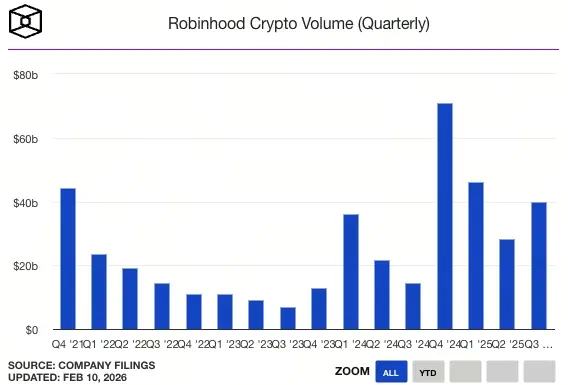
(Source: The Block)
Crypto business was the main driver of this quarter’s weak performance. Crypto trading revenue fell 38% year-over-year to $221 million, contrasting sharply with growth in other trading segments. Options trading revenue grew 41% to $314 million, while stock trading revenue increased 54% to $94 million. This result indicates a slowdown in crypto revenue compared to Q3, when it surged to $268 million.
From Q3’s $268 million to Q4’s $221 million, a quarter-over-quarter decline of about 17.5%. This worsening quarter-over-quarter trend, more concerning than the 38% year-over-year drop, suggests the decline is accelerating rather than stabilizing. The overall crypto market was sluggish in Q4, with Bitcoin retreating from its October high of $126,000, which negatively impacted trading volume. However, Robinhood’s crypto revenue decline far exceeded the market average.
Trading volume followed a similar trend. Total crypto nominal trading volume in Q4 reached $82 billion, mostly from Bitstamp, which Robinhood acquired in mid-2025. The app’s own trading volume was down 52% year-over-year, reflecting decreased retail participation compared to the crypto rally last year.
A 52% drop in retail trading volume is catastrophic. It indicates core Robinhood users’ interest in crypto trading has been cut in half. These users may have exited due to losses, shifted to other exchanges, or left the crypto market entirely. If this trend continues, it could seriously threaten Robinhood’s crypto business model. Even more worrying, this decline occurred after Robinhood heavily invested in crypto (such as acquiring Bitstamp), suggesting its strategic bets may have been misguided.
Robinhood Q4 Financials: A Tale of Two Extremes
Crypto Revenue: Down 38% to $221 million, retail trading volume collapsed 52%
Options Revenue: Up 41% to $314 million, retail enthusiasm shifts
Stock Revenue: Up 54% to $94 million, traditional business remains strong
Subscription Revenue: Gold users up 58% to 4.2 million, diversification pays off
Bitstamp’s trading volume helped mitigate the impact of crypto trading weakness on Robinhood’s core app, as the company relies more on international and institutional activity. As a well-established European exchange, Bitstamp’s user base and business model differ markedly from Robinhood’s retail clients. Its customers are mainly institutions, high-net-worth individuals, and European users, whose trading behavior is more stable and less emotional than retail traders.
Highlights of Subscription and Interest Income Transformation
Beyond crypto, other business segments continue to expand. Net interest income rose 39% year-over-year to $411 million, driven by growth in interest-bearing assets and securities lending. Robinhood Gold subscription users increased 58% year-over-year to a record 4.2 million, boosting subscription revenue.
The 4.2 million Gold subscribers is a major highlight of Robinhood’s transformation. Robinhood Gold is a $5/month subscription offering professional research, higher instant deposit limits, and around 5% interest on idle cash. With 4.2 million users, this translates to about $21 million in monthly recurring revenue, or roughly $250 million annually. This subscription model offers stability and high margins, unlike trading revenue which depends heavily on market volatility.
A 58% annual growth rate is remarkable, showing Robinhood’s subscription products are highly attractive. The $5 monthly fee, combined with the 5% interest on idle cash (similar to high-yield savings accounts), provides significant value for retail investors. This “low-cost, high-value” approach is creating a steady stream of recurring revenue, reducing reliance on highly volatile crypto trading.
User growth remains strong. Paid users increased 7% year-over-year to 27 million, and total platform assets grew 68% to $324 billion, supported by customer deposits, acquisitions, and higher equity valuations. The 27 million paid users ranks above average among US brokerages, though below firms like Charles Schwab or Fidelity. For a fintech company only ten years old, this is a significant achievement.
Overall, Robinhood’s revenue structure is shifting, reducing dependence on crypto trading peaks and expanding into prediction markets, retirement accounts, and banking services. This diversification is a positive strategic move, lowering the impact of volatility in any single business line.
Tokenized Stocks and 24/7 Trading: Future Plans
CEO Vlad Tenev recently emphasized tokenized stocks and plans to expand stock trading to 24/7 blockchain-based settlement. This forward-looking approach shows Robinhood isn’t abandoning crypto and blockchain but aiming to innovate traditional finance products. Tokenized stocks would enable trading and instant settlement on the blockchain around the clock, breaking the current T+2 settlement cycle (two days after trade execution) in US equities.
If successful, this could revolutionize stock trading. The current T+2 settlement is inefficient and increases counterparty risk. Blockchain-based instant settlement could reduce costs and risks. 24/7 trading would also meet global investor demand, allowing Asian and European traders to buy US stocks during their daytime without staying up late.
However, this innovation faces significant regulatory hurdles. The SEC’s strict regulation of security tokens means tokenized stocks might be classified as securities, with complex compliance requirements. Opposing traditional brokerages and exchanges could also pose challenges. Even if technically feasible, regulatory approval might take years.
For Robinhood shareholders, Q4 results are a mixed bag. On the plus side, overall revenue hit a new high, subscription business boomed, and user growth continued, indicating strong fundamentals and successful transformation. On the downside, crypto revenue plunged 38%, and retail trading volume halved. If crypto markets remain sluggish, this segment could become a long-term drag. The 8% after-hours decline reflects investor concern over crypto weakness rather than overall revenue growth.
Disclaimer: The information on this page may come from third parties and does not represent the views or opinions of Gate. The content displayed on this page is for reference only and does not constitute any financial, investment, or legal advice. Gate does not guarantee the accuracy or completeness of the information and shall not be liable for any losses arising from the use of this information. Virtual asset investments carry high risks and are subject to significant price volatility. You may lose all of your invested principal. Please fully understand the relevant risks and make prudent decisions based on your own financial situation and risk tolerance. For details, please refer to
Disclaimer.


