Author: Nancy, PANews
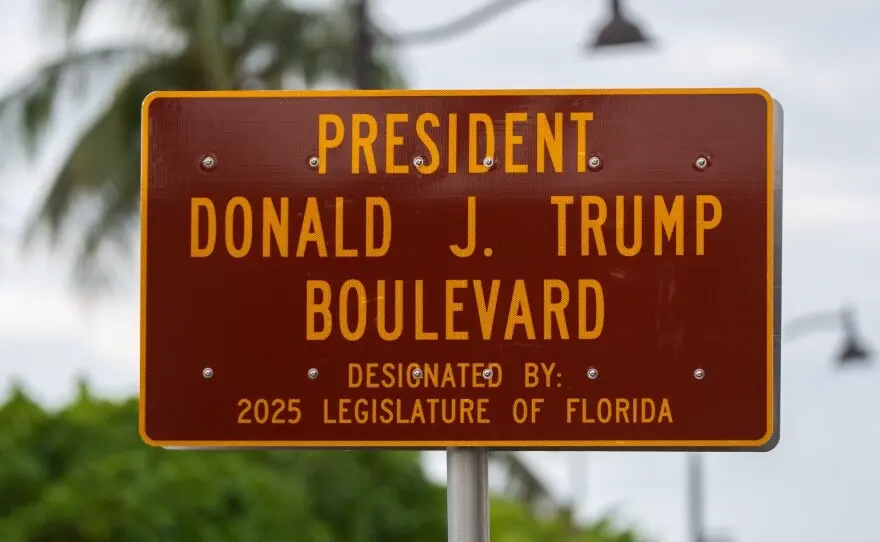
Not long ago, the main road leading to Mar-a-Lago was officially renamed “Donald J. Trump Avenue.” This road extends from Palm Beach International Airport, with a massive gold sign that has become a new visual landmark for the area and a tangible symbol of Trump’s personal influence.
In Palm Beach, Florida, Mar-a-Lago has long been more than just Trump’s private club. It is both a power hub for American political and business elites and a lucrative cash cow for the Trump family, generating tens of millions of dollars annually.
And this road named “Trump Avenue” has long been crowded with crypto visitors.
WLFI organizes, traditional elites sit at the crypto main table
At the end of January, WLFI announced that it would hold the first World Liberty Forum at Mar-a-Lago on February 18 (the second day of the Lunar New Year), with about 300 seats available.
This is not an open crypto conference but a curated, closed-door elite gathering. Entry depends on the “weight” of the participants. The organizers categorize invitees into three groups: attendees, speakers, and media. All applicants must submit their industry, position, contact information, and X (formerly Twitter) account, and all applications are subject to centralized review. Tickets are non-transferable.
From the announced speaker lineup, most are from key circles on Wall Street and American politics.
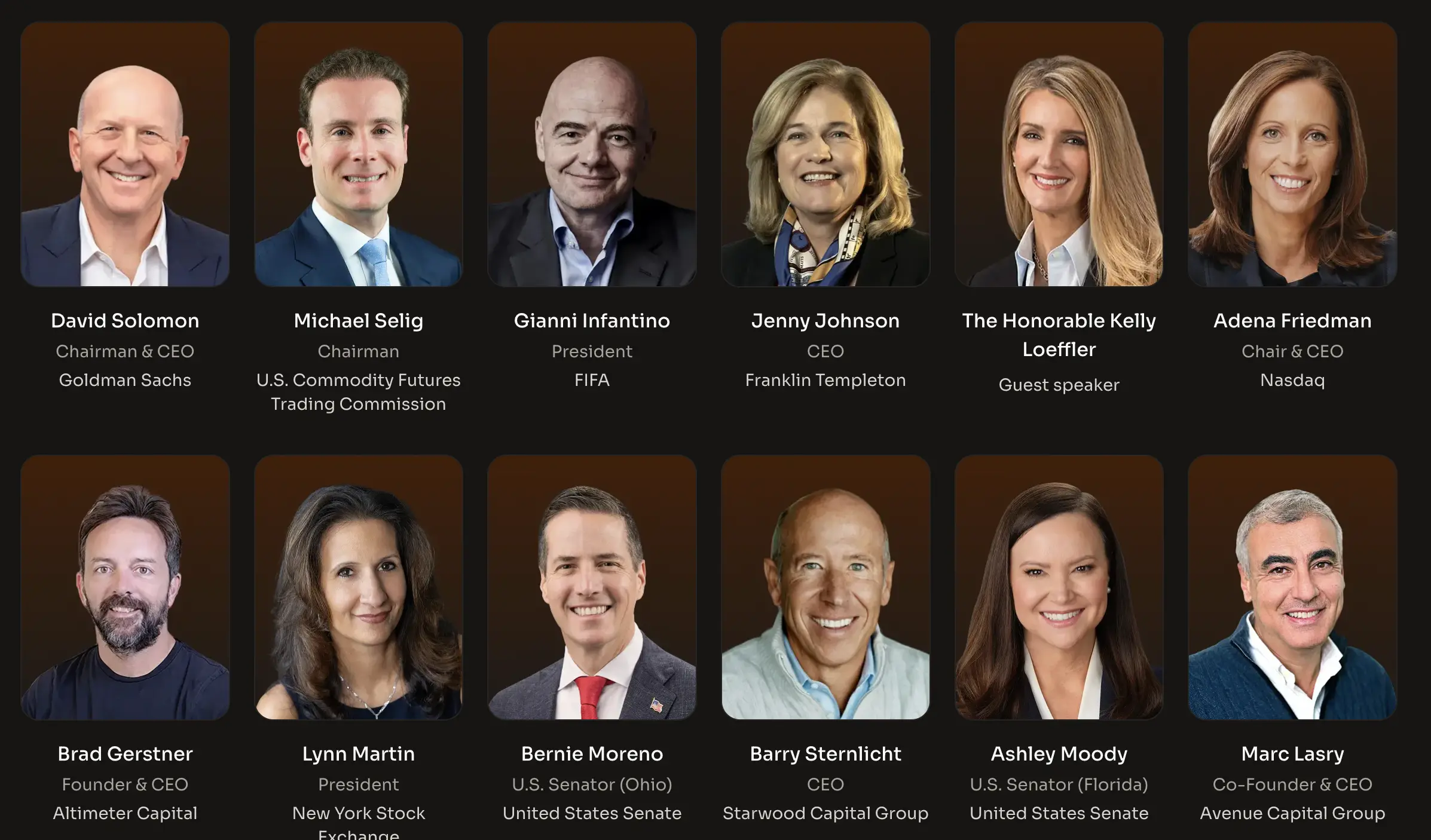
In the financial sector, confirmed attendees include Goldman Sachs Chairman and CEO David Solomon, Nasdaq Chairman and CEO Adena Friedman, and NYSE President Lynn Martin, covering critical nodes in the financial system;
In asset management and private equity, there are Franklin Templeton CEO Jenny Johnson, Third Point founder Daniel Loeb, Altimeter Capital founder Brad Gerstner, and Avenue Capital co-founder Marc Lasry, representing long-standing traditional capital forces;
In regulation and policy, the list includes current CFTC Chairman Michael Selig, U.S. Senator Bernie Moreno, Ashley Moody, and White House Deputy National Economic Advisor Jacob Helberg.
Other notable figures such as FIFA President Gianni Infantino, Turing Award laureate Yoshua Bengio, and Canton Network co-founder Yuval Rooz, from various fields, are also invited.
As the initiator, Trump’s two sons, Eric Trump and Donald Trump Jr., along with several core WLFI members, will participate throughout.
Compared to previous crypto events held at Mar-a-Lago, which mainly involved project teams, industry insiders, and whales, this time, traditional elites are sitting at the crypto main table.
This shift is likely related to WLFI’s recent strategic adjustments over the past few months.
From advancing compliance measures like applying for a national trust bank license, to promoting the launch of the lending platform World Liberty Markets, and preparing the “Digital Dollar Gateway” WLFI App, as well as continuously demonstrating real use cases and market scale for the stablecoin USD1, WLFI is attempting to position itself as a serious DeFi player, strengthening its infrastructure potential in the trend of integration between traditional finance (TradFi) and crypto.
Notably, WLFI has recently opened a special channel for its contributors. Applicants must submit their holdings and contributions in WLFI or the stablecoin USD1, which will be reviewed and screened by the official team.
Unlike the previous model of simply exchanging real money for entry, this time, a hybrid system of “contribution + review” is used. To some extent, this provides community members with a pathway to join the Trump family’s meetings. Currently, some non-X users have actively posted their contributions in hopes of qualifying for entry.
Testing, alliances, and fundraising: Trump family’s crypto stronghold
Prior to this, the approximately 80,000-square-meter “Winter White House” has long been a secret meeting place for the Trump family and crypto leaders.
As early as 2023, Trump invited NFT holders of his issued tokens to meet him. This seemingly fan-oriented gathering was seen by many observers as a turning point—Trump publicly discussed and promoted crypto investments for the first time to a clearly defined supporter base.
In May 2024, Trump held a crypto-themed event at Mar-a-Lago, where some crypto industry supporters pledged to fund his campaign. Subsequently, his campaign team began accepting cryptocurrency donations, turning crypto from a symbolic political gesture into a practical fundraising tool.
A month later, Trump hosted several Bitcoin mining executives at Mar-a-Lago and publicly stated that if he returns to the White House, he would support policies for miners. Bloomberg noted at the time that Bitcoin miners were an important support force within Trump’s campaign.
Months later, on election night, crypto leaders such as Cantor Fitzgerald CEO Howard Lutnick, Bitcoin Magazine CEO David Bailey, and Kraken Chief Legal Officer Marco Santori gathered at Mar-a-Lago to celebrate Trump’s victory, marking what is seen as the true beginning of a crypto-friendly era.
In January 2025, executives from top crypto firms like Crypto.com, Ripple, and Coinbase visited Mar-a-Lago to exchange views with Trump’s team on policy directions and regulatory frameworks, and made large donations to his political organization.
In May 2025, Trump held a private dinner at Mar-a-Lago for the top 220 holders of Meme coin $TRUMP. Attendees included Tron founder Justin Sun, former NBA star Lamar Odom, among others, raising approximately $148 million.
From early supporter gatherings to campaign fundraising, policy statements, and regulatory discussions, Mar-a-Lago has witnessed the entire process of the crypto industry’s transition from grassroots to establishment.


