


Pi Network mainnet protocol upgrade is now live! Nodes that do not complete the upgrade by February 12 will become invalid and will no longer be part of the network. Please ensure your nodes are updated before the deadline to maintain network stability and your participation.
Pi Network announces the launch of a mainnet protocol upgrade, phased from version 19 to version 23. All node operators must follow a 7-step mandatory upgrade path, with the first deadline set for completing v19.6 by February 12, 2026. At the same time, the network celebrates the annual Moderator Appreciation Day, recognizing the contributions of volunteers worldwide. The most notable feature of this upgrade is that version 23 will integrate KYC permissions directly into the blockchain layer.
Pi Network Mainnet Upgrade 7-Step Path Announced
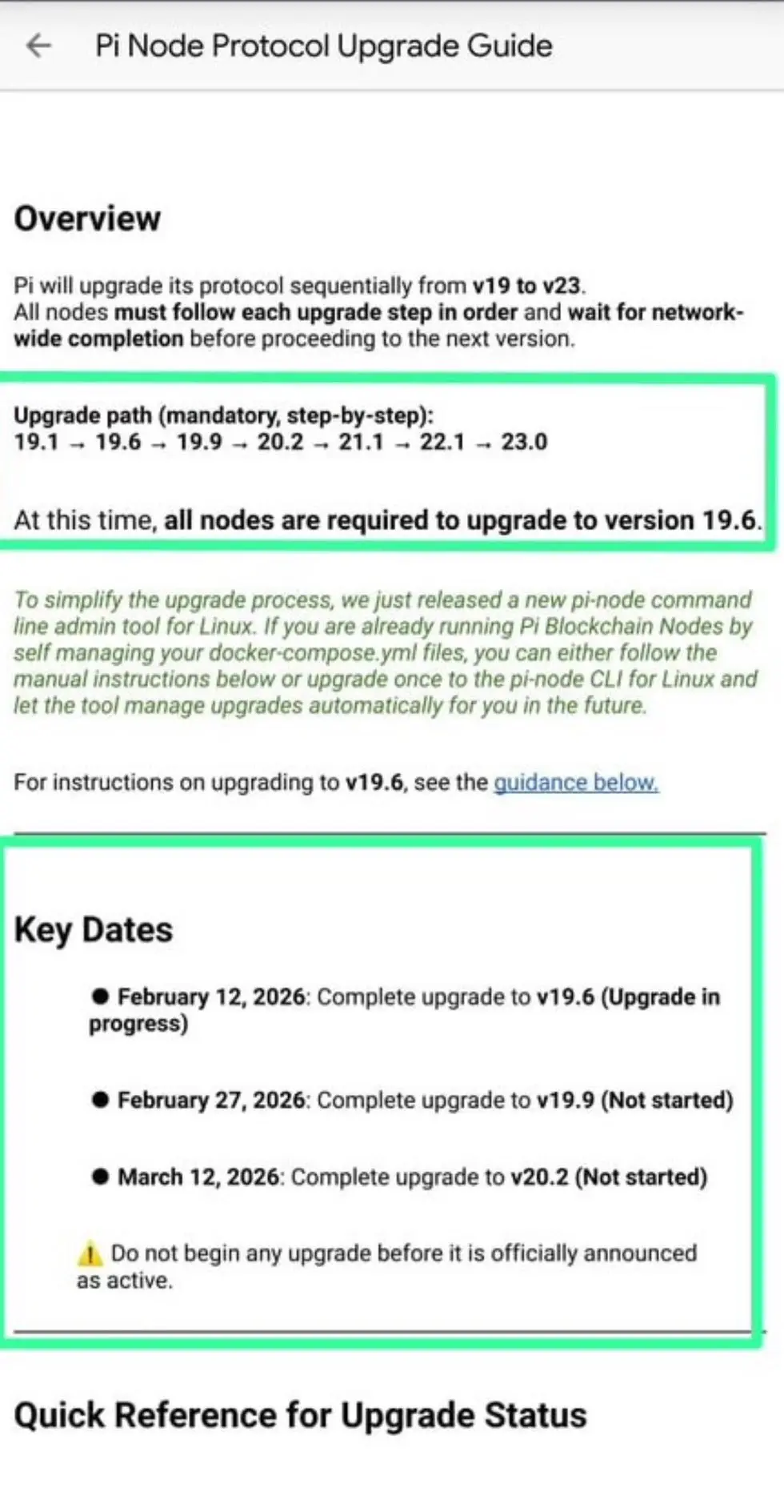
The Pi Network core team emphasizes that this upgrade will not be completed in one go; nodes must go through multiple versions in sequence. The upgrade path is: v19.1 → v19.6 → v19.9 → v20.2 → v21.1 → v22.1 → v23.0. Each step must be completed within the network before proceeding to the next; skipping any phase will result in nodes being unable to operate normally.
Key Upgrade Timeline
February 12, 2026: Complete upgrade to v19.6 (upgrade in progress)
February 27, 2026: Full upgrade to v19.9 (not yet started)
March 12, 2026: Full upgrade to v20.2 (not yet started)
Currently, Pi Network is advancing the first phase, aiming to complete v19.6 by February 12. The core team reminds node operators not to skip any upgrade steps and to wait until each step is officially activated. This helps maintain network stability and avoid errors. Nodes that fail to upgrade before the deadline may risk losing synchronization with the mainnet, which could impact their participation in consensus.
This phased upgrade strategy is uncommon in blockchain networks. Most networks opt for a one-time hard fork upgrade, but Pi Network adopts a gradual approach to reduce systemic risk. Each phase has clear testing periods and verification mechanisms, ensuring node operators have ample time to adapt to new protocols and allowing the development team to monitor network health at each stage.
Core Features of Version 23: On-Chain KYC Permissions
The most significant technological innovation in this upgrade is that version 23 will embed KYC (identity verification) permissions directly into the blockchain layer. This means users’ verification status will no longer be stored solely in centralized databases but managed through smart contracts and on-chain records. This design enhances transparency and lays the foundation for future decentralized governance.
Integrating KYC into the blockchain layer is a key step toward fully decentralized Pi Network. Currently, many blockchain projects rely on centralized providers for KYC processes, which conflicts with decentralization principles. Pi Network writes verification status onto the blockchain, enabling smart contracts to automatically execute different logic based on user verification status—for example, limiting unverified users’ transfer amounts or access to certain DApps.
Additionally, the team has released new tools to simplify the upgrade process. A command-line tool for Linux now helps node operators automate updates. This should reduce human errors during upgrades, especially for operators managing multiple nodes, as automation can significantly improve efficiency and lower maintenance costs.
Pi Network Node Operation and Consensus Model
Pi Network nodes run on laptops and desktop computers, helping verify transactions and assist the network in reaching consensus on transaction order. Unlike Bitcoin or Ethereum, Pi Network does not use energy-intensive proof-of-work but adopts a model based on the Stellar Consensus Protocol (SCP).
This system emphasizes trust groups and communication between nodes. Each node can choose trusted peers to form a “Quorum Slice,” and through cross-verification of these trust relationships, the network can reach consensus without requiring all nodes to participate. This federated Byzantine agreement (FBA) offers scalability and energy efficiency but also demands higher technical configuration and trust settings for nodes.
Pi Network Consensus Features
Trust-based rather than hash power: nodes form consensus by selecting trusted peers
High energy efficiency: no mining needed, regular computers can run nodes
Flexible Quorum Slices: nodes can autonomously choose trusted peers
Fast confirmation: transaction confirmation times are much shorter than proof-of-work blockchains
The goal is to improve network energy efficiency while maintaining sufficient decentralization. This model is especially suitable for projects aiming to expand their user base, as it lowers participation barriers—no need for specialized mining hardware or high electricity costs.
Moderator Appreciation Day Highlights Community Governance Value
Alongside technical work, Pi Network celebrates its annual Moderator Appreciation Day. Held on the first Friday of February each year, this event thanks volunteers who help manage chat rooms, answer questions, and guide new users. Moderators play a vital role in the Pi ecosystem—they translate content, manage discussions, and support users through KYC and migration processes.
Pi Network’s moderator system is central to its community-driven approach. Unlike many blockchain projects that rely solely on the official team, Pi has built a large volunteer network. These moderators handle technical support, localize content, and enable Pi to operate in over 230 countries and regions, supporting dozens of languages.
The core team publicly thanks the moderators and releases celebratory messages. This event showcases a more human side of Pi Network. While mainnet upgrades focus on code and nodes, Moderator Appreciation Day emphasizes people. This balance reflects the project’s commitment to both technological development and community building.
The day also reminds the crypto community of an often-overlooked fact: successful blockchain projects require not only strong technology but also active, engaged communities. The unpaid efforts of moderators provide friendly access for new users, lower technical barriers, and are crucial for Pi Network’s large-scale adoption.
Node Operator Upgrade Precautions
For Pi Network node operators, this upgrade requires attention to several key points. First, absolutely no skipping of versions. Each version in the upgrade path includes necessary database migrations and protocol adjustments; skipping a version may cause data inconsistency or complete node failure.
Second, ensure upgrades are completed before the official deadline. February 12 is the mandatory upgrade deadline for v19.6. Nodes that do not upgrade on time will lose synchronization with the mainnet. Re-synchronizing may require hours or days to re-download blockchain data, depending on network conditions and hardware performance.
Third, make good use of official automation tools. The newly released Linux command-line utility can automatically detect current versions, download updates, and execute upgrade scripts. For operators unfamiliar with command-line operations, official documentation provides detailed steps and troubleshooting guides. It’s recommended to back up node configuration files before upgrading to facilitate rollback if needed.
Fourth, stay tuned to official communication channels. The core team will post real-time updates via the official website, social media, and dedicated Slack channels for node operators. Since upgrades are phased, the start times for each stage may be adjusted based on the completion of previous phases.
Future Developments and Community Speculation
Some community posts discuss potential connections between Pi Network and CEXs, including exchange listings and infrastructure collaborations. However, most of these are unofficial rumors; the main confirmed progress today is the protocol upgrade.
Pi Network is steadily progressing toward version 23. If all goes as planned, this upgrade will enhance performance and stability in the coming months. Integrating KYC into the blockchain is a significant milestone toward full decentralization, and the phased upgrade strategy demonstrates the team’s focus on network stability.
For node operators, the immediate priority is to complete the v19.6 upgrade before February 12 and closely monitor subsequent timelines. For regular users, this upgrade mostly occurs in the background but will ultimately bring faster transaction confirmations and more powerful smart contract capabilities.
Related Articles
Pi Network Testnet Expands With Starpath and Pitogo Apps
Starpath launches Pi coin testnet! Technical breakthrough can't prevent the $0.14 crash
Coin distribution in February shifted 300 million tokens, the most aggressive ever! The key defense line has been breached, risking a collapse to $0.128.
Pi Network Node Mandatory Upgrade Countdown! The countdown to the upgrade is underway! March KYC verifiers are now eligible for rewards—don't miss your chance to claim your bonus! Get ready for the upcoming upgrade and participate in the reward campaign for KYC verifiers in March!
Pi Coin Payment Card is here! Teltlk Visa Card worldwide acceptance, compatible with Amazon and eBay