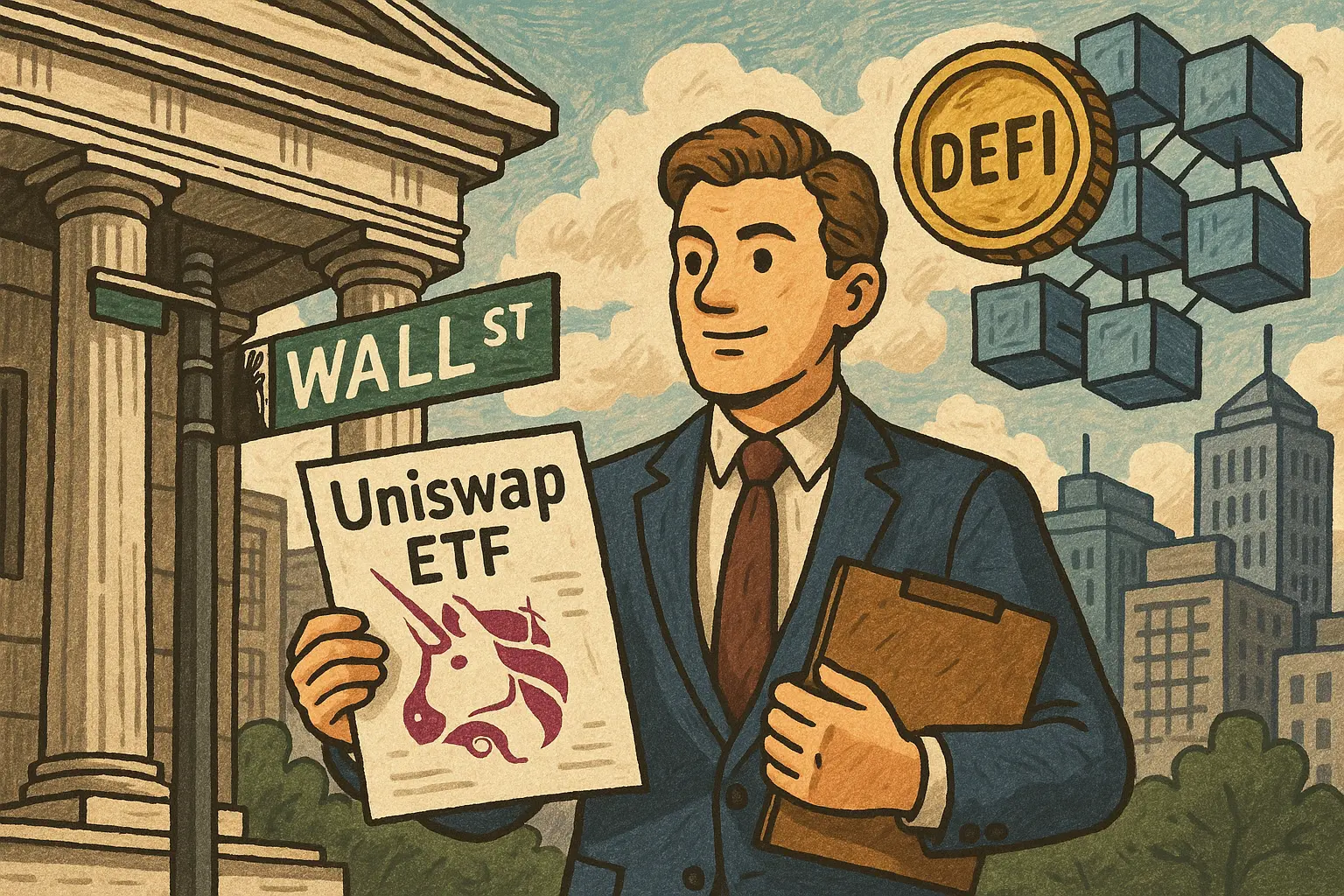
Bitwise submitted S-1 filing to the SEC on Thursday, becoming the first company to apply for a Uniswap ETF. However, the UNI token plummeted 16% in 24 hours to $3.15. The crypto market fear index dropped to 5, and Bitcoin long positions were liquidated for $1.03 billion, triggering a chain reaction of panic.
Bitwise Becomes the First Company to Submit a Uniswap ETF Application
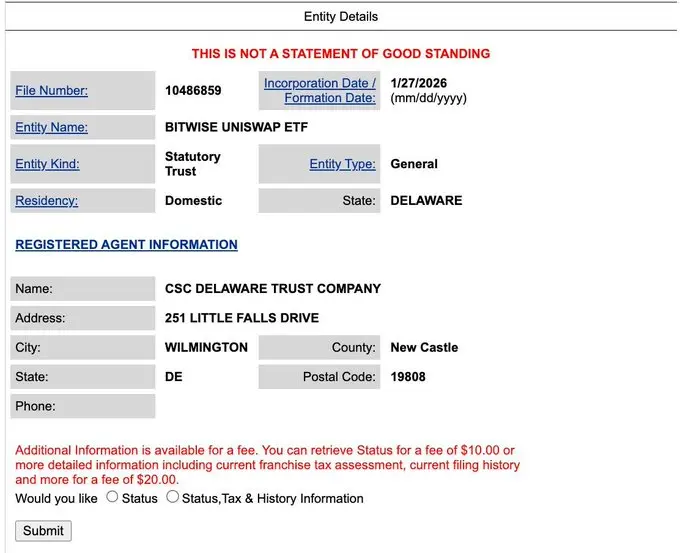
(Source: X)
Crypto asset management firm Bitwise has become the first to submit an application to U.S. regulators, planning to launch an exchange-traded fund (ETF) focused on Uniswap. The fund aims to invest in Uniswap (UNI), the governance token of the leading decentralized exchange protocol. This ETF application marks an important milestone in the development of DeFi.
The documents submitted to the U.S. Securities and Exchange Commission (SEC) on Thursday state: “The investment objective of the trust is to seek exposure to the value of Uniswap held by the trust, minus the trust’s operating expenses and other liabilities.” This language is standard in ETF filings but carries significant meaning: it indicates that traditional financial institutions are officially recognizing DeFi governance tokens as investable assets.
Uniswap is an Ethereum-based decentralized exchange (DEX) that offers token swaps without intermediaries. As one of the most successful protocols in DeFi, Uniswap’s trading volume in 2024 exceeded $1 trillion, establishing it as the de facto standard for decentralized trading. UNI token holders can vote on key protocol decisions such as upgrades and fee structures, and this governance rights are a core source of its value.
The asset management company initially registered a statutory trust for a potential Uniswap fund on January 27 in Delaware, a routine legal step before submitting filings to the SEC. This move allows Bitwise to develop ETFs related to decentralized finance protocols and ultimately file with federal authorities.
If approved by regulators, Coinbase Custody Trust Company will serve as the custodian for the Bitwise Uniswap ETF. Coinbase Custody is Coinbase’s institutional-grade custody service, licensed by the New York State Department of Financial Services (NYDFS). This regulatory endorsement is crucial for ETF compliance.
Key Information on the Bitwise Uniswap ETF Application
Submission Date: February 5, 2026
Trust Registration: January 27, 2026 (Delaware)
Underlying Asset: Uniswap governance token UNI
Custodian: Coinbase Custody Trust Company
Milestone Significance: First DeFi governance token ETF application
Regulatory Background: SEC withdrew investigation into Uniswap Labs in February 2025
This registration followed the SEC’s withdrawal of its investigation into Brooklyn-based Uniswap Labs in February 2025. The SEC had accused Uniswap of operating as an unregistered securities exchange and issuing unregistered securities. The withdrawal of this investigation cleared a major regulatory hurdle for the Uniswap ETF application, which otherwise would have faced significant obstacles given the allegations.
Why Did UNI Drop 16% Despite Good News?
Uniswap’s native token UNI fell 16.59% in the past 24 hours to $3.15, underperforming the broader market sell-off. This phenomenon of “dropping after positive news” confuses many investors. Theoretically, an ETF application should be a major positive, as it provides a compliant channel for institutional capital to enter UNI. Why did the market respond with selling?
The answer lies in the overall market environment. The decline is part of a broad correction in the crypto market. In 24 hours, the total crypto market cap dropped 9.84%, and the fear and greed index fell to 5, indicating “extreme fear.” In such an environment, even major positive news cannot prevent panic selling.
Additionally, Bitcoin long positions faced massive liquidations of $1.03 billion, forcing all leveraged positions to close. This was a key driver. When Bitcoin, as the market leader, crashes, all altcoins tend to follow regardless of their individual news. This “systemic risk outweighing positive news” phenomenon is very common in crypto markets.
From a technical analysis perspective, UNI may already be in an overbought state. If the ETF news was leaked early, some investors might have bought in anticipation before the official announcement, creating a “buy the rumor, sell the fact” pattern. When the news is officially announced, these early investors take profits, causing the price to fall.
Another reason could be market pessimism about ETF approval. Although Bitwise has filed, the SEC’s timeline and likelihood of approval remain uncertain. Historically, Bitcoin ETF applications have taken nearly a decade to be approved, and as the first DeFi governance token ETF, Uniswap’s approval process could be even longer. The market may see this as a “distant future” rather than an imminent positive.
As of press time, CoinMarketCap data shows UNI trading at $3.15. From its all-time high in May 2021 of around $45, the current price is only 7% of that peak, with a total decline of over 93%. This sharp drop has caused many early investors to incur losses, and even positive ETF news cannot reverse their selling pressure.
Milestone Significance of DeFi Going Mainstream
Despite the price plunge, the application of a Uniswap ETF by Bitwise remains highly symbolic. It’s the first time a traditional asset management firm attempts to package DeFi governance tokens into a regulated investment product. If approved, it could open a new chapter of integration between DeFi and traditional finance.
The biggest difference between DeFi governance tokens and traditional securities is the power they confer. UNI holders can vote on major protocol upgrades, fee distributions, and treasury management. This governance rights make UNI more akin to “shares in a decentralized company” rather than a mere speculative asset. Bitwise’s ETF application is essentially seeking SEC approval for this new asset class.
If the Uniswap ETF is approved, it could trigger a wave of ETF applications for other DeFi governance tokens. Protocols like Aave, Compound, and MakerDAO also have governance tokens that could become future ETF targets. This trend could bring hundreds of billions of dollars of institutional capital into DeFi, transforming its liquidity and market structure.
Regulators are currently reviewing Bitwise’s application. From the SEC’s perspective, approval hinges on several key issues: Is UNI a security? How to define the legal status of decentralized governance? How to regulate a protocol without a central operational entity? These questions have no simple answers, and the approval process could be lengthy and complex.
This registration followed the SEC’s withdrawal of its investigation into Uniswap Labs in February 2025. The SEC had accused Uniswap of operating as an unregistered securities exchange and issuing unregistered securities. The withdrawal of this investigation created the possibility for the Uniswap ETF application, which otherwise would have been difficult to approve given the allegations.
Looking at the timeline, Bitcoin ETFs took about ten years from initial application to approval, and Ethereum ETFs have also taken several years. As the first DeFi governance token ETF, Uniswap’s approval might take 1-3 years. During this period, the market will closely watch the SEC’s stance and progress.
Related Articles
Barclays: Middle East Conflict Fails to Eliminate Dollar Risk Premium
Jinse Finance reports that, according to Jinshi Data, analysts at Barclays Bank stated in a report that although the Middle East conflict has driven up energy prices and supported the US dollar exchange rate, the risk premium on the US dollar has not decreased. The market still requires a higher premium for US dollar assets to compensate for the increased uncertainty in US policies. Analysts believe that it is reasonable to expect the US dollar to weaken somewhat in the short term.
金色财经_8m ago
Keep Going All-In on Bitcoin! Strategy Announces ATM Stock Offering to Raise 42 Billion Dollars
MicroStrategy (MSTR) plans to raise $42 billion through a new at-the-market offering program by selling common stock and preferred shares, with the aim of increasing its Bitcoin purchases. Recently, the company spent $76.6 million to acquire 1,031 Bitcoin. However, the company currently has book losses exceeding $3.2 billion, and high dividend pressure and limited cash reserves raise concerns about future financial risks.
区块客20m ago
The three major US stock indices opened lower, Li Auto rose 2.8% and announced a $1 billion share buyback.
Gate News reports that on March 24, affected by factors including Iran's denial of peace talk rumors, U.S. stocks opened lower. The Dow Jones Industrial Average (U.S. blue-chip benchmark index) fell 0.24%, the S&P 500 Index (U.S. large-cap benchmark index) declined 0.62%, and the Nasdaq Composite Index (U.S. technology stock benchmark index) dropped 0.63%. Regarding individual stocks, Li Auto (LI.O) rose 2.8%, with the company announcing a $1 billion stock buyback plan. Amazon (AMZN.O) fell 1%, as the company's Amazon Web Services (AWS) region in Bahrain experienced service disruptions.
GateNews31m ago
# Gold and BTC Diverge: A Battle Over the Definition of Safe-Haven Assets
# Woke up, and BTC pulled back to 70k. On the drive this morning, the radio was reporting that gold came under pressure as the Fed's March FOMC meeting failed to meet rate cut expectations, erasing all gains for the year so far.
Recently, geopolitical tensions in the Middle East have escalated, causing global capital markets to shake. According to classical narratives in traditional finance, geopolitical conflicts should push up gold prices—a logic rooted in gold's thousands of years of safe-haven attributes, long since becoming the instinctive reaction of market participants. Yet the market performance in March 2026 has shattered this stereotype: gold prices continued to decline, breaking through the critical support level of $4,500, while Bitcoin's decline was far smaller than traditional risk assets like stocks, displaying a certain characteristic of "relative safe-haven."
This anomalous divergence, on the surface is a difference in asset price movements, but at a deeper level reflects a structural change long overlooked by the market: the investor base for gold and Bitcoin is undergoing a fundamental shift
金色财经_1h ago
US stock index futures continued their downward trend, with Nasdaq futures and Dow futures both down 0.6%
Gate News reported that on March 24, according to certain CEX data, US stock index futures continued their downward trend. S&P 500 Index (US large-cap stock benchmark index) E-mini futures fell 0.5%, Nasdaq 100 Index (US technology stock index) futures fell 0.6%, and Dow Jones Index (US industrial stock index) futures fell 0.6%.
GateNews1h ago
Bernstein: Bitcoin May Have Hit Cyclical Bottom, Maintains $150,000 Target Price by End of 2026
Gate News reports that on March 24, according to CoinDesk, Wall Street brokerage Bernstein stated in its latest report that Bitcoin may have already reached a cyclical bottom, while maintaining a price target of $150,000 by the end of 2026. The report notes that previous pullbacks were mainly driven by high interest rate environments, Middle East geopolitical risks, and ETF outflows during a certain period, but the overall fundamentals have not experienced systemic pressure. Additionally, sustained ETF inflows and corporate treasury accumulation continue to be viewed as important factors driving Bitcoin's upside.
GateNews1h ago


