Bitcoin drops below $61,000, erasing gains since Trump’s election, down 51% from all-time highs. iShares IBIT hits $10 billion in trading volume but falls 13%, and ETFs saw outflows of $5 billion in March. Mining costs at $87,000 far exceed market price, Luxor hash price hits record lows, and large-scale hash power is shutting down. Weekly RSI drops below 30 for the fifth time in history, and aNUPL turns negative, indicating holder losses.
ETF Redemption Spiral and $10 Billion Panic Trading
Why did Bitcoin crash today? The core reason is the systematic withdrawal by institutional investors, triggering a self-reinforcing sell-off cycle. For most of 2025, inflows into US spot Bitcoin ETFs supported the market, with hundreds of billions of dollars pouring in to temporarily boost Bitcoin prices. But as prices plummeted, this trend has reversed. Bloomberg data shows about $2 billion was withdrawn from Bitcoin ETFs in just the past month; over three months, total outflows exceeded $5 billion.
According to Bloomberg ETF analyst Eric Balchunas, BlackRock’s flagship spot Bitcoin fund IBIT hit a new single-day trading volume record, reaching about $10 billion. “$IBIT just broke its single-day volume record, with a trading volume of $10 billion, yet the price fell 13%, marking the second-largest daily decline since the fund’s launch. It’s devastating,” he wrote on X on Friday.
The coexistence of $10 billion in trading volume with a 13% drop is an extremely rare phenomenon. Usually, high trading volume accompanies rising prices, indicating strong buying interest; or sideways movement, showing a balance of buy and sell. But when record-breaking volume occurs during a sharp decline, it can only mean one thing: panic selling. Large ETF holders are rushing to exit, with sell orders far exceeding buy orders, forcing market makers to push prices down sharply to find buyers.
Chris Newhouse, Head of Business Development at Ergonia, said, “Fear and uncertainty are evident in the market. Without confident contrarian buyers willing to absorb the selling pressure, each ETF redemption and forced liquidation triggers a new wave of selling.” He pointed out that this mechanism “continually amplifies each downward move and reinforces defensive positions, keeping genuine demand in a state of limbo.”
Three Stages of the ETF Redemption Spiral
Stage 1: Price declines trigger some institutional redemptions
Stage 2: ETF redemptions force fund to sell Bitcoin on the market, further lowering prices
Stage 3: Accelerating price drops cause more redemptions and forced liquidations, creating a vicious cycle
Deutsche Bank analyst Marion Laboure told clients on Wednesday, “We believe this ongoing sell-off indicates traditional investors are losing interest, and overall pessimism toward cryptocurrencies is intensifying.” CryptoQuant also reported on Wednesday, “Institutional demand has undergone a fundamental reversal.” The firm noted that US ETFs that bought 46,000 Bitcoin last year will become net sellers by 2026.
Mining Costs at $87,000 vs Market Price at $61,000
The ongoing plunge is making Bitcoin mining—an energy- and hash power-dependent process—more “unprofitable” than ever, prompting some large hash power companies to shut down equipment and disconnect power. Bloomberg reports that as Bitcoin’s price continues to fall and electricity costs rise, the environment for miners is rapidly deteriorating.
Luxor Technology, a mining services company, said the “hash price” index—used to measure miners’ revenue levels—has dropped to its lowest recorded level this week. According to CoinDesk data, the average cost to mine one Bitcoin is about $87,000, well above the current market price, making mining extremely unprofitable at this stage.
This cost inversion is rare in Bitcoin history. During the 2022 bear market bottom, Bitcoin was around $15,500, with mining costs about $18,000—an inversion of roughly 16%. Currently, the $87,000 vs. $61,000 inversion is 43%, far exceeding historical records. This means miners lose about $26,000 per Bitcoin mined, even before debt, custody, and other expenses are considered.
Mining firm CleanSpark’s Chief Commercial Officer Harry Sudock told Bloomberg, “This decline is historic—the largest since China’s ban.” He pointed out that winter storms driving up electricity prices, combined with recent broader tech stock sell-offs, have significantly increased mining pressure. Industry insiders say shutting down mining equipment during extreme weather or short-term electricity price spikes is common, but the broader shutdowns amid continued crypto price weakness indicate structural industry pressures.
Bloomberg also notes that some companies are shifting focus from mining to providing computational support for AI models. While this offers a way out for individual firms, it results in a permanent loss of hash power for the Bitcoin network, potentially impacting network security long-term.
RSI below 30 and aNUPL turning negative as technical signals
(Source: SubuTrade)
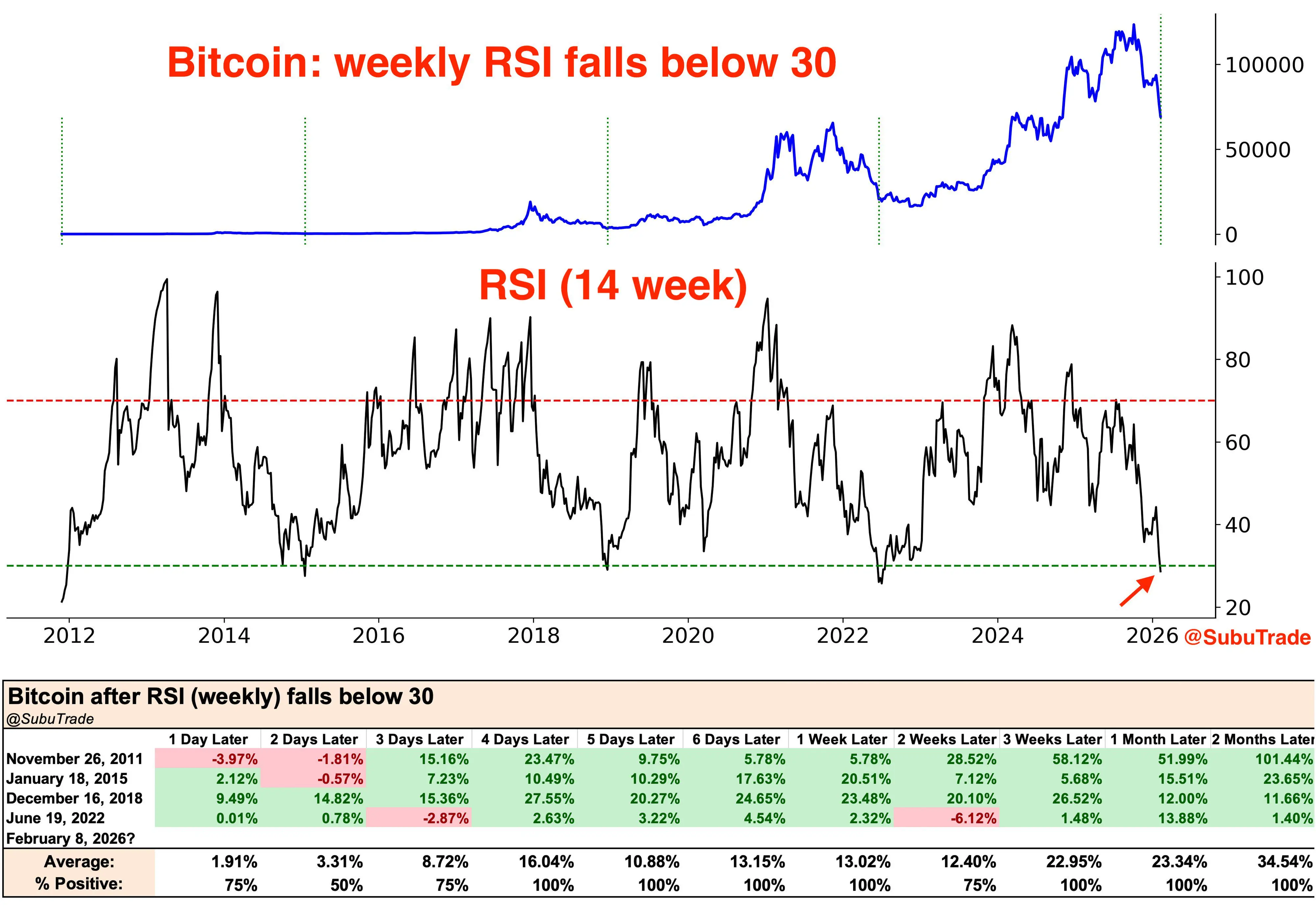
Market analyst Subu Trade states that Bitcoin’s weekly Relative Strength Index (RSI) has fallen below 30. Historically, Bitcoin has only reached this level four times, and after each, the price increased by an average of 16% over the next four days. This is an extremely rare oversold signal, previously seen only at bear market bottoms in 2011, 2015, 2018, and 2022.
Crypto analyst MorenoDV also notes that the adjusted Unrealized Profit/Loss (aNUPL) has turned negative for the first time since 2023. This indicates that ordinary holders are currently in a loss position. Similar situations in 2018-2019, 2020, and 2022-2023 led to rebounds in Bitcoin prices.
Moreno added that while a rebound may not happen immediately, the “speed of market sentiment deterioration” is faster than any previous cycle. He further explained, “This rapid shift indicates a dramatic reset in market sentiment rather than a gradual decline, which could shorten the capitulation phase.”
CryptoQuant states that Bitcoin’s recent decline suggests it could dip into the $70,000 to $60,000 range. Coinshares research head James Butterfill said that $70,000 is becoming a “key psychological level,” adding, “If we fail to hold this level, prices are very likely to fall to the $60,000 to $65,000 zone.”
Bitwise Asset Management research head Ryan Rasmussen said, “Momentum has completely taken over the market, and crypto bear markets don’t usually end in despair but in apathy. We are now in the ‘despair phase’ of this correction, with momentum dominating everything.”


