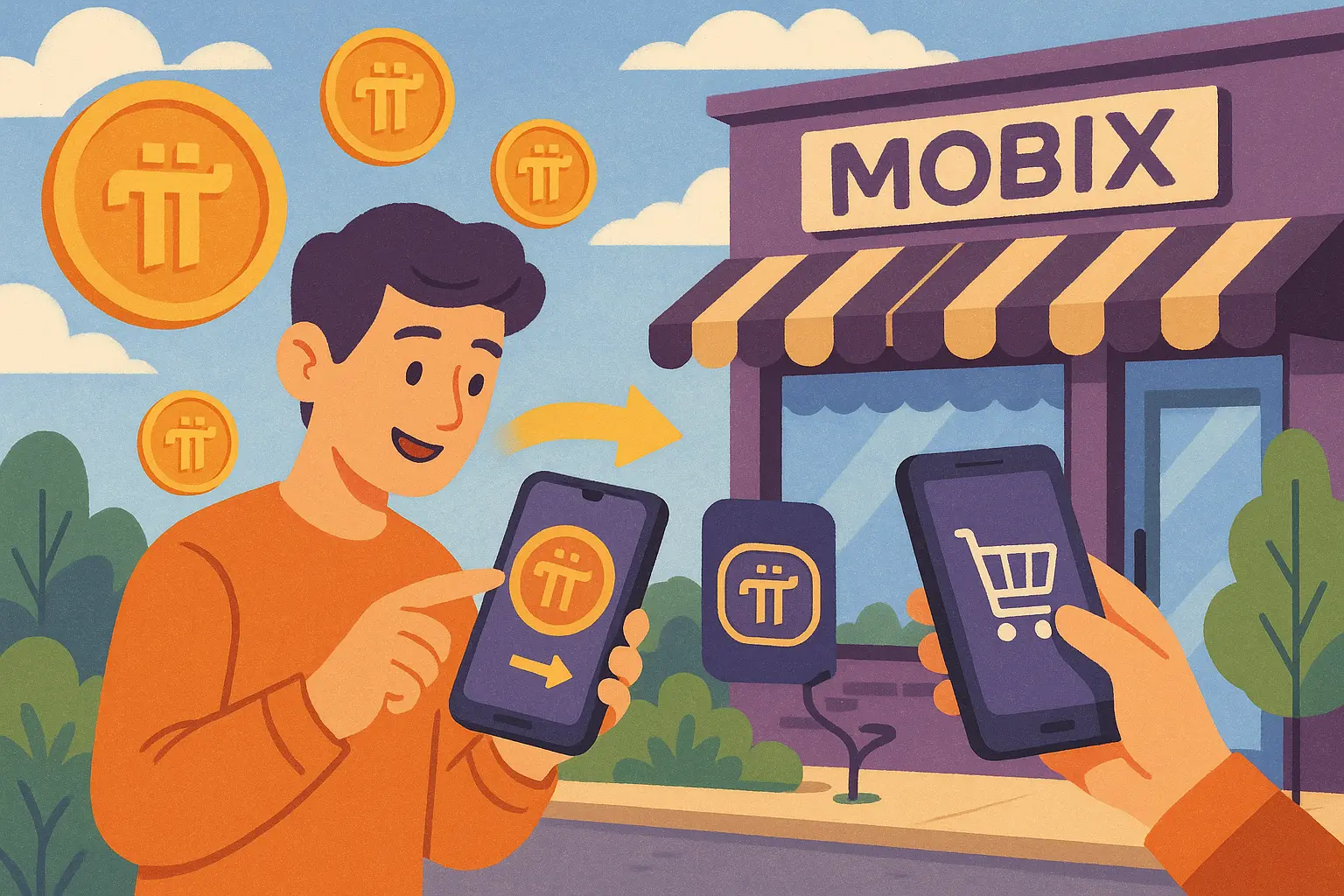
Pi Coin leverages mobile mining with zero cost, surpassing 50 million users. The mainnet migration has now enabled external transfers, with platforms like Mobix supporting payments, allowing purchases of electronics and vehicles, and gaining widespread acceptance in markets such as Nigeria. The goal is daily consumption rather than savings, avoiding Bitcoin’s energy and capital thresholds. Developer ecosystem expansion is underway, with no-code tools lowering entry barriers, and e-commerce applications leading the way.
Mobile Mining Revolution Eliminates Participation Barriers
Pi Coin emphasizes simplicity, removing technical obstacles and avoiding expensive hardware by using smartphones instead. As a result, millions of users can easily participate. Users only need to tap once daily to maintain network security through social interactions. This makes cryptocurrency approachable. This model is fundamentally different from Bitcoin. Bitcoin requires capital and energy, while Pi Network aims for mass adoption.
Launched in 2019 by Stanford graduates, Pi Coin’s mission has always been inclusivity. Mobile mining costs nothing, consumes no electricity, and requires no hardware. Consequently, Pi’s growth has been rapid, with user numbers exceeding 50 million. Emerging markets have quickly embraced Pi, and mobile-first economies are actively adopting Pi Network. This momentum continues today.
The technical principle of mobile mining is entirely different from traditional mining. Bitcoin mining involves specialized hardware performing massive calculations to solve mathematical problems, consuming huge amounts of power. Pi Network’s “mining” is actually a participation proof mechanism, where users verify activity daily through social trust relationships (invitation system) to prevent Sybil attacks (multiple accounts). This design requires no computational power, making it fully feasible on smartphones.
The advantage of this zero-cost participation model is extremely low entry barriers. In developing countries, many cannot afford expensive mining rigs or high electricity bills, but almost everyone owns a smartphone. Pi Network enables these people to participate in the crypto ecosystem for the first time, making financial inclusion its greatest value proposition. Critics argue that this “mining” is essentially a distribution mechanism rather than real proof of work, and that Pi’s value ultimately depends on its use cases and market demand, not mining difficulty.
Platforms like Mobix Support Pi Coin Physical Payments
Pi 幣 Recently entered the open mainnet migration phase. External transfer functions are now enabled, making usability more important. After completing KYC verification, users can transfer Pi to supported exchanges or payment platforms. Apps integrating payment features incentivize developers. As a result, the ecosystem continues to evolve. Price speculation has temporarily subsided, with practical applications becoming the focus. This shift marks the next chapter for Pi Coin.
Platforms like Mobix support Pi payments. Users can buy electronics and vehicles. Local markets, especially in Nigeria, are accepting Pi payments. Financial inclusion improves, and cross-border friction decreases. Pi is no longer just a theoretical concept but a practical tool. Its applications are becoming obvious, no longer just hollow promises.
Mobix is a decentralized platform focused on mobility, where users earn rewards through green travel (cycling, walking, public transit) and can redeem these rewards for goods or services. After integrating Pi payments, users can directly purchase electronics, transportation accessories, or other items on the platform with Pi. This integration provides real consumption scenarios for Pi holders, turning “mining rewards” into actual purchasing power.
Nigeria’s case is particularly noteworthy. The country has a large Pi Network user base, and many local merchants have begun accepting Pi payments. From street vendors to electronics retailers, Pi is becoming a tangible payment method. Although grassroots adoption is modest, it’s crucial in demonstrating Pi’s practicality. It shows Pi is not just a speculative asset but a payment medium capable of functioning in real economic activities.
However, the actual scale of Pi payments remains limited. Most merchants accepting Pi are concentrated in specific regions and industries; global acceptance is far below Bitcoin or Ethereum. Additionally, Pi’s price volatility poses risks for merchants accepting it, especially without mechanisms for instant conversion to stablecoins or fiat currency. Without such mechanisms, merchants risk losses from price drops. These practical challenges are obstacles Pi must overcome to move from “payable” to “widely accepted.”
Differentiation Path Between Pi Coin and Bitcoin
Pi’s vision diverges sharply from Bitcoin’s development path. Bitcoin stores value digitally; Pi aims for daily transactions. Bitcoin limits supply, while Pi expands participation. They serve different roles. Comparing them remains complex. However, Pi challenges traditional models by prioritizing user accessibility and access rights. This strategy could reshape global cryptocurrency adoption.
Pi heavily depends on its community. Users invite trusted circles, and social consensus enhances security. Engagement remains stable daily, fostering user loyalty. This also reduces speculative outflows. As a result, the network remains resilient, and growth is natural. This community-driven approach contrasts with Bitcoin’s purely technical focus.
Top 5 Core Differences Between Pi and Bitcoin
Mining Method: Mobile taps vs. Professional mining hardware calculations
Energy Consumption: Nearly zero vs. Massive electricity use
Participation Barrier: Free for anyone vs. Requires capital and technical skills
Value Positioning: Daily payment tool vs. Digital store of value
Supply Logic: Expanding participation vs. Limiting scarcity
Critics question the sustainability of Pi’s economic model. Mobile mining doesn’t consume real resources; Pi’s issuance cost is nearly zero, risking oversupply and value dilution. In contrast, Bitcoin’s value partly derives from its mining costs and energy consumption, providing a “production cost floor.” Pi lacks this floor; its value depends entirely on market consensus and use cases.
Developer Ecosystem and Long-term Adoption Strategies
Pi encourages application development. Developers use simple tools, with no-code solutions lowering entry barriers. They focus on solving real problems, with e-commerce leading and practical tools following. This diversification enhances the ecosystem and naturally increases network value.
Pi Network offers developer tools like the Pi SDK (Software Development Kit), allowing apps to directly integrate Pi payments. Developers can add Pi payment options within hours without deep blockchain knowledge. This convenience attracts traditional app developers to the Pi ecosystem, enabling them to add crypto payments to existing apps without learning blockchain from scratch.
Pi avoids short-term hype, focusing on gradual promotion. Governance mechanisms evolve slowly, and infrastructure improves steadily. Patience is core to the project. The goal remains pragmatic long-term adoption. Execution is now critical. This approach contrasts with many crypto projects that pursue rapid launch and price speculation.
However, slow progress can cause community impatience. Early miners expect quick profits, but mainnet migration is slow, exchanges are limited, and price performance is weak, testing user patience. Is Pi Network building long-term value or merely delaying? The answer will gradually unfold over the coming years.


