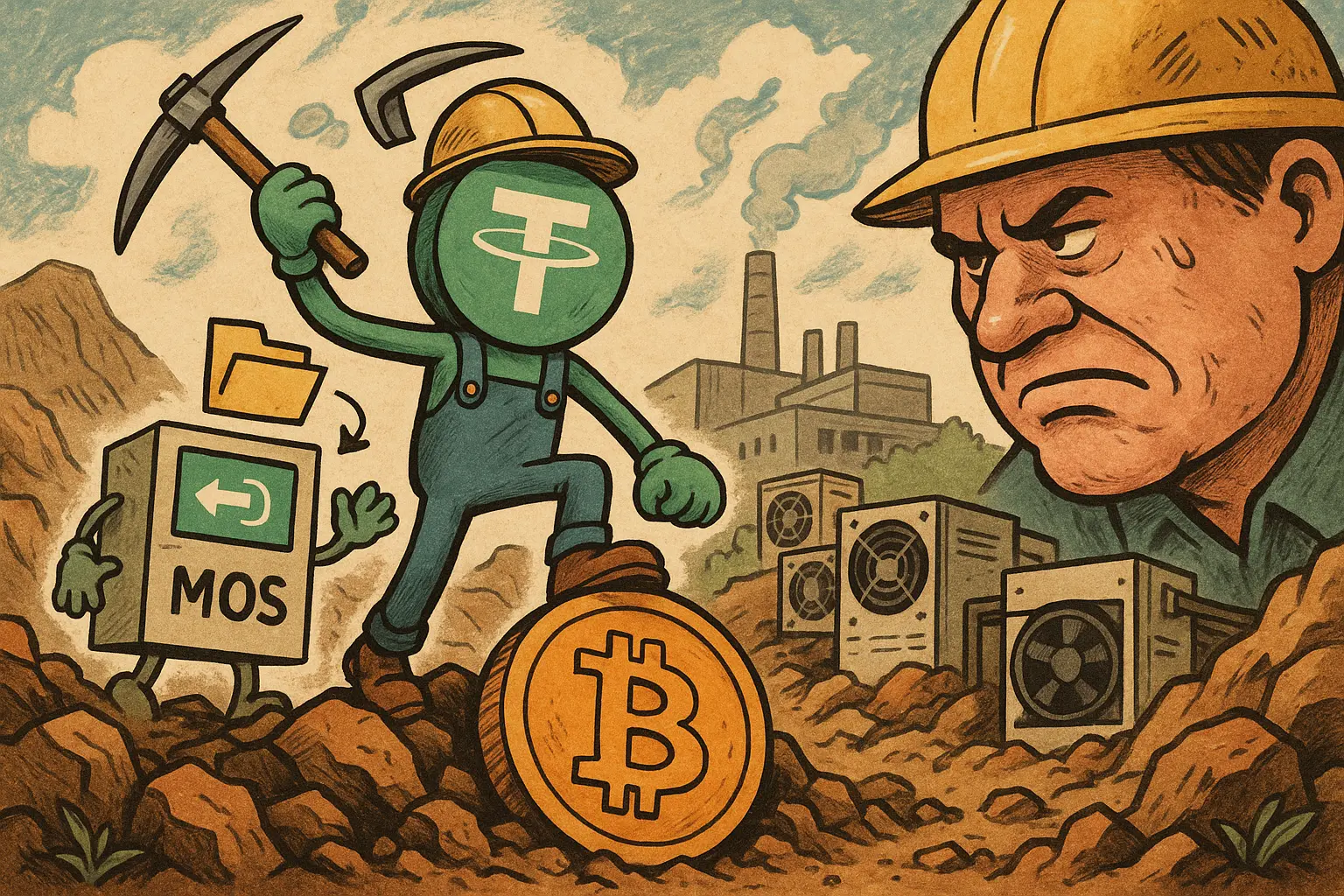
Tether announces open source Bitcoin mining system MOS, released at the El Salvador Plan ₿ Forum. The system offers end-to-end visibility across mining farms, unifying hardware, energy, and data management. CEO Paolo Ardoino states it makes mining more open and modular. Simultaneously, the Mining SDK toolkit is also released.
Tether: From Stablecoin Dominance to Mining Disruptor
Digital asset giant Tether today announced the open sourcing of its Bitcoin mining operating system (MOS). MOS is an operating system designed to manage, monitor, and automate Bitcoin mining operations at scale. It provides end-to-end visibility across mining sites, integrating hardware, energy, infrastructure, and operational data into a unified system. The open source release of MOS was officially announced at the 2026 Plan ₿ Forum in El Salvador.
Tether, known as the issuer of the world’s largest stablecoin USDT with a market cap exceeding $120 billion, accounting for about 70% of the stablecoin market, is making a significant expansion into the Bitcoin mining sector. Transitioning from a pure stablecoin issuer to a provider of mining infrastructure technology, this cross-industry move is extremely rare in the crypto world. Traditionally, stablecoin companies focus on financial services, while mining is a completely different, highly technical industry.
Tether’s timing to enter the mining space is no coincidence. The Bitcoin mining industry faces multiple challenges: rising energy costs, increasing hashrate competition, regulatory pressures, and growing complexity in managing mining equipment. Existing mining management software is mostly closed-source and expensive, making enterprise solutions unaffordable for small and medium-sized farms. Tether aims to address this pain point by offering open-source, free solutions, attempting to reshape industry cost structures and technical barriers.
A deeper strategic consideration may be that Tether hopes to strengthen its influence within the Bitcoin ecosystem through deep involvement in mining. As the largest stablecoin issuer, Tether’s business heavily depends on the prosperity of Bitcoin and the crypto market. By providing mining infrastructure, Tether can establish direct relationships with miners, who are the backbone of Bitcoin network security. This vertical integration strategy could elevate Tether’s strategic position across the entire crypto ecosystem.
MOS Unifies Hardware, Energy, and Data Management
Bitcoin mining relies on a complex array of components: machines, power systems, containers, and physical infrastructure. MOS aims to coordinate these operational elements, treating each as a controllable unit within the same operational layer. The system not only monitors hashrate but also tracks energy consumption, equipment health, and site-level infrastructure, enabling operators to manage the mining environment holistically rather than through fragmented software stacks.
Traditional mining farms often use multiple independent software: one for monitoring hash rates, another for energy consumption, a third for cooling systems, and a fourth for fault alerts. This decentralization creates information silos, making it difficult for operators to get a comprehensive view. When a machine fails, operators may need to cross-check multiple systems to identify the root cause. MOS’s core innovation is integrating all these functions into a single operational layer, providing a unified control panel.
The MOS operating system is designed to be scalable, flexible, and modular, supporting deployments from small setups to large industrial facilities. It can run on lightweight hardware for small operations or scale to monitor and manage hundreds of thousands of mining devices across entire sites. This flexible design allows both home miners and large farms to use the same system with only configuration adjustments.
Five Modules of MOS Unified Management
Hashrate Monitoring: Real-time tracking of each miner’s hash rate, rejection rate, and efficiency
Energy Management: Monitoring power consumption, cost analysis, and energy optimization
Hardware Health: Automated diagnostics of temperature, fan speeds, and chip status
Infrastructure: Centralized control of cooling, networking, and physical security
Data Analytics: Historical data tracking, predictive maintenance, and profitability analysis
The value of this unified management lies in decision-making efficiency. When operators can view all key metrics from a single interface, they can quickly identify issues and respond. For example, if multiple miners in a zone overheat simultaneously, MOS can immediately indicate whether it’s a cooling system failure or power supply problem, and automatically trigger corrective actions.
Mining SDK Lowers Developer Barriers
In addition to MOS, Tether has released the Mining SDK, which is built on the MOS framework. The SDK will be finalized and released in collaboration with the open-source community over the coming months. The Mining SDK is a modular toolkit that allows developers to build mining software without starting from scratch for device integration or operation protocols. It includes ready-to-use worker nodes, simple APIs, and a UI toolkit, enabling rapid development and deployment of dashboards and internal tools.
The strategic importance of the Mining SDK is to foster a developer ecosystem. By providing standardized development tools, Tether lowers the barrier for third-party developers to participate in Bitcoin mining software development. This could lead to an ecosystem of applications around MOS, including specialized monitoring tools, automation scripts, and data analysis plugins. This open approach is similar to Android’s impact on mobile OS, attracting developers through open source and ultimately establishing standards and an ecosystem moat.
Ready-to-use worker nodes are a key component of the SDK. These nodes handle communication with miners, receive mining tasks, and submit results. Traditionally, developing these functions requires deep understanding of mining protocols (like Stratum) and specific communication interfaces of various miners. The SDK encapsulates this complexity, allowing developers to implement functions via standard APIs.
The simple API makes it accessible even for non-experts. For example, a developer focused on energy management can use the SDK’s API to access farm energy data without understanding mining protocols. This abstraction significantly broadens the potential developer base. The UI toolkit further simplifies interface development, enabling quick creation of professional monitoring dashboards.
Tether CEO Paolo Ardoino states: “Our Bitcoin mining operating system MOS aims to make Bitcoin mining infrastructure more open, modular, and accessible. MOS is a mature operating system for mining operators, and its Mining SDK is also released as open source, to promote collaboration and ecosystem development.” This statement reveals Tether’s dual strategy: MOS serves direct users (mining farms), while the Mining SDK builds a developer ecosystem.
Can Open Source Disrupt Closed Mining Ecosystems?
Tether has already opened official documentation and invited developers to join the community. Its open source approach is highly disruptive in the Bitcoin mining industry. Currently, the market is dominated by a few giants like Bitmain and MicroBT, who control both hardware and management software. These software solutions are typically closed-source and tightly integrated with their own hardware. Small and medium farms often have to buy specific branded solutions or pay high licensing fees for third-party management software.
MOS’s open source model breaks this closed ecosystem. Any farm can freely download and deploy MOS, regardless of hardware brand. This device-neutrality is a key advantage, allowing operators to mix different brands of miners with a unified management interface. Open source also enables community auditing, vulnerability discovery, and contribution, which is highly attractive in the security-sensitive mining industry.
However, Tether’s open source strategy also faces challenges. First, competition with established giants like Bitmain, which have large customer bases and mature support systems. MOS must demonstrate stability and functionality comparable to commercial software. Second, cultivating a developer ecosystem depends on attracting enough contributors; without sufficient community engagement, the project risks stagnation. Third, the business model for monetizing free open source software remains uncertain—Tether may plan to generate revenue through paid support, cloud hosting, or advanced features.
From a broader perspective, Tether’s move into Bitcoin mining reflects its deepening ties to the Bitcoin ecosystem. USDT’s value depends on liquidity and trust in the crypto market, and Bitcoin’s network security and decentralization directly impact the industry. Supporting mining infrastructure helps solidify the foundation supporting Tether’s core business. This strategic investment demonstrates Tether’s confidence and commitment to the long-term prospects of the crypto industry.


