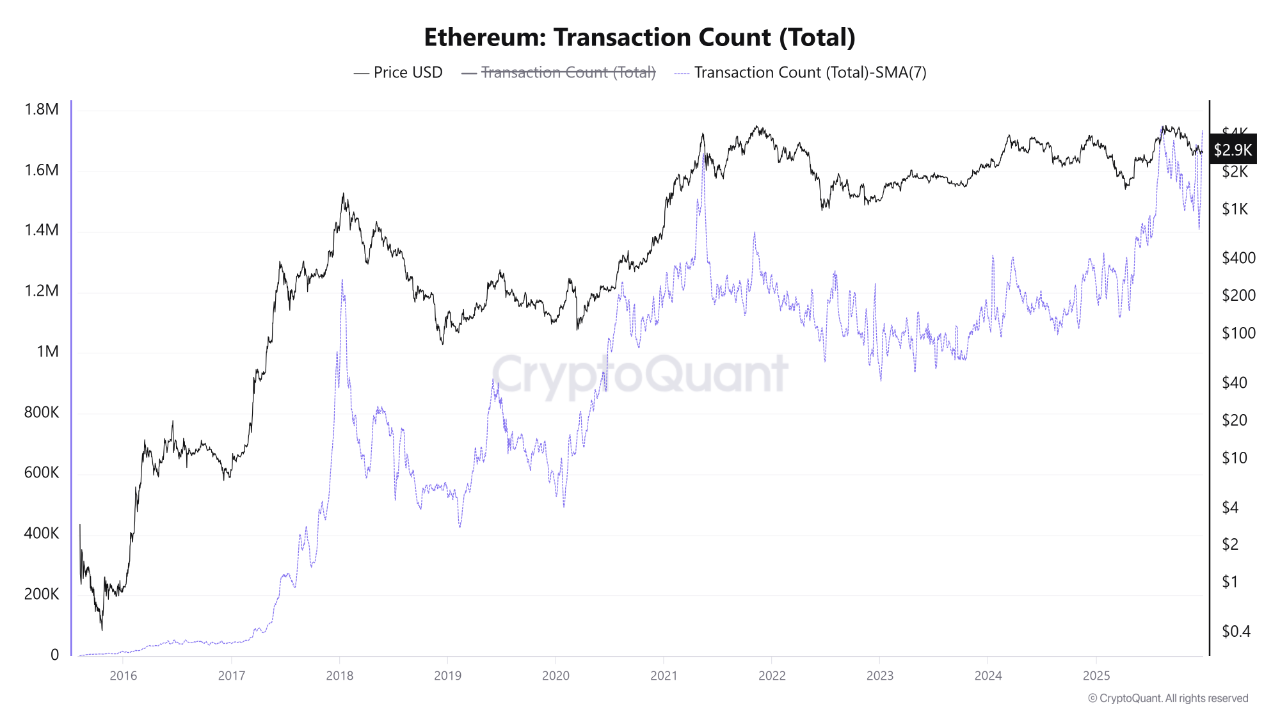
Ethereum (ETH) records the highest on-chain usage in history on 24/12/2025, while prices remain fluctuating around the $3,000 mark and have yet to return to recent highs.
The gap between record network demand and subdued price movements is sparking debates about whether Ethereum’s fundamentals are quietly improving, despite short-term market conditions still suppressing the price.
Record-breaking transactions reflect increasing usage demand
According to data shared by CryptoOnchain, the 7-day average number of transactions on Ethereum has risen to approximately 1.73 million, the highest in the network’s history. At the same time, ETH is trading around $2,950, significantly lower than the peaks of 2021 and 2025, indicating a clear disconnect between usage levels and valuation.
Analysts suggest that this activity increase results from multiple factors, including continuous Layer-2 networks settling transactions back to Ethereum, a thriving DeFi sector, and stablecoin flows. Notably, unlike previous cycles, this growth has not led to a spike in transaction fees, indicating the network is handling high demand more efficiently.
On-chain data at the end of December also supports this view. Previously, CoinPhoton reported that large wallets continued accumulating ETH, with wallets holding between 10,000 and 100,000 ETH increasing their total holdings to over 21 million ETH. Meanwhile, ETH on exchanges has decreased by more than 4 million ETH over the past year, reflecting a decline in liquid supply.
However, not all short-term signals are positive. According to an update from analyst Amr Taha on 12/25, about $1.4 billion worth of ETH was deposited into major exchanges like Kraken and Binance within just 48 hours. This influx follows significant USDT withdrawals from centralized exchanges, a pattern often seen during market sell-offs or defensive phases.
Price remains range-bound around $3,000, liquidity pressures persist
In the market, ETH is trading just below the $3,000 level, up less than 1% in the past 24 hours and nearly flat over the past week. Over a longer timeframe, the correction is more pronounced, with ETH down nearly 9% in two weeks and about 14% compared to the same period last year.
Trading data shows ETH fluctuating within a narrow range of $2,900–$3,000, with lower volatility than at the start of the quarter. Nonetheless, analysts are particularly watching the $3,100 level, which has repeatedly acted as resistance in recent years. A sustained breakout above this zone could reopen higher targets, while losing current support would keep downside risks in focus.
Despite short-term pressures, the increasing transaction load on Ethereum has significant long-term implications. Higher network activity means more ETH is burned via the EIP-1559 mechanism, slowing the supply growth rate. Additionally, as Ethereum remains the dominant platform holding most of the DeFi value and issuing stablecoins, the mismatch between network demand and market price continues to become more noticeable.
Currently, the second-largest crypto by market cap is in a fragile balance: underlying fundamentals continue to strengthen beneath, while liquidity conditions and exchange flows still dominate the price direction in the coming weeks.
Vương Tiễn
Disclaimer: The information on this page may come from third parties and does not represent the views or opinions of Gate. The content displayed on this page is for reference only and does not constitute any financial, investment, or legal advice. Gate does not guarantee the accuracy or completeness of the information and shall not be liable for any losses arising from the use of this information. Virtual asset investments carry high risks and are subject to significant price volatility. You may lose all of your invested principal. Please fully understand the relevant risks and make prudent decisions based on your own financial situation and risk tolerance. For details, please refer to
Disclaimer.
Related Articles
Ethereum Network Activity Surges As Active Addresses Hit Multi Month High
Ethereum’s growing volumes of on-chain activity suggest that investor sentiment may be shifting or increasing. Additionally, there have been many conversations regarding how ETF inflows increase the volatility of asset prices, or how their volatility affects investor sentiment. However, Ethereum’s o
BlockChainReporter1h ago
Ethereum Approaches Cycle Low as Bitmain Indicates Violent Belief
The article explores Ethereum's potential market bottom, highlighting its correlation with past S&P 500 trends and significant institutional investment by Bitmain. Despite mixed market sentiment, historical patterns suggest possible recovery.
CryptoBreaking2h ago
Ethereum poised for 25% rally as top ETH whales return to profitability
Ethereum’s native token, Ether (ETH), may push higher in the coming months as the market’s richest whale cohort returns to profitability for the first time since early February. Fresh on-chain signals point to a potential bottoming process that could set the stage for a renewed rally, though
CryptoBreaking2h ago
US Bitcoin Spot ETF Attracts Inflows for Seven Consecutive Days, Institutional Funds Return
Recent inflows into U.S. cryptocurrency spot ETFs have warmed, particularly with Bitcoin and Ethereum ETFs recording net inflows over multiple consecutive days, indicating increased investor allocation appetite. Bitcoin ETF recorded approximately $199.4 million in net inflows on the 17th, marking the longest consecutive inflow streak in five months, with capital primarily flowing to major issuers such as BlackRock and Fidelity. This wave of reflux is mutually reinforcing with Bitcoin price appreciation, reflecting the market's preference among traditional capital for allocation to regulated products, providing stable support to spot prices.
区块客4h ago


