The Planck Network has emerged as a blockchain-powered ecosystem delivering enterprise-grade GPU compute resources and AI model services through its native $PLANCK token—a BEP-20 utility asset designed exclusively for on-chain payments, staking, governance, and fee participation. Built on the BNB Chain, Planck Network enables users to access high-performance AI training, inference, and deployment via the GPU Console and AI Studio, all settled in $PLANCK without equity or ownership claims.
This utility-first model aligns with global crypto-asset regulations (EU 2023/1114), emphasizing transparency and ecosystem governance while powering the next wave of decentralized AI infrastructure. For developers and enterprises searching for scalable, blockchain-native compute, Planck Network and $PLANCK represent a compliant, high-utility solution in the evolving DeFi-meets-AI landscape.
What Is Planck Network and the $PLANCK Token?
Planck Network is a decentralized platform that tokenizes access to premium GPU infrastructure, allowing users to pay for AI model training, fine-tuning, inference, and deployment using the $PLANCK utility token. Issued as a BEP-20 standard asset on BNB Chain, $PLANCK functions purely within the ecosystem—no dividends, equity, or off-chain obligations—ensuring full compliance with securities and crypto-asset laws. The network operates across Planck₀ (core protocol) and Planck₁ (execution layer), where stakers secure operations and earn rewards from network fees. Governance is fully on-chain: $PLANCK holders vote on upgrades, pricing, and resource allocation via smart contract proposals. Planck Network Cyprus Ltd explicitly disclaims any liability or value-stabilization duties, reinforcing $PLANCK’s role as a pure utility token for compute access.
- Token Standard: BEP-20 on BNB Chain, fully transferable and wallet-compatible.
- No Equity Rights: Holders gain no ownership, profit share, or claims against Planck Network Cyprus Ltd.
- Ecosystem Exclusivity: $PLANCK required for all GPU Console and AI Studio transactions.
- Regulatory Clarity: Classified as a crypto-asset (not EMT or ART) under EU Regulation 2023/1114.
- Whitepaper Mandate: Users must review full risk disclosures before acquiring $PLANCK.
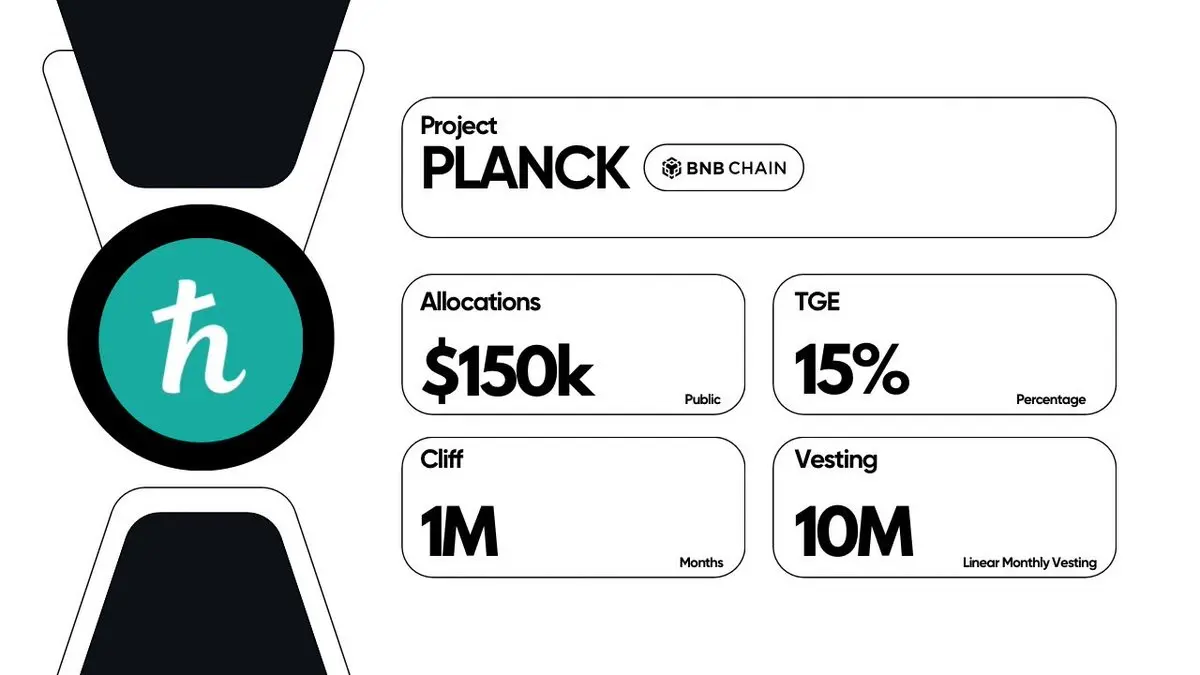
(Sources: Planck website)
Why Planck Network and $PLANCK Matter in AI and Blockchain Trends
In 2025, Planck Network and $PLANCK address the exploding demand for decentralized GPU compute as AI models grow more resource-intensive, offering a transparent alternative to centralized hyperscalers with locked-in pricing and data policies. With AI inference costs rising 40% YoY, blockchain-based utility tokens like $PLANCK enable predictable, on-chain pricing—per hour of GPU, per training job—while distributing fees to stakers and validators. This model supports privacy-preserving AI workflows, cross-border developer access, and censorship-resistant compute, critical in regulated environments. As decentralized physical infrastructure networks (DePIN) gain traction, Planck Network positions $PLANCK as a leader in the AI + blockchain convergence, rewarding participation without speculative hype.
- Cost Efficiency: Pay-as-you-go GPU access avoids long-term cloud contracts.
- Global Accessibility: Any wallet holder can deploy models, no KYC for token use.
- Fee Redistribution: Stakers earn from ecosystem revenue—training, inference, deployment.
- Governance Power: Direct voting on AI resource allocation and protocol upgrades.
- DePIN Leadership: Joins top decentralized compute networks with Tier-1/Tier-3 data center backing.
How Planck Network and $PLANCK Token Work
Planck Network operates through a dual-layer architecture: Planck₀ handles staking, governance, and fee settlement, while Planck₁ executes GPU tasks via distributed nodes in enterprise data centers. Users connect compatible wallets (e.g., MetaMask, Trust Wallet) to the GPU Console or AI Studio, select tasks—train a Llama variant, run inference at scale—and pay in $PLANCK based on real-time pricing schedules. Stakers lock $PLANCK to validate blocks and secure GPU operator commitments, earning rewards in $PLANCK from network fees. Governance proposals—such as adding new GPU types or adjusting inference rates—are submitted and voted on-chain, with results enforced via smart contracts. All operations are auditable, with Planck Network publishing usage metrics and validator performance publicly.
- Payment Flow: Select task → view $PLANCK cost → approve wallet transaction → job queued.
- Staking Rewards: Lock $PLANCK → validate Planck₀ → earn fees + protocol incentives.
- Governance Process: Submit proposal → community vote → auto-execute via smart contract.
- Infrastructure: Tier-1/Tier-3 data centers ensure 99.9% uptime, comparable to AWS/GCP.
- Transferability: $PLANCK moves freely between wallets; ecosystem use requires network compliance.
Real-World Applications and Future of Planck Network and $PLANCK
Planck Network enables practical AI development: a startup fine-tunes a vision model using 100 GPU hours paid in $PLANCK, deploys via AI Studio, and stakes earnings to reduce future costs. Enterprises run private inference on sensitive data with full transaction transparency on BNB Chain, while independent GPU operators join as validators to monetize idle hardware. Looking to 2026, Planck Network plans Layer 2 scaling, zk-proof inference, and cross-chain $PLANCK bridges, expanding to Ethereum and Solana. As AI agents and autonomous workflows proliferate, $PLANCK could become the default settlement layer for on-chain AI economies. Developers are encouraged to test via public testnets and review the full whitepaper—especially Section I on risks—before engaging.
- Startup Use Case: Train custom NLP model for $0.80/GPU-hour, paid in $PLANCK.
- Enterprise Privacy: Run HIPAA-compliant inference with on-chain audit trail.
- GPU Operator Income: Earn 15–25% APY staking + fee share via Planck₁ validation.
- Roadmap Milestones: Q1 2026—zk-inference; Q3—multi-chain $PLANCK.
- Ecosystem Growth: 50+ AI Studio templates, 10K+ monthly active wallets projected.
In summary, Planck Network and the $PLANCK token deliver a compliant, scalable bridge between blockchain utility and enterprise AI compute, with clear governance, staking, and payment mechanics—all without equity promises. This positions $PLANCK as a cornerstone of decentralized AI infrastructure in 2025 and beyond. To get started, connect a BEP-20 wallet to the GPU Console, review the official whitepaper (especially risk sections), or monitor on-chain governance for upcoming votes—essential steps for anyone building or using AI on blockchain.
Disclaimer: The information on this page may come from third parties and does not represent the views or opinions of Gate. The content displayed on this page is for reference only and does not constitute any financial, investment, or legal advice. Gate does not guarantee the accuracy or completeness of the information and shall not be liable for any losses arising from the use of this information. Virtual asset investments carry high risks and are subject to significant price volatility. You may lose all of your invested principal. Please fully understand the relevant risks and make prudent decisions based on your own financial situation and risk tolerance. For details, please refer to
Disclaimer.
Related Articles
Price predictions 3/25: BTC, ETH, BNB, XRP, SOL, DOGE, HYPE, ADA, BCH, LINK
Bitcoin (BTC) continues to face significant resistance at the $72,000 level, but the bulls have kept up the pressure. Trader Daan Crypto Trades said in a post on X that BTC will have to cross and stay above the $72,000 resistance area to “test the $80Ks again.”
Markets tend to hate uncertainty, but
Cointelegraph10h ago
BNB Chain Launches BNBAgent SDK, the First Live Implementation of ERC-8183 for Trustless Onchain AI Agents
[PRESS RELEASE – Dubai, UAE, March 18th, 2026]
BNB Chain today announced the launch of BNBAgent SDK, the first live implementation of ERC-8183 and a complete developer framework enabling trustless onchain AI workflows. The release represents a major step forward in building the infrastructure
CryptoPotato10h ago
Crypto Price Analysis March 27: ETH, XRP, ADA, BNB, and HYPE
This Friday, we examine Ethereum, Ripple, Cardano, Binance Coin, and Hyperliquid in greater detail.
Ethereum (ETH)
--------------
Ethereum is down 4% this week after sellers held strong at the $2,400 resistance and even tested the $2,000 support. Another push, and they could break this key
CryptoPotato14h ago
Gold prices plummeted by 20%, yet did giant whales seize the opportunity to buy? Significant accumulation of XAUT and the expansion of BNB Chain release key signals.
Despite the international gold price retreating, on-chain funds continue to flow into tokenized gold. Multiple whale addresses have purchased Tether Gold, indicating a medium to long-term holding signal. Macroeconomic factors influence gold price fluctuations, but Tether is promoting the expansion of XAUT to the BNB Chain, enhancing liquidity. The market size is growing rapidly, and analysts are optimistic that the gold price may rise again.
GateNews18h ago


