According to the latest data released by SoSoValue, the total net inflow of Bitcoin ETF reached 477 million USD in a single day, with a cumulative inflow of 61.98 billion USD. The total assets under management of all Bitcoin ETFs reached 151.58 billion USD, accounting for 6.86% of Bitcoin's market capitalization. BlackRock's IBIT leads with 210.9 million USD, with a cumulative inflow of 65.09 billion USD.
Bitcoin ETF single-day 477 million USD, institutional buying continues to surge
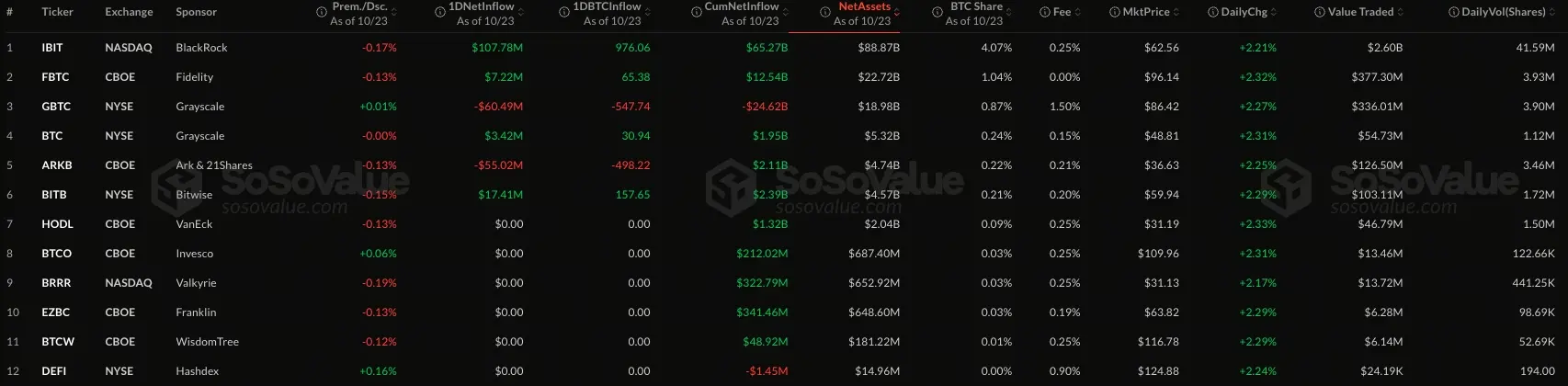
(Source: SoSoValue)
According to the recent market update on Bitcoin ETFs released by SoSoValue, the total net inflow for a single day reached 477 million USD, with a cumulative inflow of 61.98 billion USD. This single-day inflow figure is among the higher levels in recent weeks, indicating that institutional investors' interest in Bitcoin ETFs remains strong. The 477 million USD single-day inflow is equivalent to about 4,300 Bitcoins (based on 110,000 USD per Bitcoin), and such a scale of buying has a substantial impact on the market supply and demand structure.
The total assets under management of all Bitcoin ETFs reached $151.58 billion, accounting for 6.86% of Bitcoin's market capitalization. This proportion is of great strategic significance, as it means that for every $15 in the Bitcoin market, about $1 is held through ETFs. This structural buying pressure provides strong support for the Bitcoin price, as ETF investors are typically long-term holders and are unlikely to sell due to short-term fluctuations.
The trading volume remains high, reaching 7.41 billion dollars. This trading volume indicates that the Bitcoin ETF has attracted not only institutional investors who buy and hold, but also a large number of day traders participating. The high trading volume provides sufficient liquidity for the ETF, allowing large buy and sell orders to be executed without significantly affecting the price.
A cumulative inflow of $61.98 billion is a milestone figure. Since the approval of the Bitcoin spot ETF in January 2024, it has attracted over $60 billion in new funds in less than two years. This pace of capital inflow is extremely rare in ETF history, demonstrating the strong demand from institutional and retail investors for Bitcoin as an asset class.
More importantly, the cumulative inflow of $61.98 billion does not include the price appreciation component. The difference between the total assets under management of $151.58 billion and the cumulative inflow of $61.98 billion is approximately $89.6 billion, which represents the paper gains brought to ETF holders by the rise in Bitcoin prices. This investment return further attracts new capital into the market, creating a positive cycle.
BlackRock IBIT 210 million USD leads with a total of 65.09 billion dominating
Deeper data shows that BlackRock's IBIT recorded the largest single-day inflow of $210.9 million, with a total inflow reaching $65.09 billion. As the world's largest asset management company, BlackRock's IBIT product has dominated the Bitcoin ETF market since its launch. The single-day inflow of $210.9 million accounts for 44% of the total inflow of $477 million, demonstrating BlackRock's brand and distribution network advantages.
A cumulative inflow of 65.09 billion USD means that IBIT alone attracted 105% of the total inflow of Bitcoin ETFs (650.9/619.8). This ratio exceeding 100% is due to other ETFs (especially Grayscale's GBTC) experiencing net outflows. BlackRock not only absorbed new capital but also took on funds flowing out from other ETFs, highlighting its absolute dominant position in the market.
Fidelity's FBTC follows closely with a new inflow of $34.15 million and a cumulative growth of $12.59 billion. As the second largest asset management company in the United States, Fidelity's FBTC product is a major competitor to BlackRock's IBIT. Although the cumulative inflow of $12.59 billion is far lower than BlackRock's, it is still an impressive achievement that demonstrates Fidelity's brand appeal among traditional investors.
ARKB from Ark & 21Shares has added $162.85 million, making it one of the strongest performers in terms of inflows among small funds. ARK Invest, led by renowned investor Cathie Wood, is known for its bets on disruptive innovation. The single-day inflow of $162.85 million indicates that its clientele is very optimistic about the long-term prospects of Bitcoin. Bitwise's BITB recorded a net inflow of $20.08 million, while VanEck's HODL increased by $17.41 million.
Main Bitcoin ETF Daily Inflow Ranking:
BlackRock IBIT: 210.9 million USD (cumulative 65.09 billion USD)
Ark ARKB: $162.85 million (the strongest performer among small funds)
Fidelity FBTC: 34.15 million USD (cumulative 12.59 billion USD)
Bitwise BITB: 20 million dollars
VanEck HODL: 17.41 million USD
Grayscale's GBTC saw no new inflows, with a cumulative net outflow remaining at $24.5 billion. The continued outflow of GBTC is a unique phenomenon in the Bitcoin ETF market. As the earliest Bitcoin trust product, GBTC held a monopoly position before the approval of spot ETFs, but its management fee of up to 1.5% far exceeded the 0.2% to 0.25% of new ETFs. This fee disadvantage has led to significant capital flowing out of GBTC and into lower-cost products, particularly BlackRock's IBIT.
The contradiction between the market price drop and stable trading volume
The market prices of ETFs have generally fallen, with a decline ranging from 3.39% to 3.57%, indicating an overall downturn in the market. The market price of IBIT closed at 61.29 dollars, down 3.47%; while FBTC closed at 94.14 dollars, with a decline of 3.50%. This price drop, in contradiction to the influx of funds, is worth analyzing in depth.
Typically, when there is a significant inflow of funds into an ETF, the price should rise. However, on that day, Bitcoin ETF prices generally fell by about 3.5%, reflecting an overall correction in the Bitcoin spot price. The price of Bitcoin ETFs closely tracks the Bitcoin spot price, and when the spot market is under pressure, ETF prices will also decline in sync, even if there is an inflow of funds that cannot fully offset it.
This situation illustrates two points. First, the inflow of $477 million, while considerable, has limited impact relative to the $151.58 billion in managed assets and the $7.41 billion in daily trading volume. Second, the selling pressure that day may have come from the spot market or redemptions of other ETFs, offsetting the impact of new buying. This dynamic shows that the Bitcoin ETF market has reached a certain scale, and single-day inflows can no longer solely dictate price direction.
Overall, ETF trading volume remains stable, with IBIT trading volume reaching 65.66 million shares and GBTC trading volume amounting to 697.16 million USD. Although funds continue to flow out of GBTC, the trading volume remains substantial, which may reflect the process of large positions being converted from GBTC to other ETFs. This conversion requires selling GBTC first and then buying other ETFs, therefore the high trading volume of GBTC is consistent with its capital outflow.
The trading volume of IBIT at 65.66 million shares is approximately 4.02 billion dollars calculated at 61.29 dollars, accounting for 54% of the total trading volume of 7.41 billion dollars that day. This further proves that BlackRock's dominance in the Bitcoin ETF market is reflected not only in capital inflows but also in liquidity and trading activity. High liquidity makes IBIT the preferred choice for institutional investors as they can execute large trades without significantly impacting the price.
6.86% market capitalization significance of the strategy
The total assets under management of all Bitcoin ETFs reached $151.58 billion, accounting for 6.86% of Bitcoin's market capitalization. Although this proportion may seem low, its strategic significance is extremely substantial. First of all, this 6.86% of Bitcoin is locked up by institutions for the long term and will not easily enter market circulation. ETF holders are usually long-term investors such as pension funds, insurance companies, and family offices, with holding periods measured in years.
Secondly, a 6.86% share means that the pricing power of the Bitcoin market is shifting from crypto-native traders to traditional financial institutions. When Wall Street controls nearly 7% of the supply, their influence on prices significantly increases. This structural change enhances the correlation of Bitcoin prices with traditional financial markets, making macroeconomic factors such as interest rates, inflation, and the dollar exchange rate have a more direct impact on Bitcoin.
Third, the share of 6.86% is still growing rapidly. If the current inflow rate continues, Bitcoin ETF may reach a 10% market capitalization share by the end of 2026. Once it breaks through 10%, the ETF will become a dominant force in the Bitcoin market that cannot be ignored, and its capital flow direction will directly determine the mid-term trend of Bitcoin.
For Bitcoin price predictions, monitoring the fund flows of Bitcoin ETFs has become one of the most important leading indicators. Continuous large inflows over several days often signal an impending price breakout, while sustained outflows may trigger a deep correction. An inflow of $477 million on that day is a positive signal; if this inflow trend continues, Bitcoin may challenge its historical high again in the short term.


