The price of Pi Network (PI) is currently in a dangerous sideways consolidation phase after experiencing a historic low at the end of September. Technical analysis shows that several key indicators have turned red, including a continuous decline in ATR, the formation of effective resistance at the 20-day EMA, and shrinking volume, all of which suggest that a new round of falls may be imminent. If the key support level of $0.2565 is broken, the price of PI may once again test the historic low of $0.1842, and investors should closely monitor this dangerous signal.
Pi Network coin price is trapped in a dangerous Sideways, Technical Analysis indicators have fully turned bearish

(Source: Trading View)
Since hitting a historical low of $0.1842 on September 22, the native token of Pi Network, PI, has been struggling within a narrow sideways channel, with the upper boundary at the resistance level of $0.2917 and the lower boundary at the support level of $0.2565. This sideways consolidation is typically viewed as a market decision phase, and the current technical indicator combination shows that sellers are gradually taking control.
The Average True Range (ATR) is an important indicator of market volatility. The ATR of PI has been steadily declining since the sideways consolidation began on September 23, and as of the time of writing, it has dropped to 0.0234, hitting a recent low.
The continuous decline of ATR reflects two key market signals:
Trader participation has significantly decreased: Investor interest in PI is waning, and new capital inflow is scarce.
Volatility narrowing: This situation is often a “calm period” before significant fluctuations in the cryptocurrency market, and the current technical analysis leans towards a downward trend.
Market analysts point out that a decline in ATR, in the absence of positive catalysts, typically signals that prices will break through in the direction of the prevailing trend, which is clearly downward for PI.
20-day EMA forms effective resistance: Sellers control the situation
(Source: Trading View)
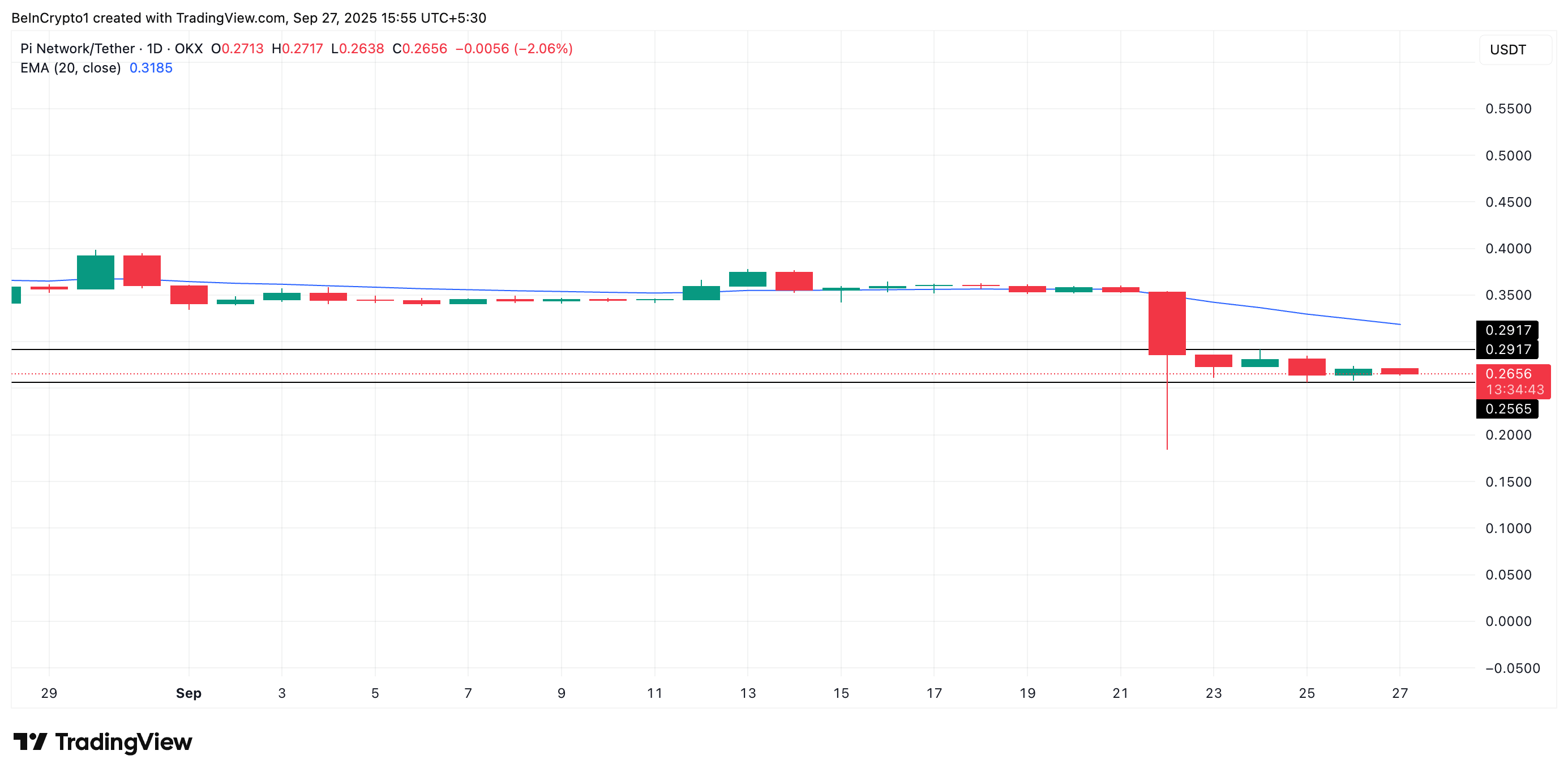
The current trading price of PI is solidly below the 20-day Exponential Moving Average (EMA), which is a key technical indicator located at $0.3185, forming a dynamic resistance.
The 20-day EMA is an important indicator of short-term trends. When the price continues to trade below this moving average, it indicates:
Sellers control the market: Selling pressure dominates in the short term.
Lack of Upside Momentum: Any rebound may encounter resistance when approaching or reaching this moving average.
Trend Confirmation: The downward trend is confirmed by Technical Analysis.
It is noteworthy that PI has attempted multiple times to break through this moving average in the past two weeks, but all have ended in failure, further reinforcing the effectiveness of this technical resistance.
Key support level 0.2565 USD facing test
(Source: Trading View)
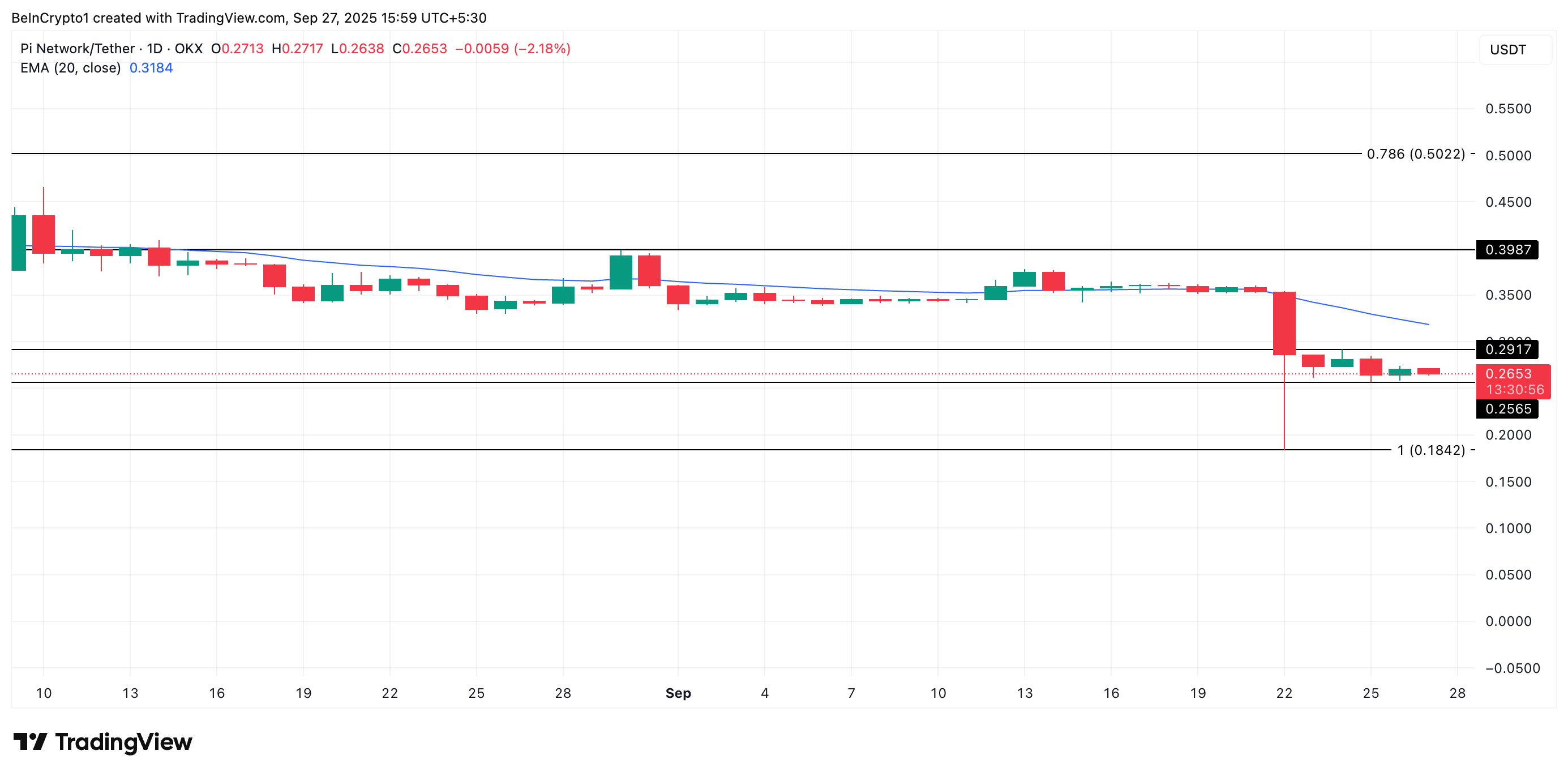
The current price structure of PI shows that the support level of $0.2565 is crucial. This level has been tested multiple times since September 23 but has not been breached, forming a short-term bottom. However, as technical indicators turn bearish, this support level is facing increasing pressure.
Technical analysts predict that if PI falls below the support level of 0.2565 USD, it may trigger a new wave of selling, and the price could swiftly retreat to the historical low of 0.1842 USD established on September 22. In the worst-case scenario, if market sentiment deteriorates further, PI could even set a new historical low.
Potential Reversal Signals: Key Levels Investors Should Follow
Although the current technical analysis is leaning bearish, investors should still follow potential reversal signals. If PI can break through the resistance level of $0.2919 and hold above that level, it may indicate a shift in the short-term trend.
More importantly, if the PI can regain the 20-day EMA (0.3185 USD), it will be a stronger bullish signal that could trigger a larger-scale rebound.
Disclaimer: The information on this page may come from third parties and does not represent the views or opinions of Gate. The content displayed on this page is for reference only and does not constitute any financial, investment, or legal advice. Gate does not guarantee the accuracy or completeness of the information and shall not be liable for any losses arising from the use of this information. Virtual asset investments carry high risks and are subject to significant price volatility. You may lose all of your invested principal. Please fully understand the relevant risks and make prudent decisions based on your own financial situation and risk tolerance. For details, please refer to
Disclaimer.
Related Articles
Pi Network V23 Upgrade to Launch Smart Contracts, DApp Ecosystem, and DEX Next Month
Pi Network will launch its V23 upgrade next month, featuring smart contracts, a DApp ecosystem, and a decentralized exchange. With over 18 million KYC-verified users, this upgrade moves Pi towards practical applications and utility in its ecosystem.
GateNews14h ago
Pi Network Agreement 23 Targets the Institutional Market, Smart Contracts, and RWA Tokenization to Launch in Early May
Pi Network officially went live with Protocol 23 on May 18, bringing smart contracts, real-world asset tokenization, and the AI App Studio, enabling Pi to transform from a payment token into a programmable blockchain infrastructure. The protocol covers four major functions, similar to Ethereum, and is expected to attract institutional investors. The upgraded node milestones signal market confidence and may affect Pi’s price performance.
MarketWhisper04-15 03:02
Pi Network 18 million users complete KYC, and 26.5 million PI are issued to verifiers
Pi Network distributes 26.5 million PI tokens to more than 1 million community members who have completed KYC verification, to accelerate user identity verification and strengthen the decentralized model. 18 million already-verified users have laid the groundwork for the ecosystem’s development, but the key lies in how to convert these users into active participants. With the protocol upgrade, Pi Network is moving toward the open network phase, and smart contract support signals richer application scenarios.
MarketWhisper04-14 05:07
Pi Network price hits a new 7-week low as a wave of 60 million token unlocks comes in
Pi Network's native token PI fell to $0.165 in April, hitting a 7-week low and leaving market sentiment weak. The unlock peak will release more than 60 million PI, adding downward pressure. Despite the core team recently publishing technical updates, it failed to improve market confidence and instead drew community criticism due to KYC access issues and the ongoing slide in price. Increased future supply could further drive prices lower.
MarketWhisper04-14 02:50
Pi Network Distributes 26.5M PI to 1M KYC Validators
Pi Network has taken another step forward in building its ecosystem. The project recently distributed 26.5 million PI tokens to more than 1 million KYC validators.
These rewards were given to users who helped verify identities on the network. This process is important. Because it ensures that
Coinfomania04-13 13:30


