On July 21, Jito Labs announced a proposal to build the Block Assembly Marketplace (BAM) – a new transaction ordering system that allows developers to deploy a central order book (CLOB), perpetual exchange, and dark pool on Solana without changing the underlying protocol. Jito proposes the block market to turn Solana into a “decentralized Nasdaq.”
BAM System: Maintaining Privacy, Ensuring Auditability
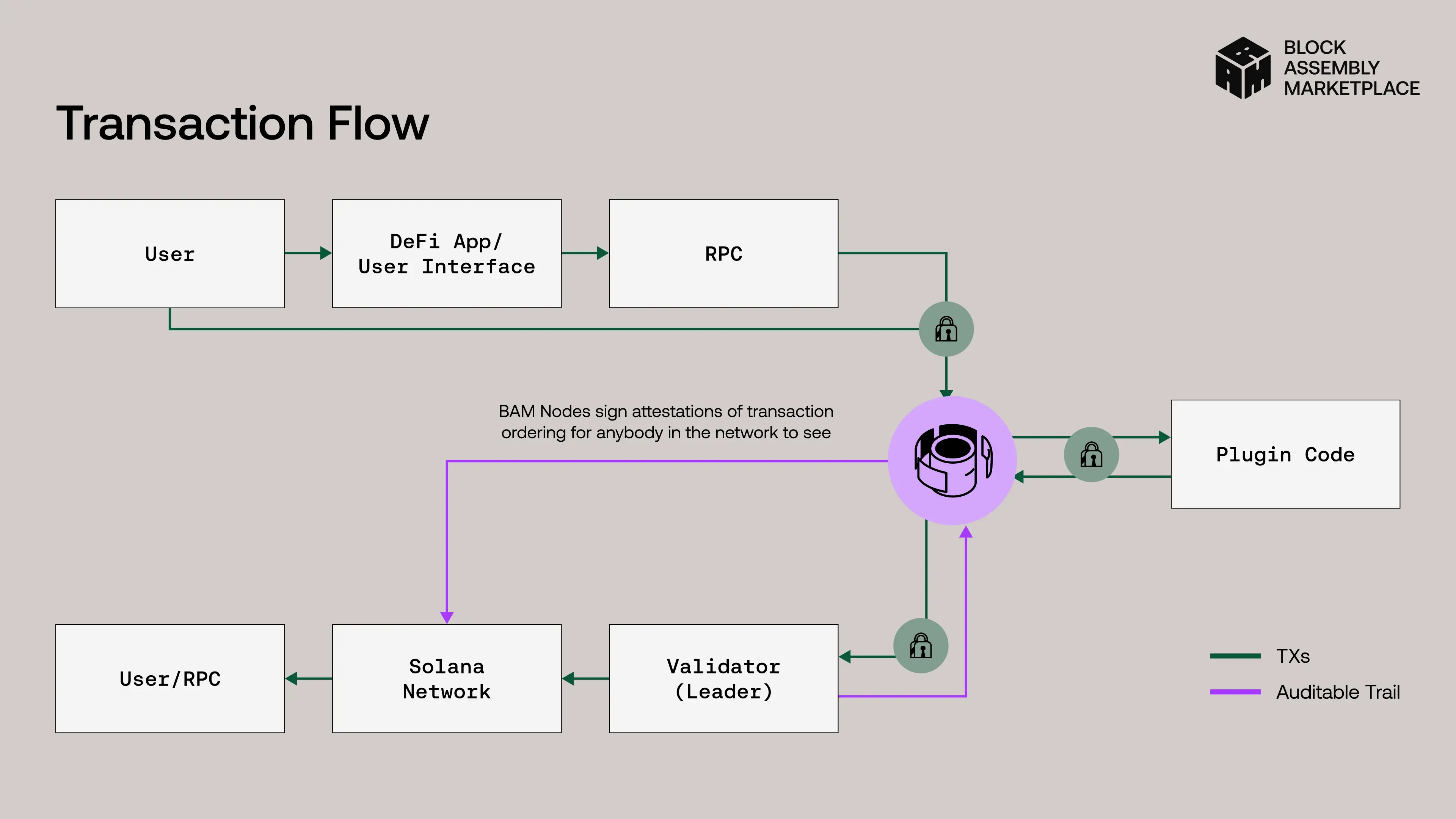
The design of BAM introduces a network of BAM Nodes that operates in parallel with the current validators. These nodes will organize transactions encrypted in Trusted Execution Environments (TEE) – secure execution environments – and send them to the leader along with cryptographic proofs that verify the integrity of the order.
The BAM validators, running the updated Jito-Solana client, will execute the ordered transactions and return proof that this process was carried out accurately.
The BAM proposal sets three technical objectives:
- Secure the transaction order until the execution time to limit negative MEV exploitation.
- Create a transparent transaction history with a public audit trail for each transaction bundle.
- Provide direct access to schedule trading through the Plugin system, allowing the application to automatically adjust the ordering and execution of trades.
Each Plugin can insert or reorder orders in a secure environment, serving cases such as timely oracle updates (just-in-time) or priority cancel-replace operations for market makers.
Implementation roadmap by phases
In the initial phase, Jito will operate the first BAM Nodes, while an alpha validator group – including Triton One, SOL Strategies, Figment, Helius, and other units – will test the client.
The plan aims to maintain a high single-digit delegated stake ratio of (%) immediately after launch, and increase to 30% or more as more node operators participate. Jito also plans to open source BAM, reach a milestone of 50 geographically distributed nodes, and then transfer governance to the DAO.
According to Jito, BAM will provide two key factors that institutions and high-frequency traders (HFT) require: deterministic execution ( and verifiable privacy ).
By allowing custom transaction ordering without the need for a private mempool or off-chain agreements, BAM can attract the order flow that is currently redirecting to centralized exchanges.
Jito believes that with the current throughput of Solana, this network can completely become a decentralized Nasdaq, as plugins for perpetual and dark pool are deployed.
Finally, Jito Labs plans to propose a vote to transfer all BAM fees and block engine to the treasury of Jito DAO, while the company continues to maintain technical operations. This approach is expected to redirect value from MEV mining to revenue sharing through transaction scheduling services.
Currently, the BAM plan is awaiting feedback from validators, developers, and holders before entering the phase of testing the actual product.
Thạch Sanh
Disclaimer: The information on this page may come from third parties and does not represent the views or opinions of Gate. The content displayed on this page is for reference only and does not constitute any financial, investment, or legal advice. Gate does not guarantee the accuracy or completeness of the information and shall not be liable for any losses arising from the use of this information. Virtual asset investments carry high risks and are subject to significant price volatility. You may lose all of your invested principal. Please fully understand the relevant risks and make prudent decisions based on your own financial situation and risk tolerance. For details, please refer to
Disclaimer.


