Michael Saylor hinted that MicroStrategy (MSTR) will again make large purchases of Bitcoin to strengthen its fully committed reserve strategy. However, this move comes as MicroStrategy faces the risk of being removed from the MSCI index, with MSCI considering excluding MicroStrategy from its global index in February's assessment, believing that the company's operations resemble those of an investment firm rather than an operating company. JPMorgan estimates that exclusion could trigger about $11.6 billion in forced selling.
MSCI Delisting Crisis and $11.6 Billion Forced Sell
The most direct threat faced by MicroStrategy is not the price of Bitcoin, but rather the potential regulatory reclassification. MSCI is considering removing MicroStrategy from its global index in the February assessment. The index provider has expressed concerns that the company's current operations resemble those of an investment institution rather than an operating company.
The core of this classification controversy lies in MicroStrategy's business model. Traditionally, MicroStrategy is a business intelligence software company that provides data analytics and business intelligence solutions. However, since Saylor began purchasing Bitcoin in large quantities in 2020, MicroStrategy's balance sheet has been dominated by Bitcoin. As of the time of writing, MicroStrategy holds 671,268 Bitcoins, worth approximately $50.3 billion, accounting for 3.2% of the total Bitcoin supply.
In contrast, MicroStrategy's software business has an annual revenue of only about $500 million and is on a downward trend. This structure effectively transforms MicroStrategy into a “Bitcoin holding company,” with its stock price fluctuations driven entirely by Bitcoin holdings rather than software business performance. MSCI's logic is that if more than 95% of a company's market value comes from investments rather than operations, it should be classified as an investment company rather than an operating company.
Market analysts point out that the financial impact of this move is quite severe. JPMorgan estimates that if excluded, it will trigger about $11.6 billion in forced selling, as passive ETFs and index-tracking funds will liquidate their MSTR positions. This mechanical selling pressure could decouple the stock from its Bitcoin holdings, causing a liquidity spiral decline.
MSCI's Delisting: A Triple Blow to MicroStrategy
11.6 billion dollars of forced dumping: Passive ETFs and index funds must liquidate their MSTR positions, creating significant selling pressure in the short term.
Stock price decoupled from BTC holdings: The premium of MSTR (premium of stock price relative to BTC holdings) may turn into a discount, with market value shrinking.
Financing ability impaired: The decline in stock prices has weakened MicroStrategy's ability to purchase Bitcoin through stock issuance, reversing the flywheel effect.
In response, MicroStrategy has launched a strong defense. The company stated that MSCI's proposal is “arbitrary, discriminatory, and unfeasible,” and believes that the proposal unfairly targets digital asset companies while ignoring other holding conglomerates. The report states: “The proposal improperly introduces policy considerations into index construction. The proposal is in conflict with U.S. policy and will stifle innovation.”
Saylor's Dual Strategy Intent of Increasing Investment in Adversity
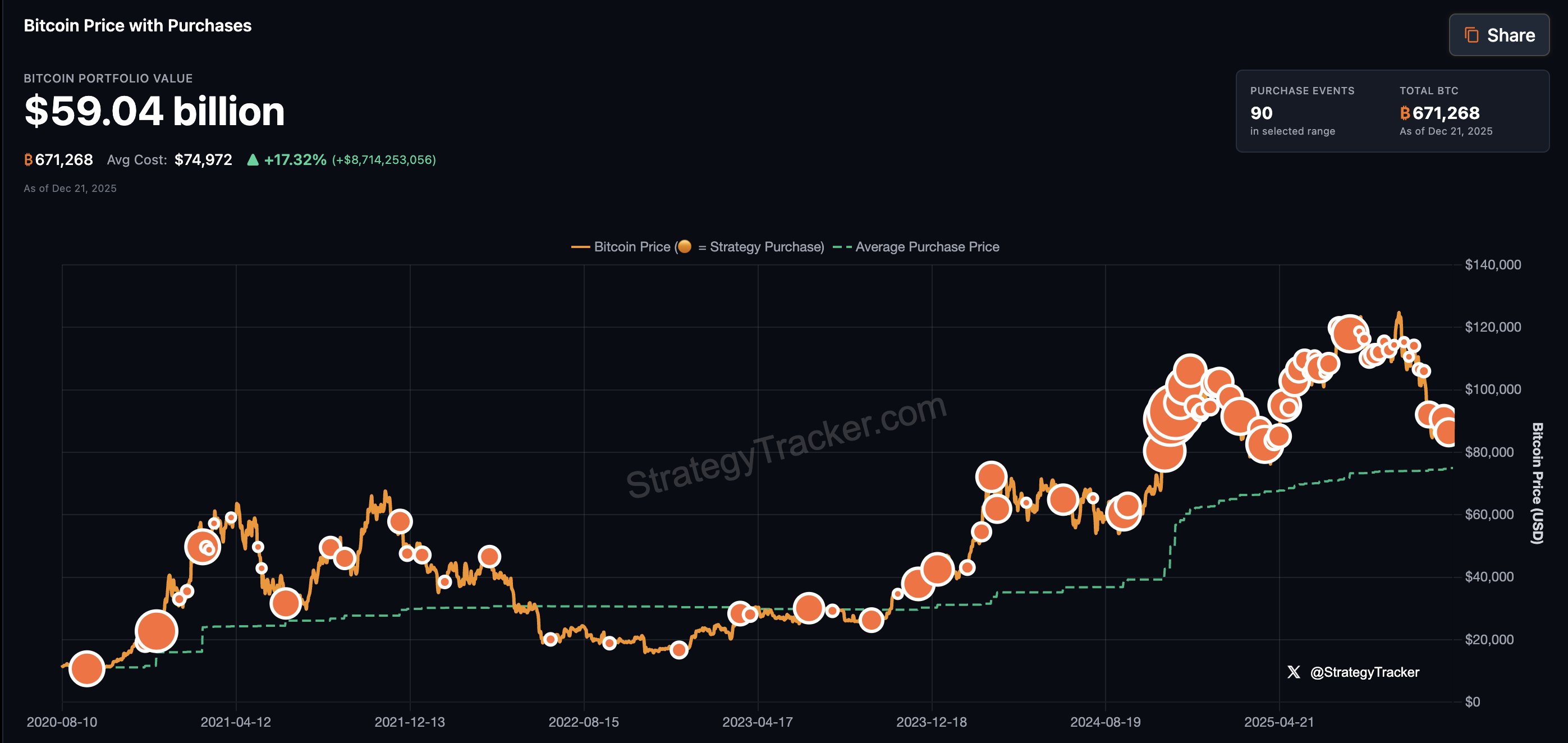
(Source: StrategyTracker)
Saylor's potential new acquisition has a dual purpose: to lower the company's average cost basis during market adjustments, but more importantly, it sends a signal to the market that despite the threat from MSCI and poor stock performance, the “full steam ahead” strategy remains unchanged. This approach of increasing positions in adversity is consistent with Saylor's style and is a trait most appreciated by his followers.
The logic behind reducing the average cost basis is clear. MicroStrategy holds 671,268 Bitcoins, with an average cost basis of approximately $75 billion (including purchase and financing costs), which is about $111,700 per coin. If a large purchase is made at the current price of $89,000, it can significantly lower the average cost. Assuming 20,000 new coins are purchased (approximately $1.8 billion), the average cost will drop from $111,700 to about $111,000. Although the decrease is not large, it is psychologically very important because it brings MicroStrategy's overall position closer to the breakeven point.
More importantly, the signal's meaning. The MSCI delisting crisis has led some investors to doubt whether Saylor will adjust his strategy due to external pressure, or even be forced to sell part of his Bitcoin. Saylor clearly conveys through hints of new purchases: “Not only will I not sell, but I will also continue to buy.” This determination is extremely important for stabilizing market confidence, as MicroStrategy has become a “barometer” of the Bitcoin market, and its movements are widely interpreted as indicators of market sentiment.
The market punished MicroStrategy stock in 2025. MSTR stock has plummeted 43% so far this year, trading at around $165, similar to Bitcoin's 30% drop from its peak of $126,000 in October. This decline exceeds that of Bitcoin itself, indicating that concerns about MicroStrategy's leverage structure and the risk of being removed from the MSCI have already been reflected in its stock price.
Although the company claims its “BTC Yield” is 24.9% (this is a proprietary metric for measuring the appreciation of Bitcoin per share), institutional investors are increasingly focused on the imminent external risks rather than internal yield metrics. The BTC Yield is a metric created by Saylor, calculated as (current BTC holdings - previous BTC holdings) ÷ previous BTC holdings ÷ rate of change in diluted shares. This metric attempts to measure the growth of “BTC content per share,” but it overlooks stock price volatility, financing costs, and market risks.
The Historical Patterns and Market Expectations of the Weekend Mystery Charts
On December 21, Saylor posted a mysterious image on X titled “Green Dots Get Orange Dots,” referring to the company's “SaylorTracker” portfolio visualization tool. This post continues Saylor's trend over the past year of hinting at a new round of Bitcoin acquisitions. Notably, these weekend teasers often materialize on Monday mornings in the form of filings submitted to the SEC, confirming a significant acquisition.
This “weekend hint → Monday announcement” pattern has repeated multiple times. Every time Saylor posts mysterious messages or Bitcoin-related images over the weekend, the market expects a buying announcement on Monday. This predictability itself is a tool for market manipulation, as it can drive price expectations up in a low liquidity environment over the weekend, allowing MicroStrategy to make purchases at slightly higher prices while still claiming to “buy the dip.”
As of the time of publication, MicroStrategy holds 671,268 Bitcoins, worth approximately $50.3 billion, accounting for 3.2% of the total Bitcoin supply. This holding size has reached a systemically important level. If MicroStrategy is forced to sell due to financial difficulties, the Bitcoin market will face catastrophic impacts. This “too big to fail” status makes MicroStrategy one of the largest systemic risks in the Bitcoin ecosystem.
However, Saylor's strategy is not without logic. His argument is that Bitcoin is the hardest currency and will inevitably appreciate in the long term, so buying at any price is correct. He positions MicroStrategy as a “Bitcoin bank” or “Bitcoin bond,” providing shareholders with leveraged exposure to Bitcoin. This business model is highly attractive in a bull market, as the rise in MSTR stock often outpaces Bitcoin by 2-3 times. However, in a bear market, this leverage also amplifies the declines.
The new procurement will further expand the already astonishing scale of accumulation. If Saylor purchases another 20,000-30,000 Bitcoins (approximately 1.8-2.7 billion USD), MicroStrategy's holdings will exceed 700,000 coins, further solidifying its position as the “King of Bitcoin Whales.” Such a scale of purchase will also provide support for the short-term Bitcoin price, as it represents hundreds of millions of dollars in actual buy orders.
For MicroStrategy shareholders, it is currently a difficult time. The stock price has plummeted by 43%, there is a risk of being delisted from MSCI, and a threat of a $11.6 billion forced sell-off. These negative factors combined make holding MSTR shares a high-risk bet. However, Saylor's accumulation suggests that his confidence in the long-term outlook remains unchanged. This is a test of faith: if one believes in Saylor's Bitcoin conviction and MicroStrategy's business model, now is an excellent buying opportunity; if there are doubts about the sustainability of this model, one should exit early to avoid greater losses.
The market will verify on Monday whether Saylor's hints materialize. If SEC filings confirm new purchases, MicroStrategy and Bitcoin prices may rebound in the short term. If they fail to materialize, Saylor's credibility will be damaged, and the market may view his weekend posts as “pie in the sky” rather than genuine intentions. Regardless, MicroStrategy's story has become one of the most controversial and closely watched narratives in the crypto market, and its success or failure will profoundly impact the path of institutional adoption of Bitcoin.


