Individuals transacting cryptocurrency on offshore platforms or independently must now report their movements when the amount of crypto transacted surpasses $5,000 per year. Users must now deliver sensitive data, including the purpose of each transaction, hashes, and destination addresses.
Paraguay Ramps Up Crypto Reporting Requirements For VASPs and Individuals
The government of Paraguay is ramping up the scrutiny of the cryptocurrency market.
The National Directorate of Tax Revenue (DNIT), Paraguay’s tax watchdog, has issued a resolution creating a new figure, a sworn cryptoassets statement, to obtain a more granular control and oversight of the crypto movements in the country.
Resolution No. 47 establishes that both operators of virtual asset service providers (VASPs) and individuals making crypto transactions with volumes going over $5,000 per year, even if transacting using offshore accounts or outside exchange platforms, must issue this detailed statement.
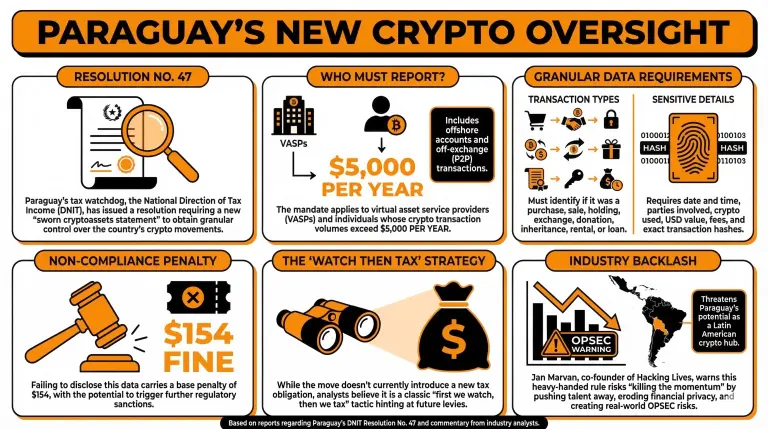
The document must identify, at the very minimum, the class of transaction completed -purchases and sales, holding or possession, exchanges between different crypto assets, donations, inheritances, temporary assignments, rentals, or loans, among others.
In the same way, for each transaction, the user must include sensitive data, such as date and time, the parties involved, the cryptocurrency used, the amount traded, the value transacted in U.S. dollars, fees, and transaction hashes.
The penalty for failing to disclose this data during the expected period is $154, and it could result in other penalties.
While this move doesn’t introduce a tax obligation, analysts believe this might be a classic “first we watch, then we tax” move, hinting at future moves to leverage this information via new levies.
Jan Marvan, co-founder of Hacking Lives, stressed that this was a troubling development for the nation’s crypto scene, as it could affect its possibilities of becoming a crypto hub in Latin America.
“This kind of heavy-handed rule risks killing that momentum. It will push talent away, slow down everyday adoption, erode financial privacy, and in the worst cases create real-world OPSEC risks for users,” he concluded.
FAQ
- What recent action has the government of Paraguay taken regarding cryptocurrencies?
Paraguay is increasing scrutiny of the crypto market by implementing a sworn cryptoassets statement for enhanced oversight of crypto transactions.
- What does Resolution No. 47 require from virtual asset service providers and individuals?
Operators and individuals engaging in crypto transactions over $5,000 per year must issue a detailed statement identifying transaction types and sensitive data.
- What details must be included in the sworn statement?
The statement must include transaction specifics such as date, time, parties involved, cryptocurrency used, and amount traded, along with the transaction hash.
- What implications does this resolution have for Paraguay’s crypto market?
Analysts warn that while it doesn’t introduce new taxes now, it may lead to future taxation, potentially hindering Paraguay’s growth as a crypto hub in Latin America.
Aviso legal: La información de esta página puede proceder de terceros y no representa los puntos de vista ni las opiniones de Gate. El contenido que aparece en esta página es solo para fines informativos y no constituye ningún tipo de asesoramiento financiero, de inversión o legal. Gate no garantiza la exactitud ni la integridad de la información y no se hace responsable de ninguna pérdida derivada del uso de esta información. Las inversiones en activos virtuales conllevan riesgos elevados y están sujetas a una volatilidad significativa de los precios. Podrías perder todo el capital invertido. Asegúrate de entender completamente los riesgos asociados y toma decisiones prudentes de acuerdo con tu situación financiera y tu tolerancia al riesgo. Para obtener más información, consulta el
Aviso legal.
Artículos relacionados
Ley CLARITY: Acuerdo sobre Rendimiento de Stablecoin Cercano mientras la SEC Redefine Tokens
Los legisladores y reguladores están haciendo progreso en la política de criptomonedas, con una propuesta de rendimiento de monedas estables anticipada pronto. La SEC y la CFTC clasificaron la mayoría de los activos criptográficos como no valores, designando varios como productos básicos digitales.
CryptoFrontNewsHace35m
FAQ de la CFTC sobre Activos Criptográficos y Negocios Blockchain, Marco Claro de Orientación Normativa
El presidente de la Comisión de Comercio de Futuros de Productos Básicos de EE.UU., Mike Selig, anunció en la plataforma X que la CFTC ha publicado una FAQ dirigida a activos criptográficos y negocios de blockchain, proporcionando orientación de cumplimiento que abarca temas centrales como garantías tokenizadas, con el objetivo de establecer un marco operativo claro para los participantes del mercado.
GateNewshace1h
CFTC Permite Bitcoin y Ethereum como Garantía de Margen
La CFTC permite Bitcoin, Ethereum y stablecoins como colateral de margen con recortes de valoración estrictos y controles de riesgo aplicados.
Los stablecoins reciben cargas de capital más bajas que BTC y ETH, reflejando volatilidad reducida en cálculos de margen.
Las empresas deben cumplir con reportes, ciberseguridad y
CryptoFrontNewshace3h
La Senadora Cynthia Lummis Impulsa la Presentación de la Ley CLARITY Después del Receso de Pascua
La senadora Cynthia Lummis anunció que el Comité de Banca del Senado avanzará la Ley CLARITY después de Semana Santa. Se han resuelto cuestiones clave como el rendimiento de monedas estables y las regulaciones de DeFi, con el objetivo de su aprobación antes de fin de año a pesar de los retrasos legislativos.
CryptoFrontNewshace7h
Los senadores llegan a un acuerdo sobre monedas estables, la Ley CLARITY avanza
Los legisladores han llegado a un acuerdo bipartidista para resolver la disputa sobre el rendimiento de las stablecoin, un obstáculo clave para la legislación criptográfica. El acuerdo, que involucra a los Senadores Tillis y Alsobrooks, tiene como objetivo equilibrar la innovación y la estabilidad bancaria mientras se avanza la Ley CLARITY. Se necesita una revisión adicional de la industria antes de finalizar los detalles.
CryptoFrontNewshace7h
Un CEO de intercambio centralizado: Si el Congreso aprueba la "Ley CLARITY", puede proporcionar certidumbre regulatoria
Noticia de Gate News: El 21 de marzo, Vlad Tenev, director ejecutivo de un cierto CEX, publicó un tuit indicando que la industria se encuentra en un punto de inflexión importante en su desarrollo. Señaló que si el Congreso aprueba la Ley CLARITY, la industria finalmente obtendrá la certidumbre regulatoria que siempre ha defendido. Considera que la controversia clave actual radica en decidir si los clientes deberían obtener rendimientos de las monedas estables que poseen.
GateNewshace9h


