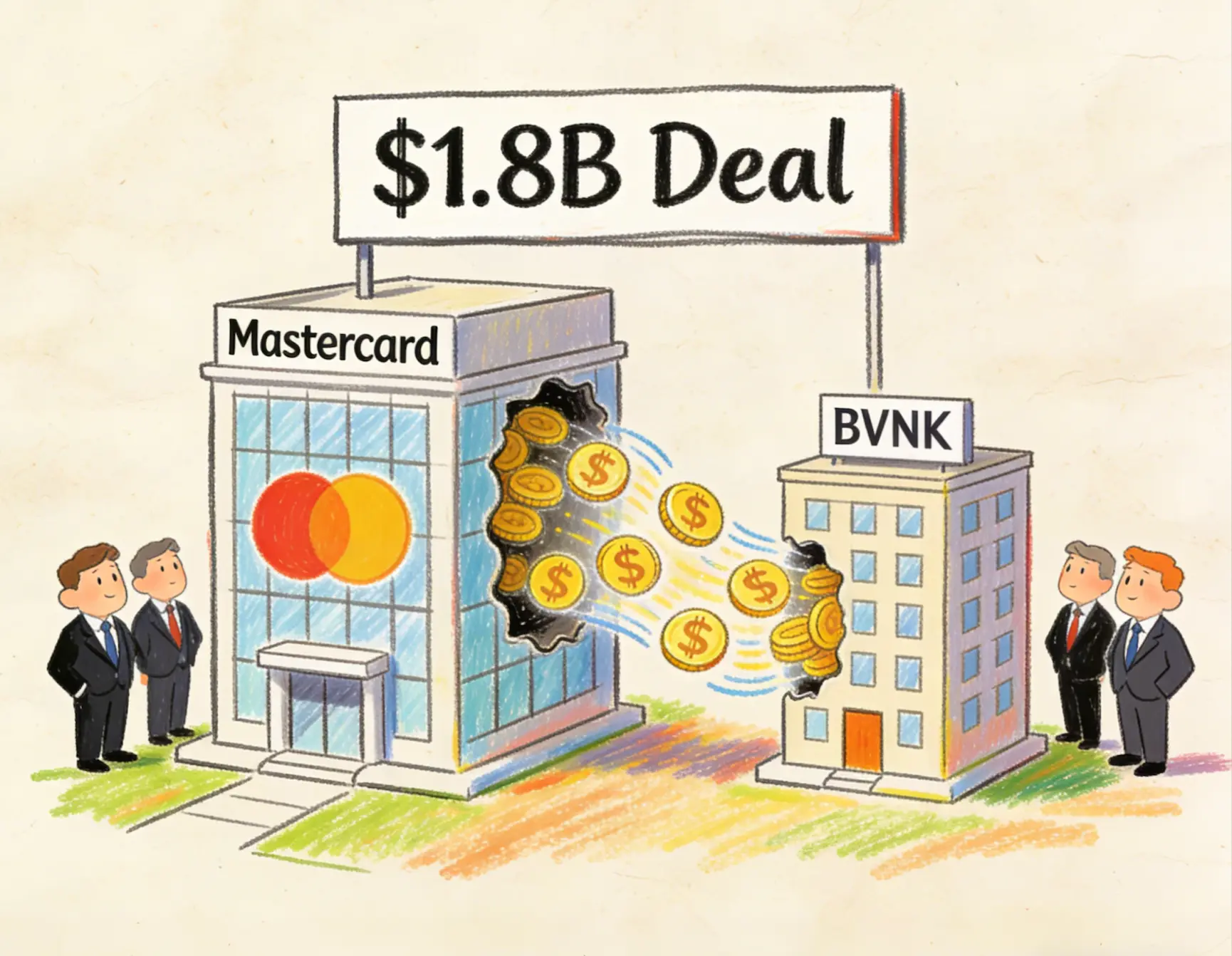
 Mastercard announced on March 17, 2026, that it has agreed to acquire BVNK, a London-based stablecoin infrastructure provider, for up to $1.8 billion, including $300 million in performance-contingent payments, marking the payment giant’s largest crypto-related acquisition to date.
The deal gives Mastercard the ability to connect traditional payment rails with blockchain-based systems that support stablecoins and tokenized deposits, allowing the company to embed itself in the growing digital currency payments ecosystem as banks, fintechs, and merchants increasingly adopt blockchain settlement. BVNK, founded in 2021 and recently valued at approximately $750 million, operates across more than 130 countries on all major blockchain networks .
The acquisition reflects a broader race among traditional financial institutions to acquire stablecoin infrastructure, following Stripe’s $1.1 billion purchase of Bridge in 2024 and as banks including JPMorgan Chase, Bank of America, and Citigroup explore issuing their own stablecoins under the newly enacted GENIUS Act framework .
Deal Structure and Strategic Rationale
Transaction Details
The acquisition includes $1.5 billion in upfront consideration plus up to $300 million tied to BVNK meeting specific performance milestones. The deal is expected to close in 2026 . Mastercard Chief Product Officer Jorn Lambert framed the acquisition within the company’s long-term vision: “We expect that most financial institutions and fintechs will in time provide digital currency services.”
Strategic Imperative: Protecting Core Revenue
Mastercard derives approximately 37% of its revenue from cross-border transactions and international e-commerce, according to Raymond James analyst John Davis. Traditional cross-border payments routed through SWIFT typically take three to five days with fees ranging from 3% to 6%, while stablecoin settlements occur in minutes with fees below 1% .
The threat to card networks is not theoretical. McKinsey data shows stablecoin-linked card issuance reached $4.5 billion in 2025, up 673% year-over-year . These products allow users to spend stablecoin balances at any Visa or Mastercard merchant without first converting to fiat, effectively using card networks’ acceptance rails while bypassing their settlement infrastructure.
Third Bridge analysts highlighted the deeper structural risk: the largest threat comes from merchant-side adoption. Platforms like Amazon, Walmart, and Shopify have strong incentives to replace card payments with lower-cost stablecoin alternatives, potentially redefining checkout economics .
BVNK’s Business and Integration Plans
Company Overview
BVNK provides infrastructure that bridges fiat currency with blockchain-based stablecoins, enabling cross-border transfers, B2B settlement, and remittance services. The company processes approximately $30 billion in annualized transaction volume across 130 countries, with clients including Worldpay, Deel, and Flywire. Annual revenue is approximately $40 million, though the company has not yet achieved consistent profitability .
Integration Architecture
Following the acquisition, BVNK will be integrated into Mastercard’s network across three key layers according to American Banker :
Stablecoin settlement: Providing settlement options for processors and acquirers
Payment gateway integration: Adding stablecoin checkout within Mastercard’s payment gateway
Fiat-to-digital conversion: Enabling seamless conversion across cards, accounts, and wallets
Raj Dhamodharan, Mastercard’s Executive Vice President of Digital Asset and Blockchain Products, described the vision: “We see stablecoins as a rail. Each stablecoin can be viewed as a global ACH, with consumers never seeing the complexity underneath.”
Technical and Regulatory Hurdles
BVNK’s value proposition includes chain-agnostic functionality across Ethereum, Solana, and Tron, but unifying these diverse networks’ confirmation times, gas fee structures, and security models to meet Mastercard’s consistency requirements presents significant engineering challenges .
Regulatory complexity adds another layer. BVNK operates across 130 countries with varying stablecoin frameworks. While the U.S. GENIUS Act provides federal clarity, Europe’s MiCA framework imposes different requirements, and Asian markets maintain fragmented approaches. Compliance costs will remain an ongoing consideration .
Industry Context: The Race for Stablecoin Infrastructure
Competitor Activity
Mastercard’s acquisition follows a pattern of traditional financial institutions acquiring stablecoin infrastructure:
Stripe: Acquired Bridge for $1.1 billion in 2024 and launched its own blockchain, Tempo, in March 2026
Visa: Partnered with Bridge to expand stablecoin card offerings across more than 100 countries
PayPal: PYUSD stablecoin circulation has exceeded $1 billion
JPMorgan Chase: Operates JPM Coin on Coinbase’s Base network
European banks: Eleven institutions have partnered to launch a euro-denominated stablecoin expected in 2026
Broader Financial Industry Adoption
Total crypto M&A value surged to $37 billion in 2025, up more than sevenfold from the previous year, according to Architect Partners . Major financial institutions are actively building internal capabilities:
Goldman Sachs and CitiGroup: Actively recruiting crypto talent
JPMorgan Chase, Bank of America, Citigroup, Wells Fargo: Reportedly in talks to issue stablecoins
Morgan Stanley: Announced plans to build proprietary Bitcoin custody and trading services
The “Orchestrator” Thesis
VanEck Ventures General Partner Wyatt Lonergan characterized the race for stablecoin infrastructure: “Everyone wants the orchestrators. Why? Because moving between the fiat and stablecoin layer is where the complexity is, and complexity is where they can extract margin.” Lonergan noted that building distribution in this layer allows firms to expand into adjacent areas including wallets, stablecoin issuance, and eventually proprietary chains .
Regulatory Context: The GENIUS Act Effect
President Trump signed the GENIUS Act into law in 2025, establishing a federal framework for stablecoin issuance. The law permits banks and other entities to issue stablecoins backed by assets such as U.S. Treasuries, provided they maintain monthly reserve disclosures . U.S. Treasury Secretary Scott Bessent has projected stablecoin supply could reach $3 trillion by 2030, with Citi offering a bullish projection of $4 trillion .
The regulatory clarity has accelerated institutional adoption but also shifted the competitive landscape. Industry observers note that the primary beneficiaries of stablecoin legalization may not be crypto-native firms but established players like Mastercard, Stripe, and Visa that already possess licenses, compliance infrastructure, and distribution networks .
Acquisition History: From Coinbase to Mastercard
BVNK’s path to acquisition reflects shifting dynamics in the crypto infrastructure space. The company raised its Series B in December 2024 at a $750 million valuation, with Haun Ventures leading participation from Tiger Global and Coinbase Ventures . In October 2025, Coinbase entered exclusive negotiations to acquire BVNK for approximately $2 billion . One month later, Coinbase exited the deal for undisclosed reasons, after which Mastercard entered and ultimately agreed to a $1.5 billion fixed price plus $300 million in earn-outs—approximately $200 million below Coinbase’s earlier offer .
The outcome illustrates a broader pattern: crypto-native companies are being acquired by traditional financial institutions at valuations that reflect integration value rather than standalone growth potential .
Frequently Asked Questions
Why is Mastercard acquiring BVNK?
Mastercard is acquiring BVNK to secure its position in the emerging stablecoin payments ecosystem. Approximately 37% of Mastercard’s revenue comes from cross-border transactions—a market where stablecoins offer significantly lower costs and faster settlement times. By integrating BVNK’s infrastructure, Mastercard can offer stablecoin settlement to merchants, processors, and financial institutions while maintaining its role as a trusted intermediary in payment flows.
What does BVNK do and why is it valuable to Mastercard?
BVNK builds infrastructure that connects traditional fiat currency systems with blockchain-based stablecoins. Its platform enables cross-border payments, B2B settlement, and remittance services across more than 130 countries and all major blockchain networks. For Mastercard, BVNK provides ready-made technology to embed stablecoin capabilities into its existing network without building the infrastructure from scratch.
How does the GENIUS Act affect this acquisition?
The GENIUS Act, signed into law in 2025, provides a federal framework for stablecoin issuance, allowing banks and regulated entities to issue stablecoins with transparent reserve requirements. This regulatory clarity has encouraged traditional financial institutions to enter the stablecoin space. For Mastercard, the act reduces regulatory uncertainty around the assets BVNK’s infrastructure supports, making the acquisition more strategically viable.


