Strawmap sketches seven forks by 2029, targeting faster finality, privacy upgrades, and quantum-resistant security.
Ethereum’s base layer could see up to seven major upgrades by 2029 under a new planning document from the Ethereum Foundation. Called the “Strawmap,” the proposal sets out a long-term vision for Layer 1 development. Researchers describe it as a coordination tool and not a fixed roadmap.
Strawmap Details Ethereum’s Multi-Year Scaling and Security Strategy
Ethereum Foundation presented the Strawmap as a long-term plan for future network upgrades. Justin Drake, a researcher within the EF Protocol team, shared the plan publicly. He framed it as a tool to guide discussion and support developers, researchers, and governance participants in pursuing shared goals.
Strawmap spans several years ahead instead of focusing only on the next upgrade. Most core devs typically focus on the next one or two upgrades. Meanwhile, the roadmap extends to 2029, with an estimate of one network upgrade every 6 months, or up to 7 forks in total.
Introducing strawmap, a strawman roadmap by EF Protocol.
Believe in something. Believe in an Ethereum strawmap.
Who is this for?
The document, available at strawmap[.]org, is intended for advanced readers. It is a dense and technical resource primarily for researchers,… pic.twitter.com/gIZh5I8Not
— Justin Drake (@drakefjustin) February 25, 2026
The Strawmap roadmap originated at an Ethereum Foundation workshop in January 2026. Participants discussed how to connect big long-term goals with technical limits and upgrade schedules. After those talks, the plan was shared publicly to invite feedback and wider discussion.
Guiding the entire plan are five main goals. These “north stars” show what Ethereum wants to achieve over the long term. The five main goals include:
- Fast L1 targets shorter slots and second-level finality to improve the user experience at the protocol level.
- Gigagas L1 sets a throughput ambition of 10,000 transactions per second, powered by zkEVM systems and real-time proof generation.
- Teragas L2 pushes scaling toward roughly 10 million transactions per second through higher data throughput and sampling methods.
- Post-Quantum L1 plans to introduce hash-based cryptography to withstand potential quantum-computing threats.
- Private L1 proposes shielded ETH transfers to allow stronger privacy directly on the base layer.
Strawmap presents all planned upgrades on a single visual timeline. Structure divides changes into three horizontal layers: consensus, data, and execution. Each part handles a different function of the network.
Most upgrades, or “forks,” include one major change to consensus and one to execution. That way, development moves forward step by step without adding too many changes at once.
Ethereum’s Roadmap Details Future Fork Structure
Upcoming upgrades already have official names, such as Glamsterdam and Hegotá. Other future forks carry placeholder labels like “I*” and “J*.” Naming conventions follow a star-based sequence for consensus layer upgrades, building on earlier forks such as Altair and Capella.
Each fork usually features one major upgrade on the consensus side and one on the execution side. These key changes are called “headliners.” They are the main focus of that upgrade cycle. Limiting them helps keep each fork realistic and easier to manage.
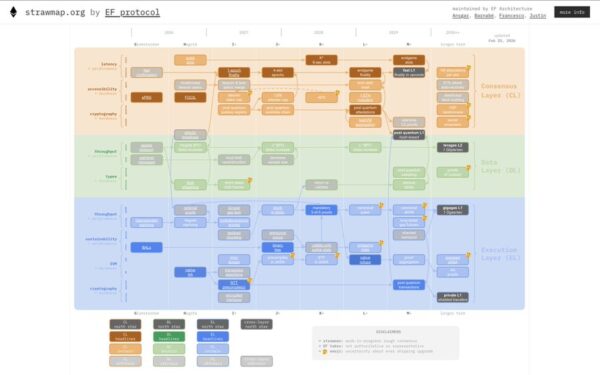
Image Source: Strawmap
Strawmap is not an official roadmap. Ethereum is decentralized, with many different voices involved. No single plan reflects everyone’s opinion. Even within the Ethereum Foundation’s protocol team, views can differ.
The term “Strawmap” combines “strawman” and “roadmap.” Strawman label signals a work in progress. Justin stressed that the document sketches one coherent path among many possible outcomes. It does not predict future decisions.
Updates are expected every 3 months as research and governance decisions advance. Faster development methods, including AI tools and formal verification, could shorten timelines. For now, the plan assumes traditional, human-led development.
In simple terms, Strawmap gives a long-term outline for Ethereum’s base layer. From here, community discussions will focus on how to balance scaling, privacy, security, and decentralization over the coming years.
Disclaimer: The information on this page may come from third parties and does not represent the views or opinions of Gate. The content displayed on this page is for reference only and does not constitute any financial, investment, or legal advice. Gate does not guarantee the accuracy or completeness of the information and shall not be liable for any losses arising from the use of this information. Virtual asset investments carry high risks and are subject to significant price volatility. You may lose all of your invested principal. Please fully understand the relevant risks and make prudent decisions based on your own financial situation and risk tolerance. For details, please refer to
Disclaimer.
Related Articles
ETH rises 0.65% in 15 minutes: spot buying led to net capital inflows
Between 2026-04-16 15:00 and 15:15 (UTC), the ETH price recorded a +0.65% return. The highest price in the range was 2330.16 USDT, while the lowest was 2308.58 USDT, with a swing of 0.93%. The short-term rally immediately drew market attention, increasing capital activity; volatility remained moderately elevated, characterized by strengthening spot buying power.
The main driving force behind this unusual move is that buy orders in the spot markets of major trading platforms continued to dominate. Within 15 minutes, the buy volume accounted for 58%–59%, and the total buy volume was about 2.2K–2.6K ETH
GateNews1h ago
Bitcoin, Ethereum and Solana ETFs Record Positive Net Inflows on April 16
Gate News message, according to the April 16 update, Bitcoin ETFs recorded a 1-day net inflow of +2,855 BTC (+$209.95M) and a 7-day net inflow of +11,849 BTC (+$871.52M). Ethereum ETFs showed a 1-day net inflow of +15,477 ETH (+$35.44M) and a 7-day net inflow of +90,366 ETH (+$206.94M). Solana ETFs
GateNews1h ago
Ethereum Foundation Announces ETH Rangers Project Results: Over $5.8M in Recovered or Frozen Assets
The Ethereum Foundation's ETH Rangers project has successfully completed, funding 17 researchers to enhance public security in the ecosystem. Achievements include recovering $5.8M in assets, identifying over 785 vulnerabilities, and developing several security tools.
GateNews1h ago
ETH drops 1.23% in 15 minutes: Retail’s concentrated sell-off and amplified ETF fund outflows weigh on the spot order book
2026-04-16 13:45 to 14:00 (UTC), ETH spot prices fell by 1.23% in just 15 minutes. The candlestick price range covered 2291.2 to 2336.98 USDT, with a swing of 1.96%. Market volatility intensified, sell pressure on the board became concentrated, and the trading community’s focus clearly shifted toward changes in capital outflows.
The main driver behind this abnormal move is large-scale, concentrated selling from retail. In the spot market, net outflows in the first 5 minutes reached as high as -$95.57M. Although some lead/major funds attempted to accumulate at lower prices (net inflows of +$18.95M in large orders over 5 minutes), the overall scale was limited and unable to effectively hedge the overall short-term selling pressure. Meanwhile, the ETH futures market did not show extreme liquidations or large-scale position closures, indicating that the core of the abnormal move came from a spot supply-and-demand imbalance rather than leveraged liquidation cascades.
In addition, ETH spot ETF funds have continued to experience net outflows in early April. On April 1, the single-day net outflow was $7.1M. The overall trend in Q1 was bearish, directly reflecting weakening institutional capital allocation intent and further undermining market confidence. Some funds have shifted to on-chain staking and emerging DeFi protocols. It is also worth noting that large holders with holdings in the 100,000-ETH range have continued to reduce their positions since the end of March. Whale capital outflows have persisted, and retail has followed the above signals, leading to a multi-factor selloff resonance effect in the short term. Although both the number of active addresses on the ETH chain and daily trading volume have hit historical highs, network usage and liquidity are overall strong, but capital flow has not formed any substantive spot buy orders, making it difficult to drive a price reversal.
At present, short-term market risk remains significant. Investors should pay attention to the strength of subsequent retail selling, the direction of ETF fund flows, and changes in large-holder positions. If large holders and major funds do not form a strong follow-through/acceptance, the spot market may continue to be affected by the release of structural supply. It is recommended that investors monitor key support zones in real time, track large on-chain fund movements, and watch for macro news developments, in order to reasonably mitigate the risk of short-term price fluctuations and promptly obtain more market information.
GateNews2h ago
ETH falls below 2300 USDT
Gate News bot message, Gate quotes show that ETH has fallen below 2300 USDT, with the current price at 2296.29 USDT.
CryptoRadar2h ago
Charles Schwab Launches Schwab Crypto Spot Trading for Bitcoin and Ethereum
Charles Schwab launched Schwab Crypto on April 16, a spot cryptocurrency trading service for retail customers. It supports direct trading of Bitcoin and Ethereum and offers education and support, integrating with existing financial services.
GateNews2h ago


