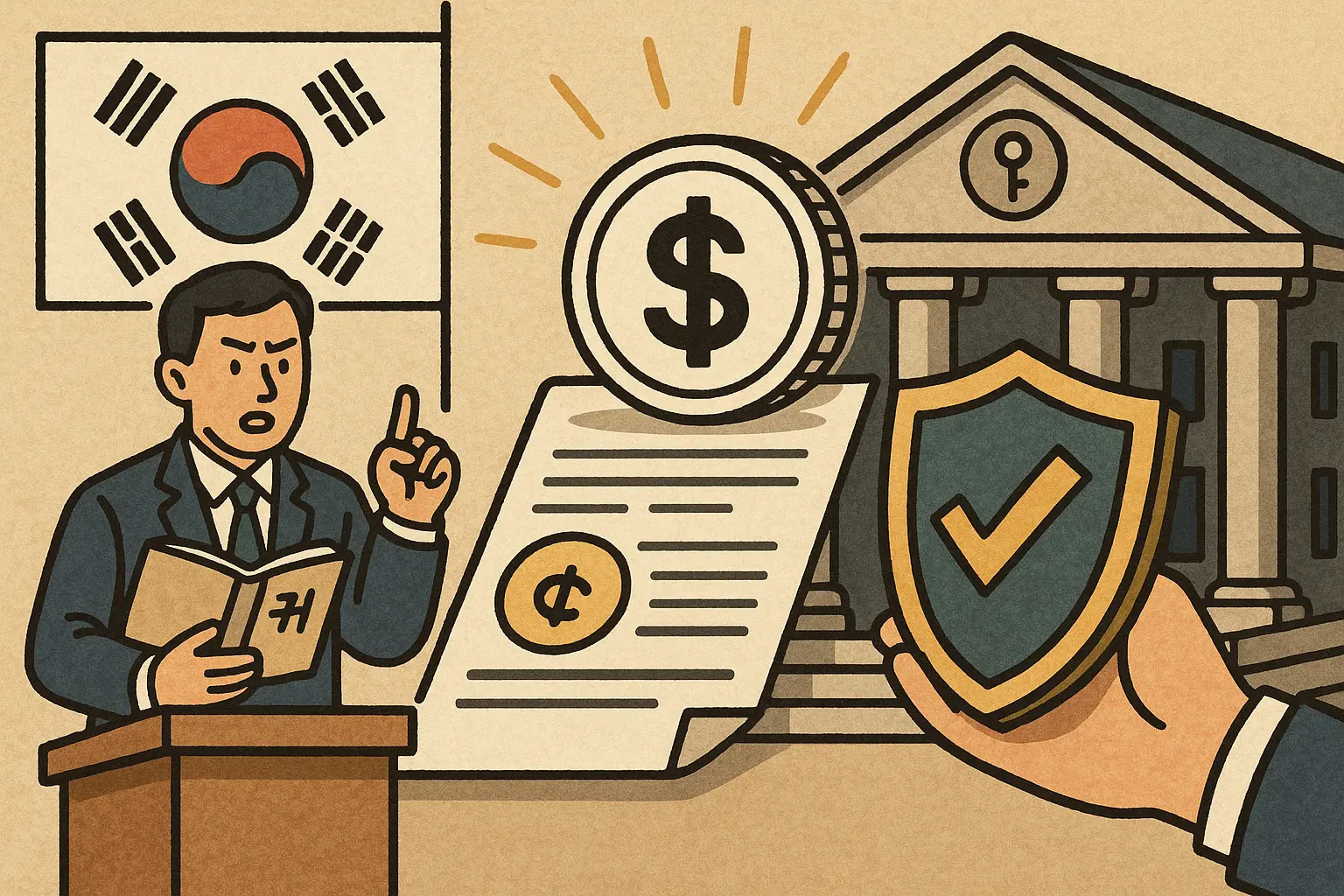
South Korea’s ruling Democratic Party submitted the “Digital Asset Basic Act” to the National Assembly on April 8. The bill will establish a comprehensive legal framework for the issuance, trading, custody, and regulation of digital assets, and for the first time impose bank-level authorization requirements, reserve standards, and redemption obligations on stablecoins that are linked to fiat currencies or real-world assets. On the same day, the Financial Services Commission (FSC) and the Financial Supervisory Service (FSS) in South Korea also announced requirements for all domestic cryptocurrency exchanges to implement a unified mandatory withdrawal delay mechanism.
Core Regulatory Framework of the Digital Asset Basic Act
The bill clearly defines “value-linked digital assets” as a category that requires special regulation, covering stablecoins linked to fiat currencies such as the South Korean won, or stablecoins backed by real-world assets.
Overview of the Bill’s Main Regulatory Frameworks
Stablecoin Issuance Side: Must obtain government authorization, meet capital thresholds, a reserve plan, and redemption obligations; overall standards are similar to banking-sector regulations.
Digital Asset Business Side: Trading, brokerage, custody, and advisory services must all be brought under a system of licensing, registration, and regular reporting.
Market Conduct Side: Clearly prohibits unfair practices such as market manipulation and trading using non-public information, and sets internal control and information disclosure standards.
Policy Coordination Side: Establishes a “Digital Assets Commission” responsible for reviewing and coordinating policies, formulating national basic plans, and implementing action measures.
Stating from the outset, the bill points out that “digital assets are becoming a core medium connecting the real economy and financial markets,” and sets “laying the foundation for South Korea to lead the global digital financial order” as its legislative goal.
Key Controversy Over Stablecoin Issuance Rights: A Standoff Between the Bank of Korea and the Financial Services Commission
Negotiations over the Digital Asset Basic Act have been stuck in a stalemate since early this year. The central disagreement is who is eligible to issue stablecoins pegged to the South Korean won. The Bank of Korea argues that only banks holding more than 51% of the shares should be eligible to issue, to ensure that the responsibility for maintaining the stability of the fiat currency rests with highly regulated financial institutions. The Financial Services Commission takes a different view, warning that if entry requirements are set too high, it could hinder crypto innovation and cause the domestic market to fall behind in global competition.
The version of the bill proposed by the ruling party attempts to strike a balance between regulatory certainty and market openness, but the specific authorization standards still need to be confirmed through deliberation in the National Assembly.
On the Same Day: New Rules for Mandatory Withdrawal Delays at Exchanges Crack Down on Voice Scams
On the same day, the Financial Services Commission and the Financial Supervisory Service announced new rules requiring all South Korean domestic cryptocurrency exchanges to implement a unified and strict withdrawal delay mechanism. The move is intended to combat a recent surge in voice phishing scams. Such scams exploit the immediacy of cryptocurrency trading to trick victims into rapidly transferring funds, resulting in large losses of property. Under the new rules, exchanges must uniformly set a mandatory waiting time window after a user initiates a withdrawal, increasing the operational difficulty of scam activities.
Frequently Asked Questions
How does South Korea’s “Digital Asset Basic Act” regulate stablecoins?
The bill classifies stablecoins linked to fiat currencies or real-world assets as “value-linked digital assets.” They require special authorization; issuers must meet capital thresholds, a reserve plan, and redemption obligations. Overall requirements are similar to banking-sector supervisory standards. This is South Korea’s first time establishing a clear institutional framework for stablecoins.
What disagreements exist between the Bank of Korea and the Financial Services Commission regarding stablecoin regulation?
The Bank of Korea argues that only banks holding more than 51% of the shares can issue stablecoins pegged to the South Korean won. The Financial Services Commission, meanwhile, is concerned that overly high entry thresholds could hinder innovation. This divide is the main reason negotiations over the Digital Asset Basic Act have stalled, and the latest version of the bill attempts to find a balance between the two positions.
What is the main purpose of South Korea’s mandatory withdrawal delay rules for exchanges?
The new rules require all domestic cryptocurrency exchanges to implement unified mandatory withdrawal delays. The purpose is to combat voice phishing scams that take advantage of the speed advantage of cryptocurrency trading. By increasing the waiting time before operations, the likelihood that victims complete scam fund transfers under urgent emotions is reduced.
Disclaimer: The information on this page may come from third parties and does not represent the views or opinions of Gate. The content displayed on this page is for reference only and does not constitute any financial, investment, or legal advice. Gate does not guarantee the accuracy or completeness of the information and shall not be liable for any losses arising from the use of this information. Virtual asset investments carry high risks and are subject to significant price volatility. You may lose all of your invested principal. Please fully understand the relevant risks and make prudent decisions based on your own financial situation and risk tolerance. For details, please refer to
Disclaimer.


