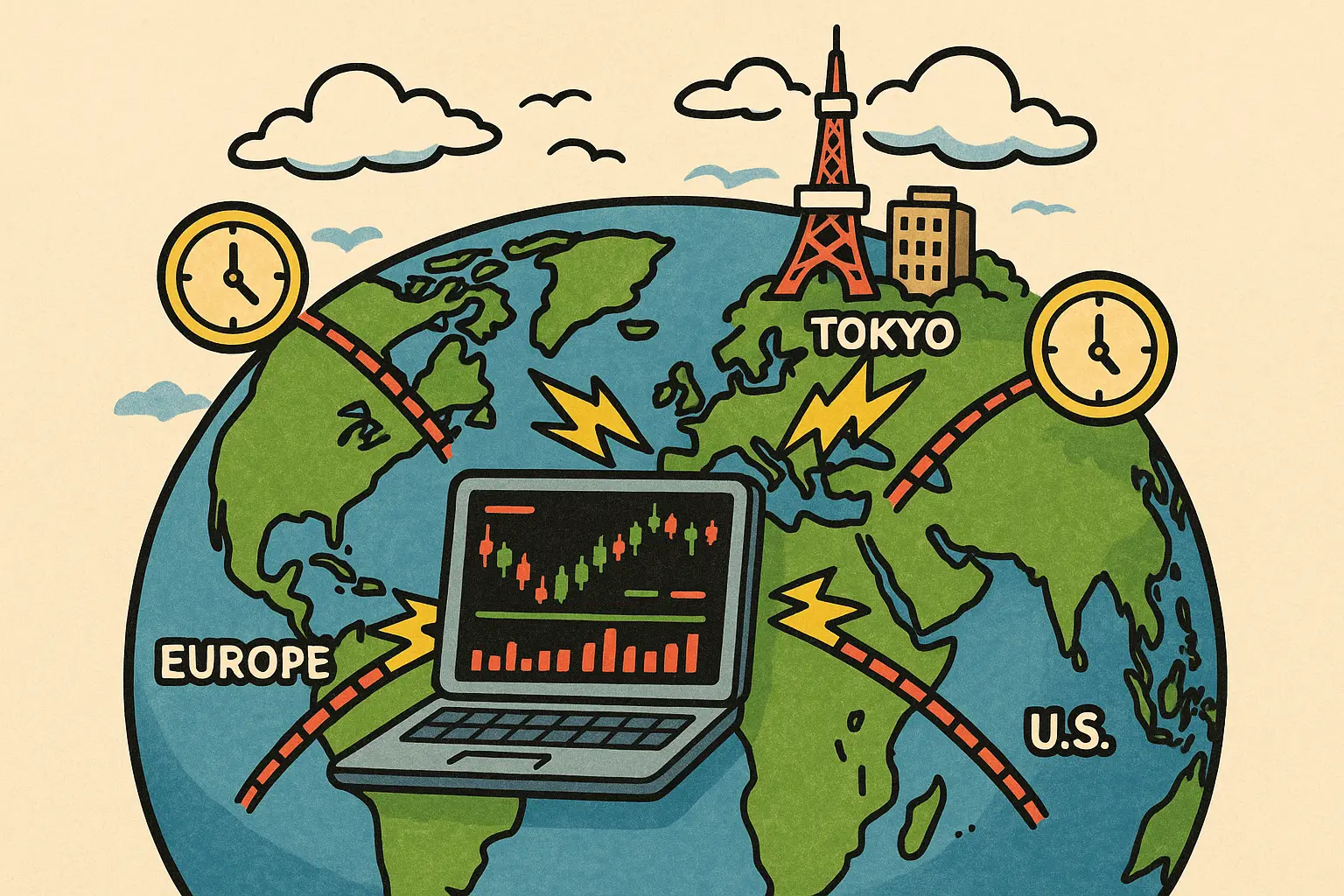
On-chain research institution Glassnode published a report indicating that all 24 validators of the decentralized perpetual contract exchange Hyperliquid are concentrated in the Amazon Web Services (AWS) Tokyo region, allowing local traders’ orders to reach the validation layer in 2 to 3 milliseconds, while participants in Europe and the United States face an additional delay of over 200 milliseconds.
Hyperliquid’s Tokyo Centralized Architecture: The Source of Speed Advantage
Hyperliquid’s 24 validators are deployed across multiple availability zones in the Tokyo AWS region. Although the API layer routes globally via AWS CloudFront, the core consensus and matching logic remain concentrated in a single cloud region in Japan.
Tokyo is also a major infrastructure hub for centralized exchanges such as Binance and KuCoin. BitMEX CEO Stephen Lutz stated that after moving their infrastructure from Ireland to Tokyo, liquidity for the main contracts increased by approximately 180%, with some altcoin markets even reaching 400%—he explicitly attributed the gains to reduced latency rather than market maker recruitment. In April of last year, a service interruption in the AWS Tokyo region caused multiple crypto platforms to simultaneously degrade, further exposing the industry’s high dependency risk on a single cloud region.
Quantifying the 200 Millisecond Gap: Hyperlatency Measurement Data Reveals the Whole Picture
The measurement results from the research tool Hyperlatency precisely quantify this gap. The median round trip time (RTT) for orders sent from the AWS Tokyo server is 884 milliseconds, with server-side processing time accounting for about 879 milliseconds and network transmission only taking 5 milliseconds; for the same request sent from the Ashburn node in Virginia, the round trip time rises to approximately 1,079 milliseconds, resulting in a gap of about 200 milliseconds.
With Hyperliquid’s daily trading volume exceeding $4 billion, this 200-millisecond gap accumulates significantly in high-frequency order flow, creating a considerable execution advantage. Notably, some users pointed out that the round trip delay for submitting complex instructions from Tokyo could be as high as 400 milliseconds, indicating that the ultimate impact still depends on the specific order type and market conditions.
Equity Mechanisms in Traditional Finance: Infrastructure That Does Not Yet Exist in DeFi
Traditional financial markets have spent decades building a specialized set of technologies and regulatory systems aimed at eliminating geographical speed advantages:
NYSE Mahwah Data Center: Utilizes optical backscatter reflection measurement technology to balance the cable lengths of all participants with nanosecond precision.
Deutsche Börse: Standardizes cross-connect latency to under 2.5 nanoseconds.
IEX: Implements a 350-microsecond “speed bump” for every order (38-mile coiled fiber), eliminating proximity advantages.
MiFID II (EU): Requires clock synchronization accuracy of 100 microseconds, mandates cable length balancing, and necessitates external audit verification.
These safeguards currently do not exist in decentralized markets. Glassnode’s report reveals a core contradiction of Hyperliquid: at the control level, the platform maintains an open-access and permissionless architecture; however, at the execution level, geographical location creates systemic unequal participation conditions, resulting in a significant gap between the fairness of the decentralized structure and the equality of execution in reality.
Frequently Asked Questions
How does Hyperliquid’s latency advantage translate into profit advantages in actual trading?
In systems where timestamping is the basis for queue ordering, orders that reach the matching engine earlier enjoy higher priority. Tokyo traders can complete matching approximately 200 milliseconds ahead of their European and American competitors, obtaining better execution prices, lower slippage, and higher order fill probabilities within the same directional competitive order flow, with cumulative benefits particularly significant in high-frequency trading scenarios.
Does the concentration of Hyperliquid’s validators in Tokyo violate decentralization principles?
From an architectural design perspective, Hyperliquid maintains core principles such as the absence of centralized controllers, open access, and transparency, allowing anyone to participate. However, the concentration of all 24 validators in a single cloud region creates geographical speed asymmetries in practice, revealing an unresolved structural contradiction between decentralized design principles and the reality of equal participation.
Why has AWS Tokyo become the de facto core hub for cryptocurrency infrastructure?
Tokyo has long been a pioneering site for the regulatory framework of digital assets in Asia, and the stable cloud infrastructure provided by the AWS ap-northeast-1 region has attracted major exchanges like Binance, KuCoin, and BitMEX to relocate there. The latency advantages brought by geographical proximity create a self-reinforcing agglomeration effect, with approximately 36% of Ethereum nodes being supported by AWS data, also showing the industry’s high dependence on this infrastructure ecosystem.
Disclaimer: The information on this page may come from third parties and does not represent the views or opinions of Gate. The content displayed on this page is for reference only and does not constitute any financial, investment, or legal advice. Gate does not guarantee the accuracy or completeness of the information and shall not be liable for any losses arising from the use of this information. Virtual asset investments carry high risks and are subject to significant price volatility. You may lose all of your invested principal. Please fully understand the relevant risks and make prudent decisions based on your own financial situation and risk tolerance. For details, please refer to
Disclaimer.


