Gold has held its place as a trusted store of value for centuries, especially during times when uncertainty creeps into global markets. Investors often turn to gold not because they expect explosive returns, but because they want stability when everything else feels unpredictable.
Gold does not behave like high-risk assets such as crypto, where 10x or even 50x gains can happen within a few years. Its role is different. It acts as a place to park wealth, protect purchasing power, and reduce exposure to inflation over time.
- Gold Price History Shows Stability Over Explosive Growth
- Why Investors Continue to Choose Gold as a Safe Haven Asset
- Gold Price Outlook for 2030 Based on Major Forecasts
- Extreme Gold Price Predictions Reflect Economic Crisis Scenarios
- How Much $5,000 In Gold Could Be Worth By 2030
- Gold Price Remains Tied To Economic Conditions More Than Charts
Gold Price History Shows Stability Over Explosive Growth
A look back at recent history helps explain how gold behaves during major global events. At the start of 2020, gold traded close to $1,600 per ounce. The global health crisis pushed uncertainty across markets, and gold responded strongly.
By August 2020, gold moved toward the $2,000 range. That represents roughly a 30% increase within a short period. For gold, that kind of move is considered very strong.
That reaction reveals something important. Gold performs best when fear, inflation, or economic stress increases. It does not rely on hype cycles or rapid speculation. Its strength comes from consistency.
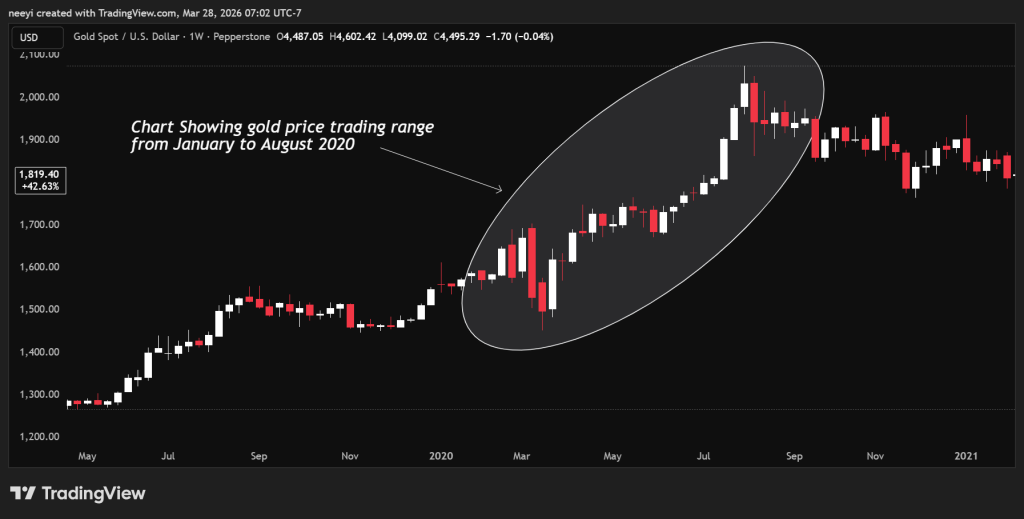
Gold Price Move in 2020 / Source: TradingView.com
Why Investors Continue to Choose Gold as a Safe Haven Asset
Gold remains attractive for several fundamental reasons that continue to hold true across decades.
Gold acts as a safe haven during geopolitical tensions or financial instability. Investors often move funds into gold when traditional markets become uncertain.
Gold carries no counterparty risk. Its value does not depend on a company or government fulfilling obligations, which makes it unique compared to stocks or bonds.
Gold has a long track record of protecting against inflation. As fiat currencies lose purchasing power, gold tends to hold or increase its value because supply cannot be expanded at will.
Gold helps diversify portfolios. It often behaves differently from stocks and bonds, which helps reduce overall risk exposure during market downturns.
Gold also provides currency protection. Since it is priced globally in US dollars, it can help offset the effects of a weakening currency.
Liquidity remains another key advantage. Gold can be converted into cash in most parts of the world without major difficulty.
Gold Price Outlook for 2030 Based on Major Forecasts
Gold currently trades around $4,500 per ounce. A $5,000 investment today represents exposure to a stable asset that aims to preserve value over time.
Several projections offer insight into where gold price could head by 2030.
J.P. Morgan expects gold to reach between $8,000 and $8,500 per ounce. This outlook is based on increased demand from central banks and higher household allocations toward gold.
Yardeni Research presents a more aggressive scenario, placing gold above $10,000. This view focuses on long-term inflation pressures and policy decisions that weaken fiat currencies.
InvestingHaven estimates gold could reach around $8,150. This projection considers a multi-stage bull cycle driven by sustained inflation concerns.
Extreme Gold Price Predictions Reflect Economic Crisis Scenarios
Some projections go far beyond conventional expectations and rely on severe economic disruption.
Pierre Lassonde believes gold could climb to $17,250 per ounce. His view centers on rising global debt levels and a major shift away from fiat reserves toward gold.
Robert Kiyosaki takes an even more extreme stance, placing gold at $35,000. His outlook assumes a deep financial breakdown that pushes investors toward assets considered real money.
Yardeni Research also appears again in this group with its $10,000+ scenario tied to what it describes as a policy-driven supercycle.
| Predictor |
| Gold Price Target By 2030 |
| — |
| J.P. Morgan |
| $8,000 to $8,500 |
| Yardeni Research |
| $10,000+ |
| InvestingHaven |
| $8,150 |
| Pierre Lassonde |
| $17,250 |
| Robert Kiyosaki |
| $35,000 |
How Much $5,000 In Gold Could Be Worth By 2030
At a current price of $4,500 per ounce, $5,000 buys a little over 1.1 ounces of gold.
Using the projections above, here is how that investment could translate by 2030.
| Gold Price Target |
| Estimated Value Of $5,000 Investment |
| — |
| $8,000 |
| ~$8,800 |
| $8,500 |
| ~$9,350 |
| $10,000 |
| ~$11,000 |
| $17,250 |
| ~$19,000 |
| $35,000 |
| ~$38,500 |
These estimates assume a direct price increase without factoring in transaction costs or market spreads.
Gold Price Remains Tied To Economic Conditions More Than Charts
Gold does not move based on technical setups alone. Economic conditions, inflation levels, central bank activity, and currency strength all play major roles in its direction.
Predictions from major institutions and well-known figures reflect different expectations about how the global economy could evolve. Some forecasts assume stable inflation, while others expect major disruptions.
Indicator That Called Bittensor (TAO) Rally Now Says “Sell”: Here’s The Outlook_**
What remains consistent is gold’s role as a store of value. Even if the most aggressive targets do not materialize, gold has historically preserved purchasing power across decades.
Disclaimer: The information on this page may come from third parties and does not represent the views or opinions of Gate. The content displayed on this page is for reference only and does not constitute any financial, investment, or legal advice. Gate does not guarantee the accuracy or completeness of the information and shall not be liable for any losses arising from the use of this information. Virtual asset investments carry high risks and are subject to significant price volatility. You may lose all of your invested principal. Please fully understand the relevant risks and make prudent decisions based on your own financial situation and risk tolerance. For details, please refer to
Disclaimer.


