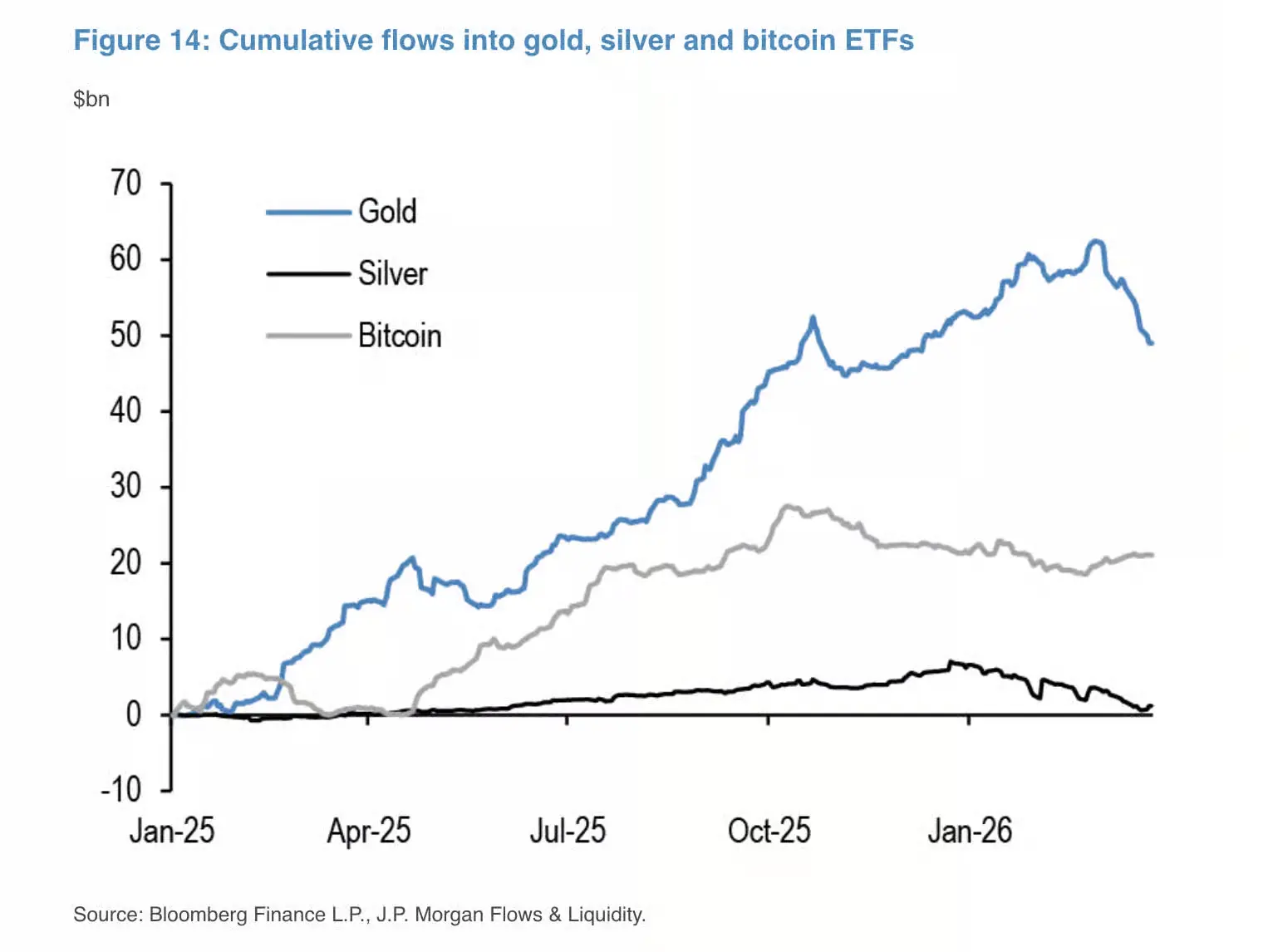
JPMorgan Chase Managing Director Nikolaos Panigirtzoglou and his research team released a report on March 26, noting that amid the Iran war outbreak, Bitcoin has performed significantly better than gold and silver. The report shows that gold has been under dual pressure from rising interest rates and a strengthening dollar, declining about 15% so far this month. In the first three weeks of March, gold ETFs saw nearly $11 billion in outflows, while Bitcoin experienced net inflows during the same period.
Three-week capital flow divergence: gold “crowded positions” liquidated, Bitcoin net inflow
 (Source: JPMorgan)
The JPMorgan report reveals the deeper causes of this decline. Gold and silver previously reached early-year all-time highs—gold approaching $5,500 per ounce, silver near $120 per ounce—creating highly concentrated bullish positions. When macro conditions changed, these “crowded positions” triggered a chain reaction of profit-taking and forced liquidations.
Institutional holdings, indicated by CME open interest data, show that futures positions in gold and silver rose to highs from late 2024 to early 2025, then sharply declined starting January 2026, indicating systematic exit by institutional investors. Bitcoin futures holdings have remained relatively stable in recent weeks, with no comparable outflows.
Momentum traders further amplified market divergence. The report notes that momentum signals for gold and silver fluctuated wildly between “overbought” and “below neutral” levels, with forced liquidations playing a significant role in recent declines. Bitcoin’s momentum signals shifted from “oversold” back to “neutral,” suggesting improving market sentiment.
Surge in Iran crypto activity: Bitcoin’s borderless nature tested under geopolitical pressure
JPMorgan cites Chainalysis data indicating that after the outbreak of war in Iran, local crypto activity surged sharply, with people transferring funds from domestic exchanges to self-custody wallets and international platforms to evade capital controls and currency devaluation risks.
The report explicitly states that Bitcoin’s borderless, self-custody, and 24/7 trading capabilities make it the preferred tool for capital transfer during times of economic instability, currency pressure, and capital controls. Analysts summarized: “The surge in Iran’s crypto activity highlights the role of cryptocurrencies as a safe haven asset in countries experiencing economic and monetary instability and geopolitical stress.”
Liquidity landscape reversal: Bitcoin market breadth surpasses gold
JPMorgan uses the Hui-Heubel ratio to quantify market breadth and liquidity. Results show that historically, gold has been more liquid than silver and Bitcoin, but this pattern has recently reversed: gold’s liquidity has deteriorated, and Bitcoin’s market breadth now exceeds gold; silver’s liquidity has declined the most, further amplifying its price volatility.
The report directly states: “Funds flowing into silver ETFs have wiped out all inflows since last summer. The deterioration in gold’s liquidity has led to its market breadth falling below Bitcoin.” This reversal in liquidity dynamics is especially significant under market stress—assets with ample liquidity can absorb large trading volumes at lower prices, reinforcing Bitcoin’s structural position in this capital rotation.
FAQs
How does JPMorgan define Bitcoin’s “safe haven” characteristics during wartime?
JPMorgan cites multiple indicators—net inflows into Bitcoin, surge in local Iranian crypto activity, and stable futures positions—to characterize Bitcoin as an asset with safe haven qualities during geopolitical and monetary instability. The core reasons are Bitcoin’s borderless nature, self-custody capability, and 24/7 liquidity.
Why did gold drop sharply during the Iran war?
JPMorgan points out that gold had previously formed “crowded positions” and approached a historic high near $5,500 per ounce. When macro headwinds from rising interest rates and a stronger dollar emerged, many long positions were forced to close, with nearly $11 billion in ETF outflows in the first three weeks of March accelerating the decline.
What does Bitcoin’s liquidity surpassing gold imply?
According to JPMorgan’s Hui-Heubel ratio, Bitcoin’s recent market breadth has exceeded that of gold, meaning Bitcoin can absorb larger trading volumes at relatively lower prices. This is an important market structure signal for institutional investors, indicating ongoing improvement in Bitcoin’s market depth.
Disclaimer: The information on this page may come from third parties and does not represent the views or opinions of Gate. The content displayed on this page is for reference only and does not constitute any financial, investment, or legal advice. Gate does not guarantee the accuracy or completeness of the information and shall not be liable for any losses arising from the use of this information. Virtual asset investments carry high risks and are subject to significant price volatility. You may lose all of your invested principal. Please fully understand the relevant risks and make prudent decisions based on your own financial situation and risk tolerance. For details, please refer to
Disclaimer.


