The Irish Criminal Assets Bureau (CAB) announced that they successfully cracked one of the 12 Bitcoin wallets held by convicted drug dealer Clifton Collins. These wallets had been considered permanently inaccessible after years of seizure, with the access keys believed to be lost forever. On Tuesday, the Bitcoin wallet labeled “Clifton Collins: Lost Keys” on the Arkham platform transferred 500 Bitcoins to an exchange.
Collins’ Bitcoin Legend: A Decade-Long Story of Drug Money and 6,000 Bitcoins
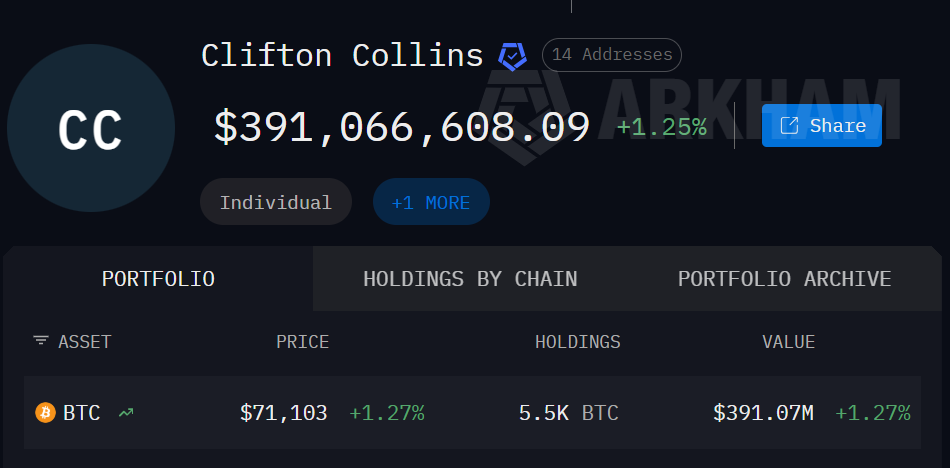 (Source: Arkham)
Collins was an Irish drug dealer sentenced to five years in prison for cultivating and selling cannabis. Investigators found that between late 2011 and early 2012, he used proceeds from drug sales to purchase 6,000 Bitcoins, which were stored across 12 Bitcoin wallets.
In 2017, Irish police searched Collins’ vehicle and found large quantities of cannabis, leading to his arrest. The 12 Bitcoin wallets were confiscated, but the real challenge was that the access keys had already been lost.
The Lost Keys Saga and a Key Breakthrough by Europol
Collins handwritten the access keys for the 12 wallets on a sheet of A4 paper and hid it inside a fishing rod case with an aluminum lid in his rented house. However, after his arrest and imprisonment, the landlord cleared out the rental property and disposed of his belongings. Collins claimed the fishing rod case had been stolen before the landlord entered, but regardless, the sheet with all the keys disappeared.
Key Timeline of the Bitcoin Wallets’ Lost Keys Case
2011–Early 2012: Collins purchased 6,000 Bitcoins with drug money; keys handwritten on A4 paper and hidden in a fishing rod case.
2017: Collins was arrested; Bitcoin wallets were confiscated, but the access keys disappeared with the fishing rod case.
Post-Imprisonment: Landlord cleared the rental; the fishing rod case and the key sheet are missing.
Recent: Europol provided “highly complex technical expertise and decryption resources” in The Hague; CAB successfully cracked one of the wallets.
This Tuesday: The cracked Bitcoin wallet transferred 500 Bitcoins to Coinbase Prime.
Typically, once Bitcoin private keys are lost, the assets become permanently inaccessible, as public key cryptography is designed to prevent brute-force cracking. Europol’s technical intervention was deemed the critical factor in this successful operation by CAB.
Significance of the 500 Bitcoin Transfer
The transfer of 500 Bitcoins to Coinbase Prime marks the Irish authorities’ official move to manage this dormant digital asset, which has been held for over a decade. It also sets a rare precedent for law enforcement agencies worldwide in cracking “lost key” encrypted assets.
Currently, Arkham data shows Collins holds about 5,500 Bitcoins across 14 addresses, but whether all keys for the 12 wallets have been recovered remains unconfirmed. Cointelegraph has reached out to CAB and the Irish Police for further details.
Frequently Asked Questions
How did Irish police crack Collins’ Bitcoin wallet keys?
According to CAB, Europol provided “highly complex technical expertise and decryption resources” in The Hague, which was crucial to the operation’s success. The specific technical methods have not been disclosed, but this case challenges the conventional belief that “Bitcoin private keys, once lost, are permanently unrecoverable.”
How much total assets did Collins’ Bitcoin wallets hold?
Based on Arkham data, Collins’ 14 addresses hold approximately 5,500 Bitcoins, worth over $391 million at current prices. He initially bought 6,000 Bitcoins between 2011 and 2012, stored across 12 wallets.
Can Bitcoin private keys usually be recovered?
Generally, no. Bitcoin’s cryptographic design makes brute-force cracking nearly impossible with current computing power. The success in this case likely involved discovering clues related to the keys or using special technical methods, not just cryptographic brute-force attacks. The exact approach has not been publicly disclosed.
Disclaimer: The information on this page may come from third parties and does not represent the views or opinions of Gate. The content displayed on this page is for reference only and does not constitute any financial, investment, or legal advice. Gate does not guarantee the accuracy or completeness of the information and shall not be liable for any losses arising from the use of this information. Virtual asset investments carry high risks and are subject to significant price volatility. You may lose all of your invested principal. Please fully understand the relevant risks and make prudent decisions based on your own financial situation and risk tolerance. For details, please refer to
Disclaimer.


