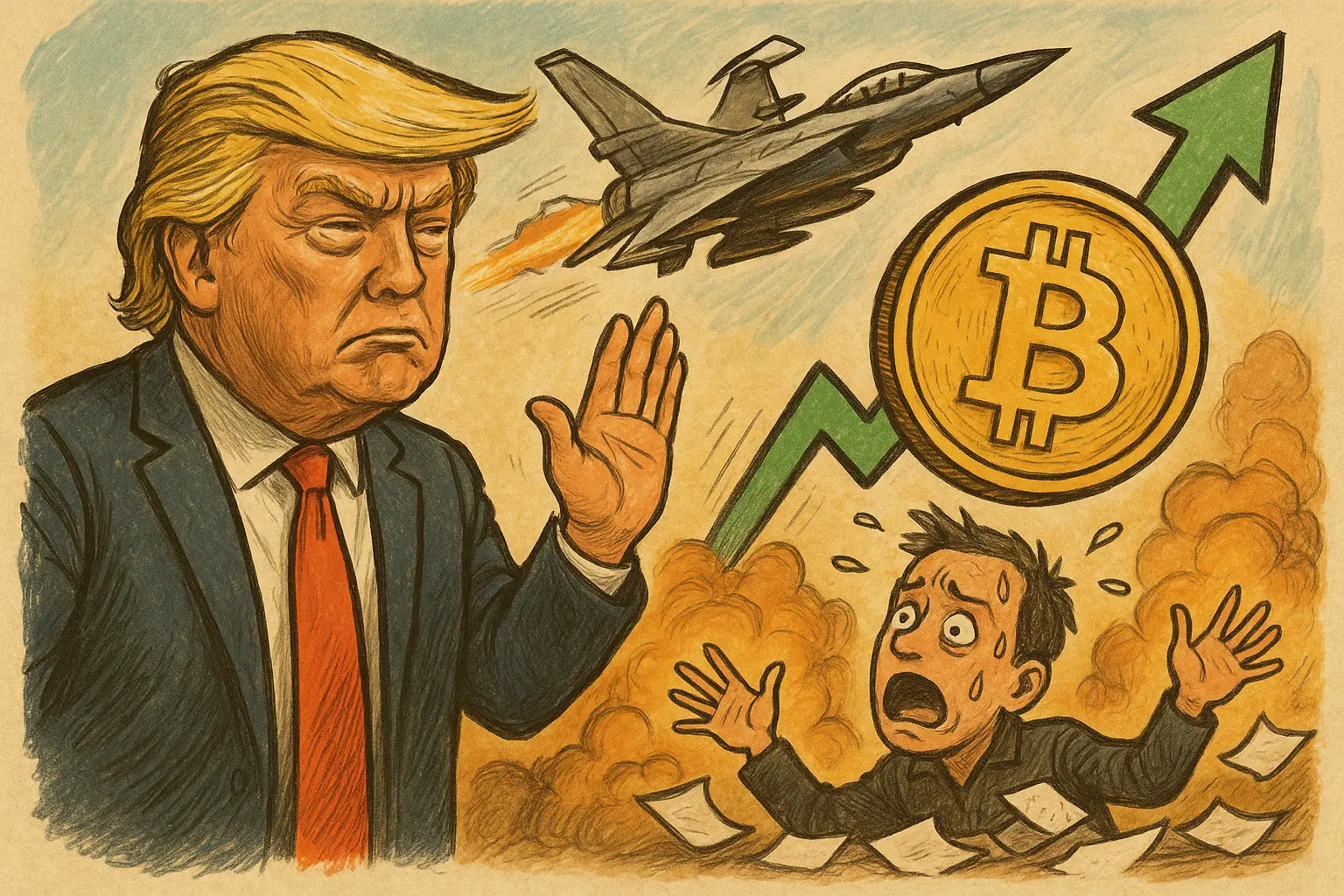
President Trump issued a statement on Truth Social, indicating that the US and Iran have begun negotiations. The US has decided to delay the planned strike on Iran’s power plants and energy infrastructure by five days, describing the communication between both sides as “very good and productive.” On March 24, Bitcoin surged to $71,000, erasing most of this week’s losses; according to CoinGlass data, over $160 million worth of Bitcoin short positions were forcibly liquidated.
Trump Statement: Major Geopolitical Shift Triggers Market Repricing
Why did Bitcoin rise today? The core reason is a policy signal that revalues the “worst-case scenario.” Over the weekend, the market widely expected the US military to strike Iran’s energy facilities after a 48-hour ultimatum expired, putting Bitcoin and global risk assets under pressure. Trump’s shift in tone reset this expectation—conflict did not escalate immediately, and the market quickly judged that the “short-term worst-case scenario has been temporarily postponed,” prompting funds to flow back into risk assets.
The S&P 500 futures surged over 2.5% after the news, while WTI crude oil fell nearly 6%, reflecting a typical “relief from escalation fears” asset movement. During this conflict, Bitcoin and the S&P 500 showed a correlation as high as 89%, both benefiting from a rapid rebound in risk appetite.
$160 Million Short Squeeze: Complete Analysis of the Short Covering
Notably, this rebound’s strength far exceeds typical geopolitical easing rallies, primarily due to a large-scale liquidation of short positions.
Short Liquidation Scale: Over $160 million in BTC/USD short positions were forcibly liquidated within minutes.
Background of Short Positions: During the weekend, many traders anticipated escalation and preemptively established short positions betting on Bitcoin’s continued decline.
Trigger Mechanism: After Trump’s statement, Bitcoin rapidly surged, reaching the liquidation price levels of many shorts, triggering a chain reaction of long chasing.
Market Health Signal: Financing rates rose only slightly, and open interest did not return to the year’s high, indicating this rally was mainly driven by spot demand and short covering rather than excessive leverage—suggesting a sustainable rebound characteristic.
Technical Outlook: $71,500 is the Key Close for Confirming Uptrend
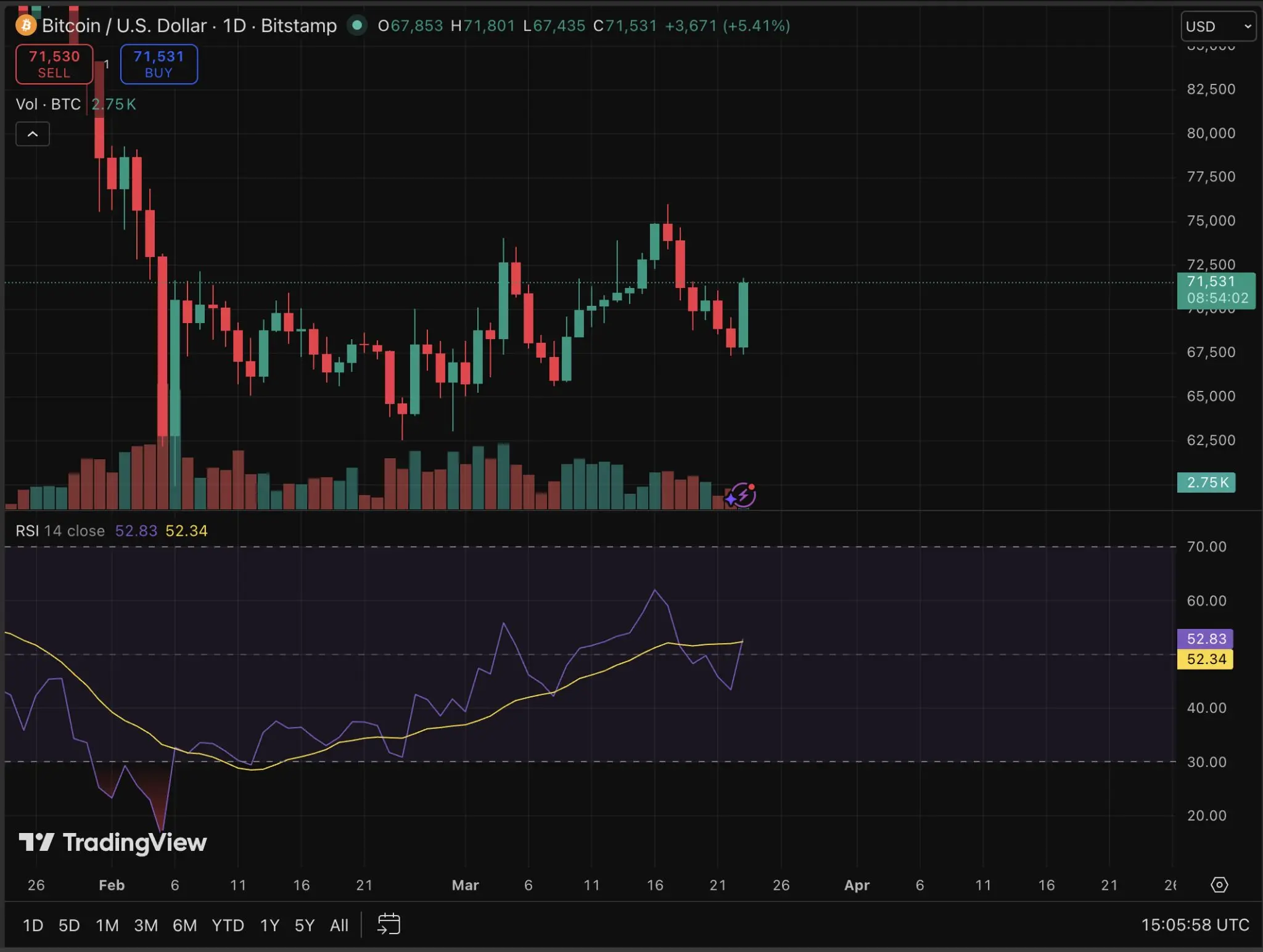 (Source: TradingView)
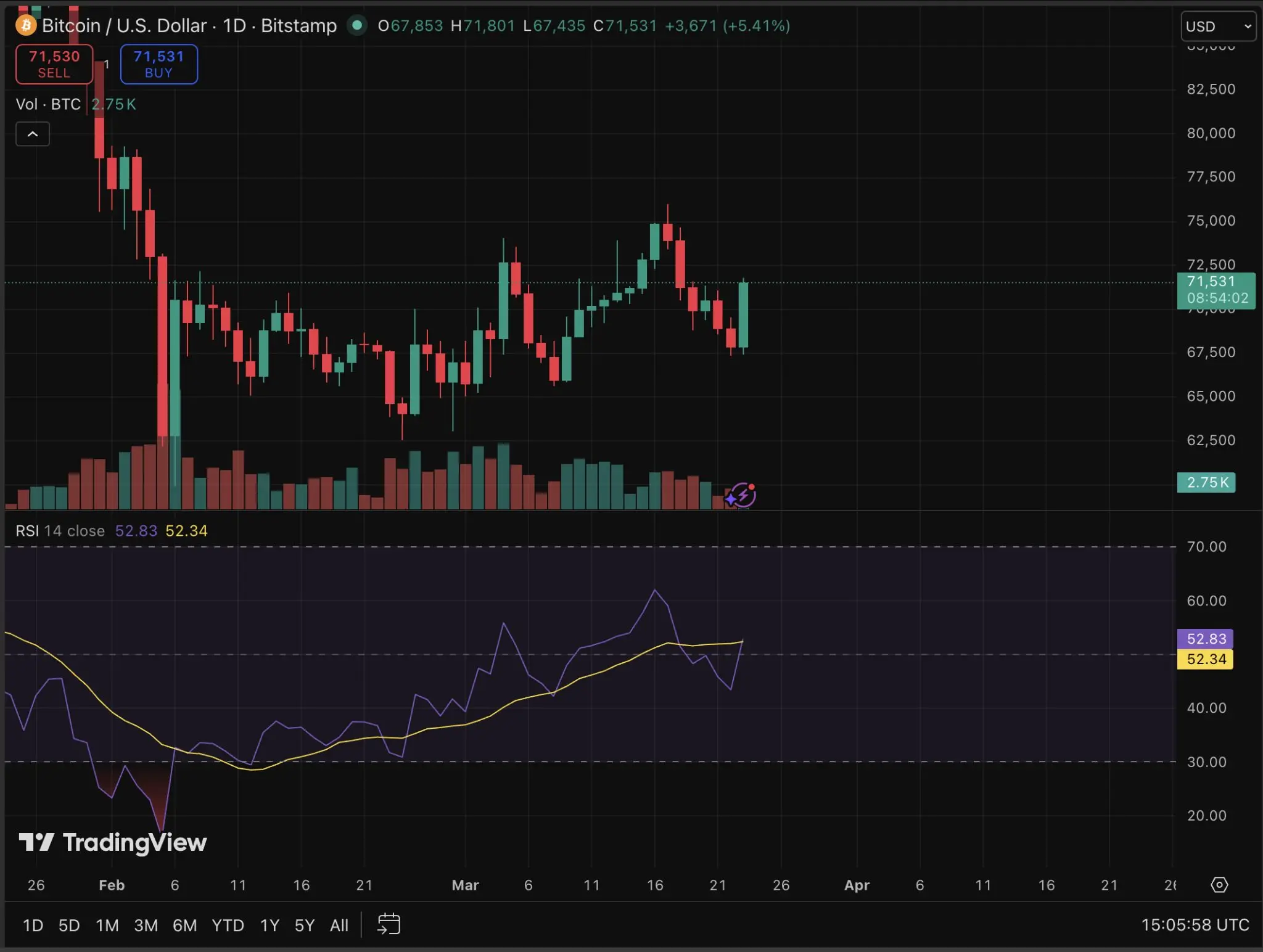
Bitcoin is currently at $71,450, approaching the psychological barrier of $72,000. From a low of $67,000, the rebound confirmed strong demand support near the 50-day moving average. The 4-hour RSI has recovered from oversold to around neutral 52, indicating upward momentum remains.
Bullish traders need to see a daily close above $71,500 to confirm this rebound as a continuation of the uptrend rather than a short-lived dead-cat bounce. If the price effectively breaks through $72,000, the next targets are $74,000 to $74,700. Conversely, if it fails to hold above $68,500, there is a risk of retracing to test the liquidity pool at $66,200.
Currently, traders are focused on the situation after the five-day buffer period ends—any signs of renewed escalation could trigger another wave of market volatility.
Frequently Asked Questions
Why did Bitcoin rise today? What is the core trigger?
The main trigger was Trump’s announcement on March 23 to delay the strike on Iran’s energy facilities by five days, stating that the US and Iran have engaged in “productive” talks. This statement directly eased market fears of immediate military escalation, rapidly boosting global risk appetite, and Bitcoin quickly surged from the $67,000 low to above $71,000.
Why was this rebound so strong? How did the $160 million liquidation happen?
Over the weekend, many traders anticipated escalation and established short positions. After Trump’s statement, Bitcoin rebounded quickly, reaching the liquidation thresholds of many shorts, causing a chain reaction of short squeeze. Over $160 million in short positions were forcibly liquidated within minutes, amplifying the upward move.
Can Bitcoin continue to rise to $74,000?
Technical signals suggest bulls need a daily close above $71,500 to confirm the uptrend. If it breaks through $72,000, the next targets are $74,000 to $74,700. However, the geopolitical situation after the five-day buffer ends remains the biggest uncertainty—any renewed escalation could suppress Bitcoin’s upward potential.
Disclaimer: The information on this page may come from third parties and does not represent the views or opinions of Gate. The content displayed on this page is for reference only and does not constitute any financial, investment, or legal advice. Gate does not guarantee the accuracy or completeness of the information and shall not be liable for any losses arising from the use of this information. Virtual asset investments carry high risks and are subject to significant price volatility. You may lose all of your invested principal. Please fully understand the relevant risks and make prudent decisions based on your own financial situation and risk tolerance. For details, please refer to
Disclaimer.


