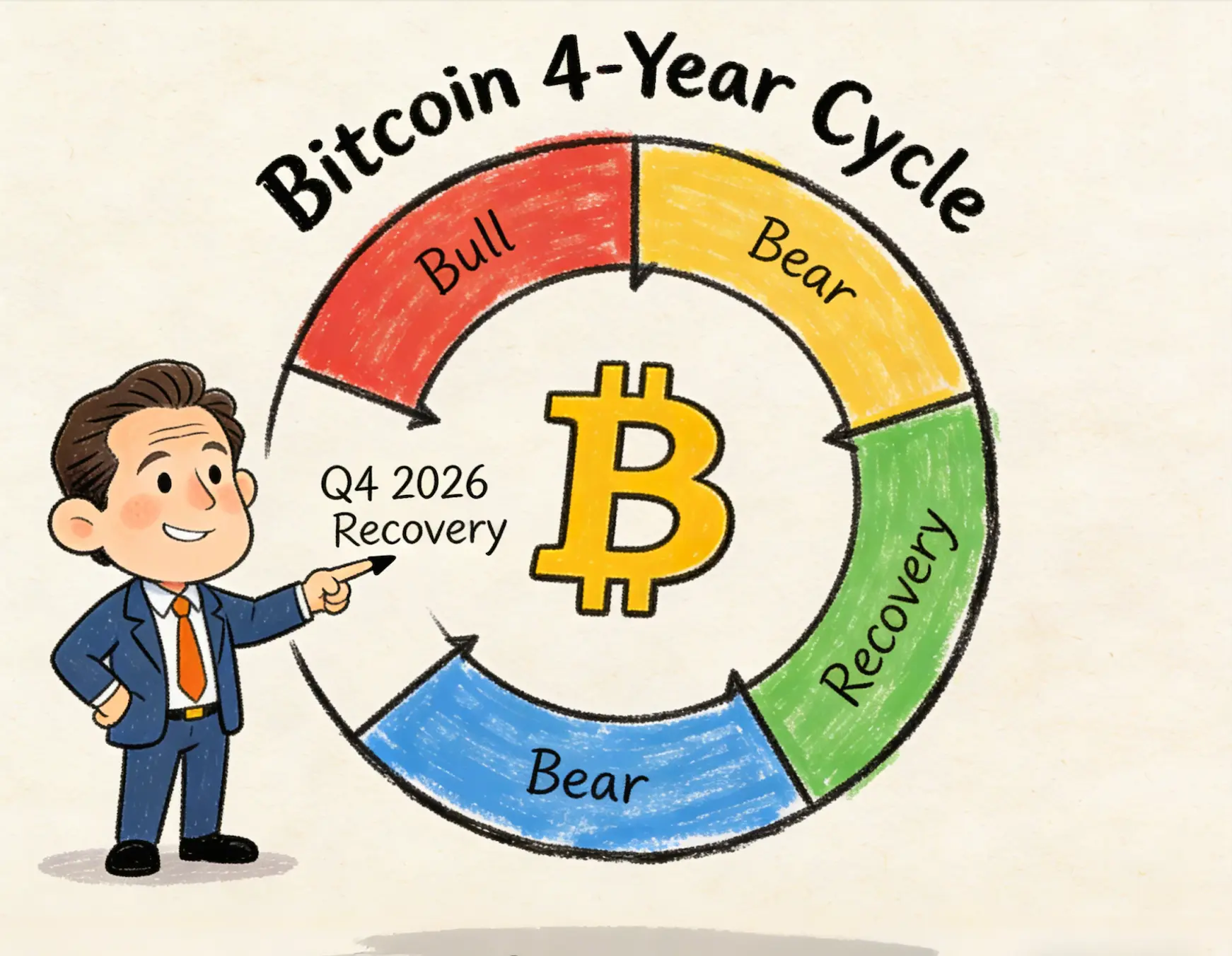
 SkyBridge Capital Managing Partner Anthony Scaramucci stated in a March 22, 2026, interview that Bitcoin’s current bear market is consistent with the cryptocurrency’s traditional four-year cycle, projecting choppy price action for most of the year before a new bull market begins in the fourth quarter of 2026.
Scaramucci attributed the downward pressure to long-term holders selling at the $100,000 psychological level, creating a self-fulfilling prophecy among market participants who believe in the cyclical pattern. While he acknowledged that institutional investors and spot Bitcoin exchange-traded fund (ETF) inflows have muted volatility and made the cycle more gradual, he maintained that changing market dynamics have not fully eliminated the traditional four-year structure.
The forecast comes as Bitcoin trades near $68,000, down approximately 45% from its October 2025 all-time high of $126,000, with the Iran conflict weighing on risk assets across global markets.
Four-Year Cycle Theory and Self-Fulfilling Dynamics
Historical Pattern Context
Proponents of Bitcoin’s four-year cycle theory observe that the cryptocurrency typically rises for three of the four years and declines in the final year. The current downturn follows a period of widespread expectations that Bitcoin would climb to $150,000 in 2025, driven by President Donald Trump’s pro-crypto agenda and U.S. regulators warming to the digital asset industry. The October 2025 market crash, which dragged Bitcoin from $126,000 to approximately $60,000, shattered that consensus.
Scaramucci explained the dynamic: “We’re in a four-year cycle, and there were some traditional whales, some OGs, that believe in the four-year cycle, and guess what happens in life when you believe in something? You create a self-fulfilling prophecy.”
Institutional Impact on Cycle Structure
Scaramucci noted that Bitcoin’s four-year market cycle has been “muted” by institutional investors and inflows from spot Bitcoin ETFs, which have cushioned volatility compared to previous cycles. However, he emphasized that these altered market dynamics have not fully erased Bitcoin’s traditional cycles—only made them more gradual.
Market Psychology and Historical Parallels
FTX Collapse Precedent
Scaramucci cited Bitcoin’s price action following the November 2022 collapse of FTX as an example of markets moving opposite to prevailing investor sentiment. “It was at a period of great disinterest and great apathy that the bull market started again,” he said, drawing a parallel to the current environment.
He characterized the current downturn as a “garden variety” correction consistent with previous cycles, distinguishing it from structural changes that would permanently alter Bitcoin’s market behavior.
Expectations vs. Reality
Scaramucci noted that market participants, including himself, widely expected Bitcoin to reach $150,000 in 2025. The sharp reversal from the October peak fundamentally reshaped market sentiment, reinforcing the cyclical pattern where markets often move against prevailing expectations.
Geopolitical Headwinds and Market Impact
Iran Conflict Effects
Bitcoin fell below $69,000 on March 21 as the Iran conflict entered its third week, jolting risk assets across global markets. The S&P 500 extended its decline on March 20, dropping approximately 1.3%, and closed below its 200-day moving average for the first time in 10 months—a key technical indicator closely watched to assess the overall trend of equities markets.
Correlation Concerns
Some analysts have warned of a potential 50% drop in Bitcoin’s price in 2026 if it continues to exhibit a positive correlation with the S&P 500 index. The ongoing geopolitical turmoil adds uncertainty to the timing and magnitude of any recovery.
Ongoing Market Debate
Cycle Validity Questions
The current market environment has intensified debate among crypto industry executives, analysts, and market participants about whether Bitcoin’s four-year cycle theory remains valid after BTC ended 2025 in the red. Key questions center on whether changing market dynamics—including institutional adoption, ETF inflows, and regulatory evolution—have permanently altered how Bitcoin’s price moves.
Scaramucci’s Position
Despite these debates, Scaramucci maintains that while institutional participation has muted volatility, the underlying cyclical structure remains intact. He projects choppy price action through most of 2026, with a new bull market cycle beginning in the fourth quarter.
Frequently Asked Questions
What is the Bitcoin four-year cycle theory?
The four-year cycle theory observes that Bitcoin’s price typically follows a pattern where it rises for three consecutive years and declines in the fourth year. This pattern has been observed across multiple market cycles and is often tied to Bitcoin’s halving events, which reduce mining rewards approximately every four years and historically precede significant price rallies.
Why does Anthony Scaramucci believe the current bear market is part of the four-year cycle?
Scaramucci attributes the current downturn to long-term holders selling at the $100,000 psychological level, creating a self-fulfilling prophecy among market participants who believe in the cycle. He notes that while institutional investors and ETF inflows have muted volatility, they have not eliminated the underlying cyclical structure—only made it more gradual than in previous cycles.
What factors could influence Bitcoin’s recovery timeline?
Scaramucci projects choppy price action for most of 2026, with a new bull market beginning in the fourth quarter. Key factors to watch include geopolitical developments, particularly the Iran conflict, the trajectory of U.S. interest rates, continued ETF flows, and whether the S&P 500 correlation persists. The ongoing debate over whether institutional adoption has permanently altered Bitcoin’s cycle dynamics also remains a key variable for market participants.
Disclaimer: The information on this page may come from third parties and does not represent the views or opinions of Gate. The content displayed on this page is for reference only and does not constitute any financial, investment, or legal advice. Gate does not guarantee the accuracy or completeness of the information and shall not be liable for any losses arising from the use of this information. Virtual asset investments carry high risks and are subject to significant price volatility. You may lose all of your invested principal. Please fully understand the relevant risks and make prudent decisions based on your own financial situation and risk tolerance. For details, please refer to
Disclaimer.


