Alvaro Rosenblüth, treasury and exchange manager at Banco de Crédito de Bolivia, stated that the Central Bank of Bolivia lifted the ban on cryptocurrency operations out of necessity. Stablecoins are now acting as a dollar proxy, enabling remittances and payments to combat the dollar shortage.
Bolivia’s Crypto Pivot Was Executed out of Necessity, Says Bank Executive
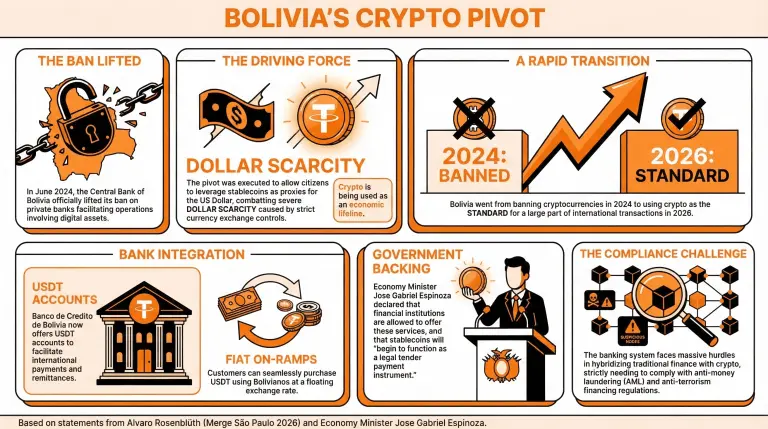
As cryptocurrency is now being used as a useful tool in Bolivia, analysts examine the pivot the country executed since June 2024, when the central bank lifted the ban on private banks facilitating operations involving digital assets.
Alvaro Rosenblüth, treasury and exchange manager at Banco de Credito de Bolivia, discussed the subject at Merge São Paulo 2026, an event focusing on digital assets and financial infrastructure.
He stated that Bolivia lifted the cryptocurrency ban to allow its citizens to leverage cryptocurrency, especially stablecoins, as dollar proxies to face the growing dollar scarcity the country has faced for years due to its currency exchange controls.
He stated:
“That’s why our central bank lifted the crypto ban. We now offer USDT and other stablecoins.”
“Imagine having a country that banned cryptocurrencies in 2024, and now crypto is the standard in 2026. A large part of international transactions nowadays is done with crypto,” he stressed, highlighting the growing adoption of crypto to support these use cases in limited economic environments.
Banco de Credito de Bolivia offers USDT accounts to facilitate international payments and remittances. Bank customers can also purchase USDT with Bolivian Bolivianos, the fiat currency, at a floating exchange rate.
In November, Bolivia’s Economy Minister, Jose Gabriel Espinoza, declared that financial institutions would be allowed to offer cryptocurrency services. Espinoza also referred to stablecoins, stating that they would “begin to function as a legal tender payment instrument.”
Nonetheless, this implementation process has faced difficulties. Rosenblüth pointed out compliance as one of the biggest challenges of the banking system’s hybridization, as these financial institutions must comply with current regulations and ensure crypto assets are not used to launder money or finance terrorist activities.
FAQ 🔎
- Why did Bolivia lift its ban on cryptocurrency? The central bank reversed the ban to allow citizens to use stablecoins as dollar alternatives amid a national dollar shortage.
- How are Bolivian banks utilizing crypto in 2026? Financial institutions like Banco de Credito de Bolivia now offer USDT accounts to facilitate international payments and remittances.
- What is the current legal status of stablecoins in Bolivia? The Economy Minister declared that stablecoins are now permitted to function as a legal tender payment instrument within the country.
- What challenges do Bolivian banks face with this new integration? The primary hurdle is ensuring strict regulatory compliance to prevent money laundering and terrorist financing.
Disclaimer: The information on this page may come from third parties and does not represent the views or opinions of Gate. The content displayed on this page is for reference only and does not constitute any financial, investment, or legal advice. Gate does not guarantee the accuracy or completeness of the information and shall not be liable for any losses arising from the use of this information. Virtual asset investments carry high risks and are subject to significant price volatility. You may lose all of your invested principal. Please fully understand the relevant risks and make prudent decisions based on your own financial situation and risk tolerance. For details, please refer to
Disclaimer.


