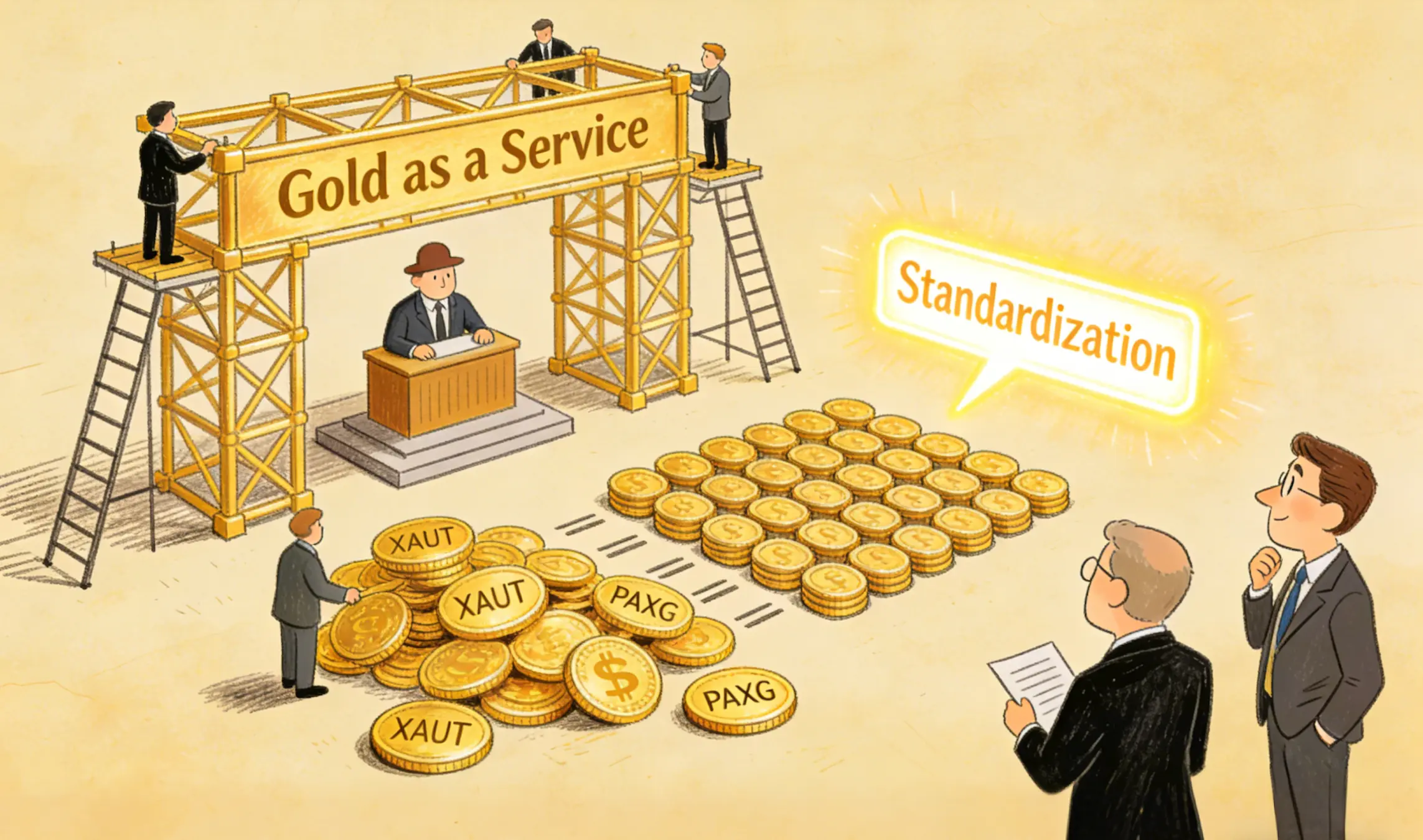
 The World Gold Council (WGC), the organization behind the $163 billion SPDR Gold Shares ETF (GLD), unveiled a proposed “Gold as a Service” infrastructure framework on March 19, 2026, designed to standardize the tokenized gold market currently dominated by Tether Gold (XAUT) and PAX Gold (PAXG).
The initiative, developed in partnership with Boston Consulting Group (BCG), would create an open platform connecting physical gold custody with digital issuance systems, enabling continuous audits, interoperability across products, and standardized redemption rights. The proposal aims to address structural barriers that have kept the combined market capitalization of tokenized gold at $4.9 billion after five years, compared to GLD’s $163 billion.
If adopted, the framework could transform a market that crypto-native firms built from scratch through proprietary custody arrangements, potentially opening the door for hundreds of new issuers and challenging the competitive advantages Tether and Paxos developed through their bespoke systems.
The Tokenized Gold Market: Current Landscape
Market Size and Dominant Players
Tokenized gold has grown to a combined market capitalization of approximately $4.9 billion across its two leading products:
Tether Gold (XAUT) : $2.6 billion market cap, with reserves stored in a Swiss vault that once operated as a Cold War-era nuclear bunker
PAX Gold (PAXG) : $2.2 billion market cap, with reserves held in London vaults managed by security firm Brink’s
Both products launched approximately five years ago and have grown through proprietary custody pipelines, independent audit processes, and bespoke redemption frameworks.
Structural Barriers to Growth
The WGC’s white paper identifies several factors limiting tokenized gold adoption:
Fragmentation: Each product operates through its own custody pipeline, creating lack of fungibility across different gold tokens
High entry barriers: New issuers must solve complex custody, insurance, and logistics challenges independently
Carry costs: Unlike stablecoins backed by cash and U.S. Treasuries that generate income, gold in storage incurs vault costs, insurance, and logistics expenses with no yield
Trust deficits: Investors lack standardized verification mechanisms for physical backing
The contrast with traditional gold ETFs is stark: GLD alone carries a $163 billion market cap, more than 33 times the combined value of all tokenized gold products.
Gold as a Service: The WGC Proposal
Shared Infrastructure Model
The WGC’s “Gold as a Service” framework proposes an open platform that would:
Standardize custody coordination: Connect physical gold custody with digital issuance through shared backend infrastructure
Enable continuous audits: Provide ongoing verification of physical reserves rather than periodic attestations
Establish consistent redemption rights: Create fungibility across different issuers’ products through standardized processes
Reduce barriers to entry: Allow any issuer to plug into existing infrastructure rather than building proprietary systems
Mike Oswin, the WGC’s Global Head of Market Structure and Innovation, compared the initiative to Intel’s iconic stickers on Windows-based laptops. “If you see that little symbol, you know that it’s Intel inside,” he said. “You’re getting the best processor, so you know you’re walking out with what you need.” Similarly, seeing the WGC’s standard on a gold token would signal to investors that it has verified physical backing.
Cost Structure Transformation
The shared infrastructure fundamentally changes the economics of launching tokenized gold products. By eliminating the need for each issuer to independently solve vault access, insurance, and logistics, the platform could make gold-backed tokens economically viable for hundreds of potential issuers rather than a handful of successful products.
Implications for Tether and Paxos
Challenging Proprietary Advantages
The WGC’s framework does not target XAUT or PAXG directly, positioning itself as complementary infrastructure for new entrants. However, standardization inherently challenges first movers who built competitive advantages through proprietary systems.
The custody moats that Tether and Paxos constructed—the Swiss nuclear bunker, the Brink’s-managed London vaults—become less defensible if hundreds of issuers can launch gold tokens using shared infrastructure with continuous audits, interoperability, and consistent redemption rights built in.
From Fragmentation to Fungibility
The current market features gold tokens that are not interchangeable across products. Each has its own custody pipeline, audit frequency, and redemption terms. A standardized backend would raise the floor for the entire market, potentially making tokenized gold more attractive to institutional investors who require consistency and verified backing.
WGC’s Track Record and Strategic Positioning
GLD’s Success
The WGC helped establish SPDR Gold Shares (GLD) in 2004, the first US-listed ETF backed by physical gold. GLD now carries a market cap of $163 billion, demonstrating the organization’s ability to create gold investment products at scale. The gap between GLD and the entire tokenized gold market reflects structural barriers that the WGC believes its platform can remove.
Industry Convener Role
The WGC has 29 member companies across the gold mining industry and describes itself as a neutral convener. It called on “innovators and market participants from inside and outside the gold industry” to help build the platform. BCG Managing Director Matthias Tauber framed the challenge directly: “The question is no longer whether gold will be digital; it’s how it can participate in modern financial systems without compromising physical integrity.”
Implementation and Outlook
Current Status
No timeline or implementation roadmap was disclosed in the proposal. The framework remains conceptual, and its success depends on industry-wide adoption and alignment across jurisdictions. The WGC’s research indicates that investors who self-custody their digital assets often prefer holding physical gold themselves, partly because of the bespoke custody arrangements required.
Market Potential
Oswin suggested the service could address barriers to entry for other firms, aligning with the WGC’s goal of promoting gold broadly. “Instead of a handful of successful products, this will potentially lead to hundreds of products that can now come to market,” he said. “The business case stands up much better because of the way they can access the physical gold in a simplified, more cost-effective way.”
For Tether and Paxos, the question is whether their five-year head start becomes a lasting advantage or a legacy system as the World Gold Council brings its institutional weight to tokenized gold infrastructure.
Frequently Asked Questions
What is the World Gold Council’s “Gold as a Service” proposal?
The WGC proposed an open infrastructure platform that would standardize custody coordination, continuous audits, and redemption rights for tokenized gold products. The framework would allow any issuer to plug into shared backend systems rather than building proprietary custody pipelines, potentially reducing barriers to entry and creating fungibility across different gold tokens.
How does this challenge Tether Gold and PAX Gold?
Tether and Paxos currently dominate tokenized gold with $4.9 billion in combined market cap, built through proprietary custody arrangements—Tether’s Swiss nuclear bunker vault and Paxos’s Brink’s-managed London facilities. The WGC’s standardized infrastructure would allow hundreds of new issuers to launch gold tokens without solving these complex logistics independently, potentially commoditizing the custody advantages that gave first movers their edge.
Why is the World Gold Council pursuing this initiative?
The WGC, which helped launch the $163 billion GLD gold ETF in 2004, views tokenization as an extension of its mission to promote gold access. The organization sees structural barriers—fragmentation, high entry costs, and lack of fungibility—limiting tokenized gold growth compared to traditional products. Standardized infrastructure could expand the market from a handful of products to hundreds, consistent with the WGC’s goal of broadening gold participation.


