
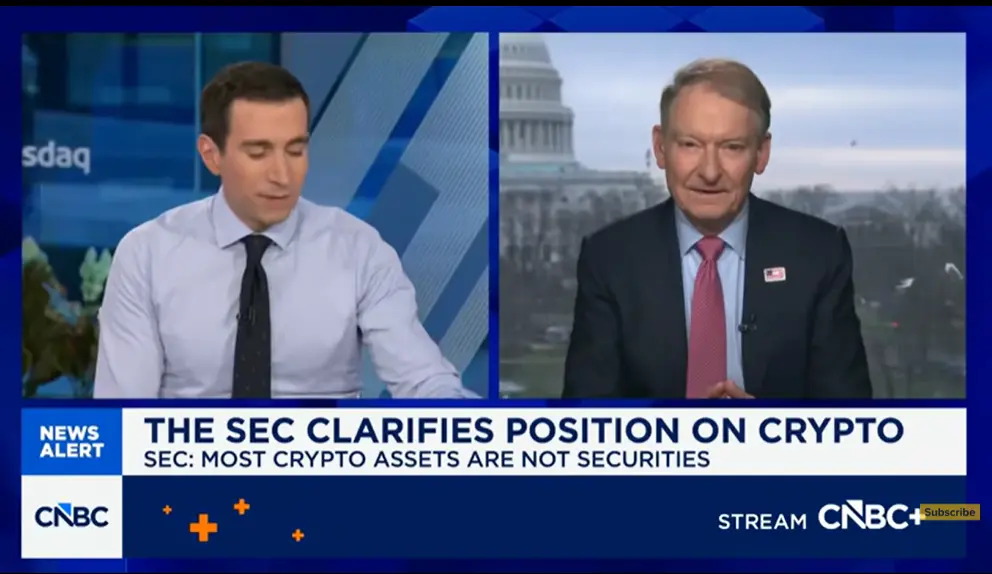
The U.S. Securities and Exchange Commission (SEC) Chairman Paul Atkins publicly explained on March 18 during an interview with CNBC why NFTs are generally not regulated under federal securities laws. Atkins pointed out that the SEC has issued interpretive guidance classifying digital collectibles like NFTs as “assets that typically do not constitute investment contracts,” reasoning that purchasing behavior is more akin to collecting physical items like baseball cards rather than investment tools.
Atkins’s Core Argument: NFTs Are “Unchangeable Purchases”
 (Source: CNBC)
When asked by CNBC host Andrew Ross Sorkin, Atkins clearly distinguished the fundamental difference between NFTs as collectibles and as investment contracts.
Atkins stated: “These collectibles, such as baseball cards, memes, or those meme coins, NFTs—these are things people buy. It’s an unchangeable purchase… unlike other assets that people trade.”
The core of his argument is that buying NFTs is a consumer activity—holders typically do not expect to profit through “others’ efforts.” This aligns with the long-standing Howey test used by the U.S. Supreme Court, which is central to determining whether an asset qualifies as an “investment contract.”
Atkins also emphasized that SEC’s determinations depend on the “facts and circumstances” of each asset, and not all NFT structures automatically avoid securities regulation.
SEC Interpretive Guidance: Four Types of Digital Assets Usually Not Securities
In this policy update, the SEC explicitly listed four categories of digital assets that are generally not subject to securities laws:
- Digital Commodities: Digital assets primarily characterized as commodities
- Digital Utilities: Tokens with specific functions or usage rights
- Digital Collectibles: Including NFTs, assets used for collecting like baseball cards
- Stablecoins: Coins pegged to fiat currencies or other assets
This framework provides a significant degree of legal clarity for the crypto industry, with the key premise that the main motivation for holding these assets is for ownership or use, not to generate investment returns through others’ efforts.
Regulatory Shift: Atkins Declares a Move Away from “Enforcement as Regulation”
This CNBC interview marks the latest step in Atkins’s ongoing push to shift the regulatory approach. He publicly criticized SEC’s past “enforcement over regulation” strategy in the crypto sector and committed to providing clear guidance instead of passive enforcement.
Atkins pointed out that past regulatory missteps have set back the U.S. by a decade in crypto development, and he explicitly characterized tokenization as a key innovation that should be supported rather than restricted. “We are drawing a line under the past,” Atkins said, emphasizing that SEC’s goal is to offer clearer guidance and a more predictable regulatory framework for digital assets.
Frequently Asked Questions
Why are NFTs generally not subject to U.S. securities laws?
SEC Chairman Atkins explained that NFTs are typically classified as collectibles, purchased and held by buyers without expectations of profit through others’ efforts. This does not meet the long-standing Howey test standard used by the U.S. Supreme Court, and thus generally does not qualify as an “investment contract” under securities law.
What types of digital assets does the SEC consider outside securities regulation?
The SEC’s interpretive guidance covers four categories of digital assets that are usually not securities: digital commodities, digital utilities, digital collectibles (including NFTs), and stablecoins, providing a structured legal reference for the industry.
Does Atkins completely rule out the possibility of NFTs being regulated as securities?
No, Atkins explicitly stated that SEC’s analysis still depends on the specific facts and circumstances of each asset. If a particular NFT’s structure creates a reasonable expectation of profit through others’ efforts, it could still be classified as an investment contract and subject to securities regulation.
Disclaimer: The information on this page may come from third parties and does not represent the views or opinions of Gate. The content displayed on this page is for reference only and does not constitute any financial, investment, or legal advice. Gate does not guarantee the accuracy or completeness of the information and shall not be liable for any losses arising from the use of this information. Virtual asset investments carry high risks and are subject to significant price volatility. You may lose all of your invested principal. Please fully understand the relevant risks and make prudent decisions based on your own financial situation and risk tolerance. For details, please refer to
Disclaimer.


