Author: Nancy, PANews
Bitcoin quietly recorded eight consecutive days of gains amid the smoke of Middle East conflicts, with the world’s largest Bitcoin strategy using real money to fuel this round of rebound with a blazing fire.
Half a month ago, Strategy (MicroStrategy) suddenly stepped on the accelerator, finally turning Bitcoin positions from losses to profits. In just one week, it accumulated over 40,000 Bitcoin, spending more than $2.8 billion. The size of this capital exceeds the net inflow into Bitcoin ETFs during the same period.
Behind Strategy’s vigorous activity, nearly half of the funds come from perpetual preferred stock STRC, contributing over 20,000 Bitcoin to the treasury. This financing tool, focused on stable returns, successfully packages highly volatile Bitcoin into a fixed-income product favored by traditional finance, continuously attracting funds from Wall Street and becoming a new growth engine for Strategy.
Single-day purchase volume exceeds five times the entire network output, making STRC a new financing weapon
In just a few months since its launch, STRC has transformed from an innovative tool into a powerful financing weapon in Strategy’s arsenal.
Data from STRC.live shows that since its launch in July 2025, STRC has issued 10 ATM (at-the-market) offerings, selling over 50.25 million units, injecting approximately 50,792 Bitcoin into Strategy’s treasury over eight months—equivalent to about $4.74 billion.
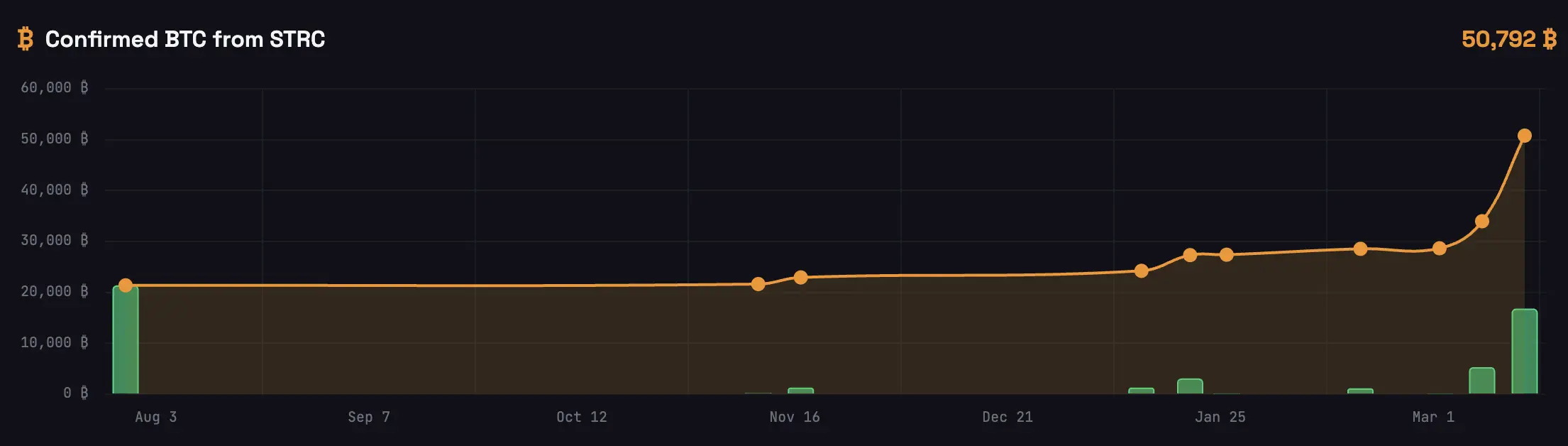
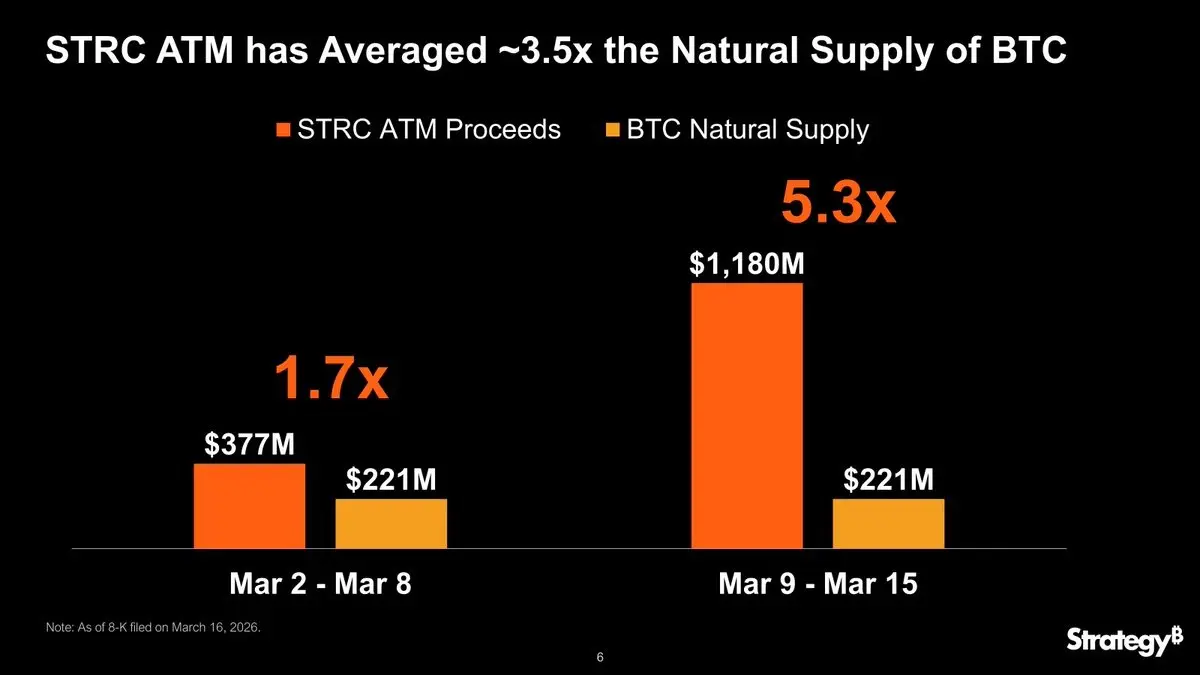
Especially in the past week, STRC contributed about 22,000 Bitcoin, accounting for 43.5% of the overall increase during that period, representing 54.8% of Strategy’s net increase. On March 9, it funded the purchase of 5,315 Bitcoin, equivalent to 1.7 times the total network mining output during the same period; on March 16, it reached 16,816 Bitcoin, about 5.3 times the network’s total production.
In fact, during this year’s sideways or even declining Bitcoin prices, demand for STRC has been rising.
As of March 18, STRC’s market cap exceeded $5.02 billion, up $2.08 billion from the end of last year, a 58.5% increase. From a trading perspective, after March began, daily trading volume of STRC rapidly expanded, once exceeding $740 million in a single day. Between March 9 and 13 alone, total trading volume reached $2.3 billion, with about 86% of transactions above $100.
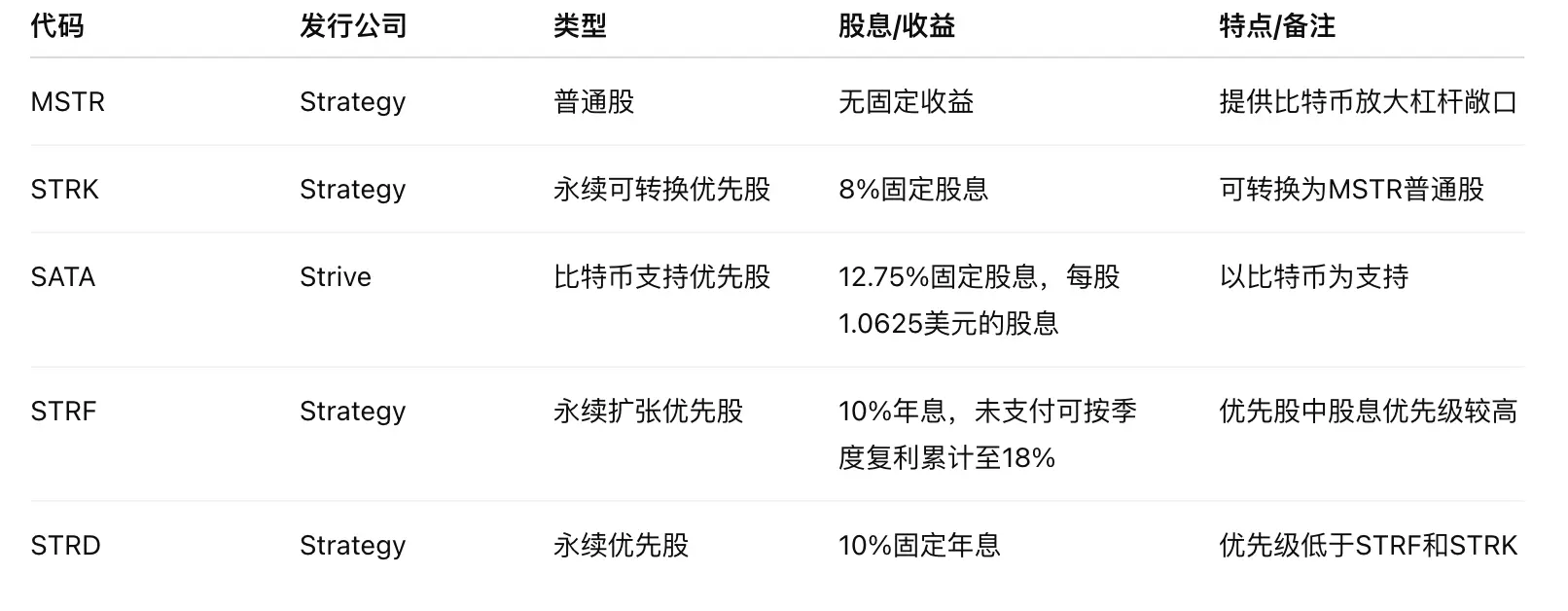
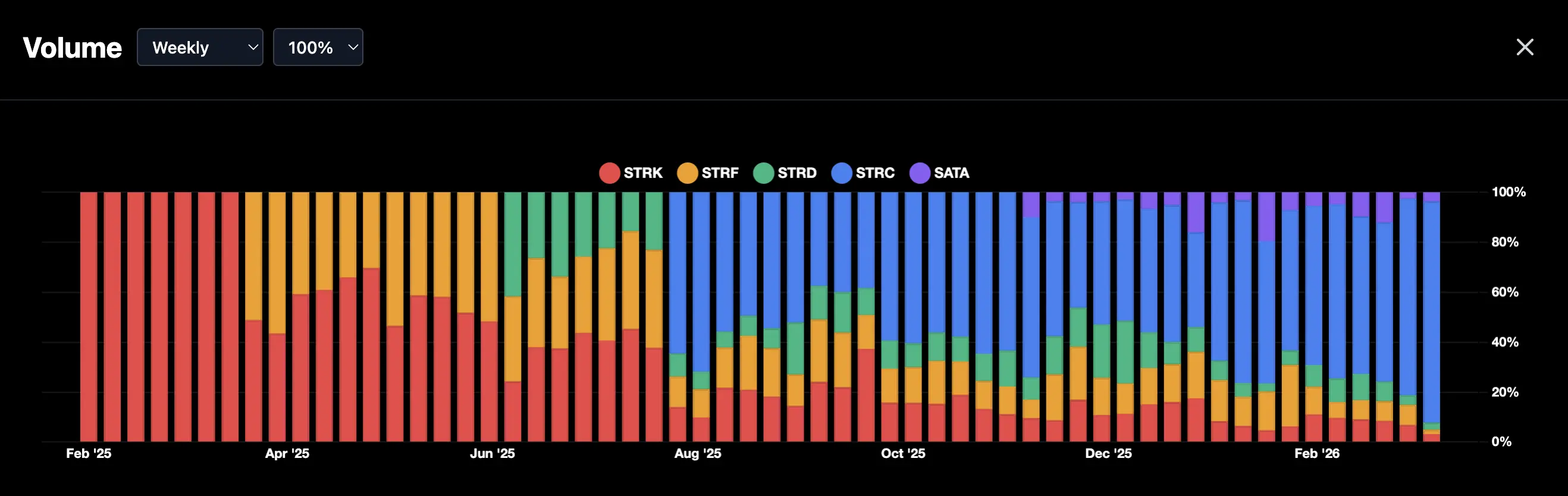
STRC’s performance far surpasses other similar products. Data from BitcoinQuant shows that over the past 30 days, STRC’s trading volume exceeded $150 million, significantly higher than products like STRK, SATA, and STRF; weekly trading share also climbed from a low of 37.5% to 88.5%.
Strategy CEO Michael Saylor recently stated that STRC is currently the most liquid preferred stock in the market. Strategy’s head of strategy, Chaitanya Jain, admitted that STRC and MSTR will together form the “ultimate Bitcoin accumulation machine.”
This model has also attracted DAT (cryptocurrency treasury) companies and traditional financial institutions to “get on board,” including DAT firms like Strive, Prevalon Energy, Anchorage Digital, and OranjeBTC, as well as funds under BlackRock, Fidelity, Virtus InfraCap, and John Hancock, all holding STRC.
From arbitrage premiums to yield games, Strategy’s dual ATM magic
The popularity of STRC essentially stems from Strategy packaging Bitcoin into a fixed-income product more aligned with traditional finance preferences.
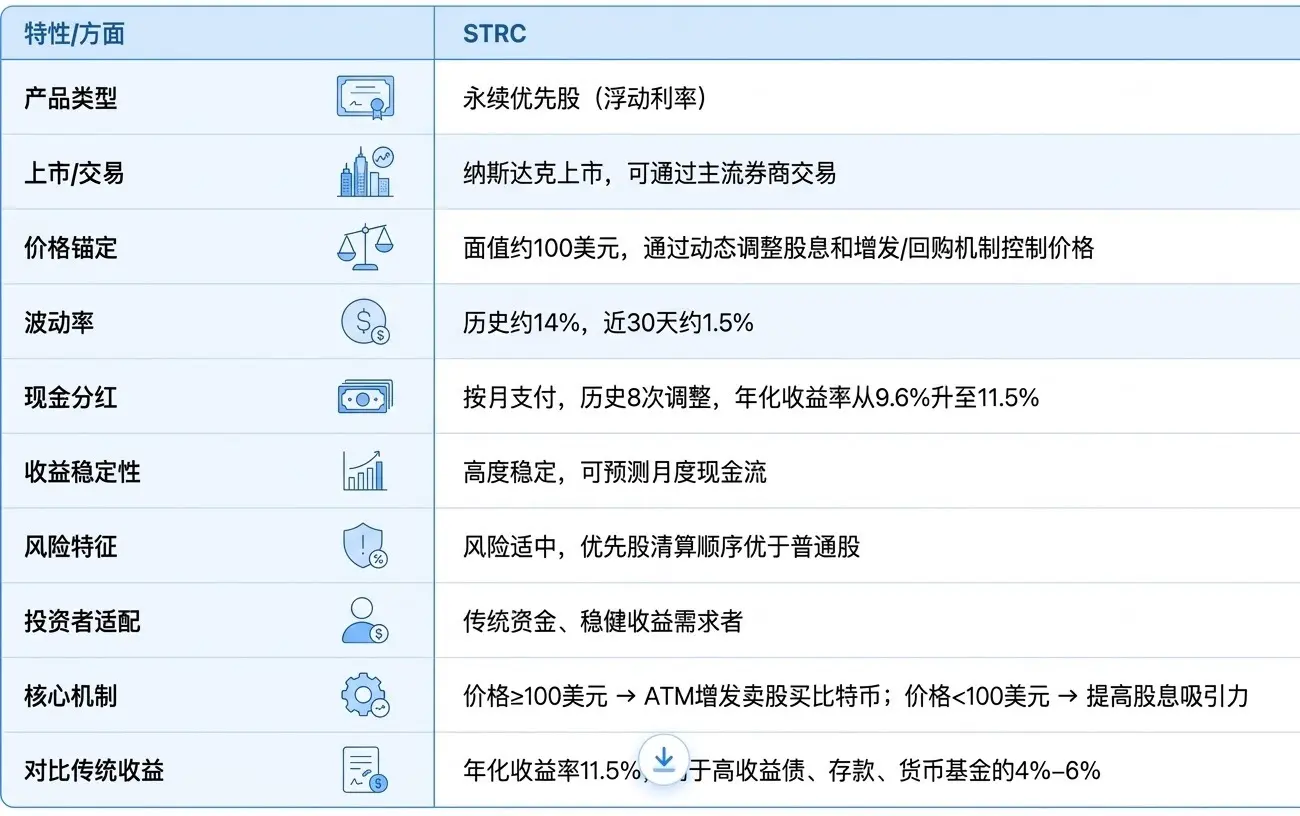
This product, already listed on Nasdaq, can be traded directly through mainstream brokers. Unlike ordinary shares like MSTR, STRC is a floating-rate perpetual preferred stock designed to stay as close as possible to a $100 face value.
The implementation is straightforward: by dynamically adjusting dividend rates each month to anchor the price. Specifically, when STRC trades at or above $100, Strategy initiates an ATM offering, selling new shares and buying Bitcoin; when the price falls below $100, it increases dividends to boost attractiveness and pull the price back toward par.
This mechanism significantly reduces volatility. Official data shows that STRC’s historical volatility is about 14%, and over the past 30 days, it’s only 1.5%, much milder than Bitcoin or MSTR.
Meanwhile, monthly cash dividends are one of STRC’s biggest selling points, especially suitable for investors seeking stable income.
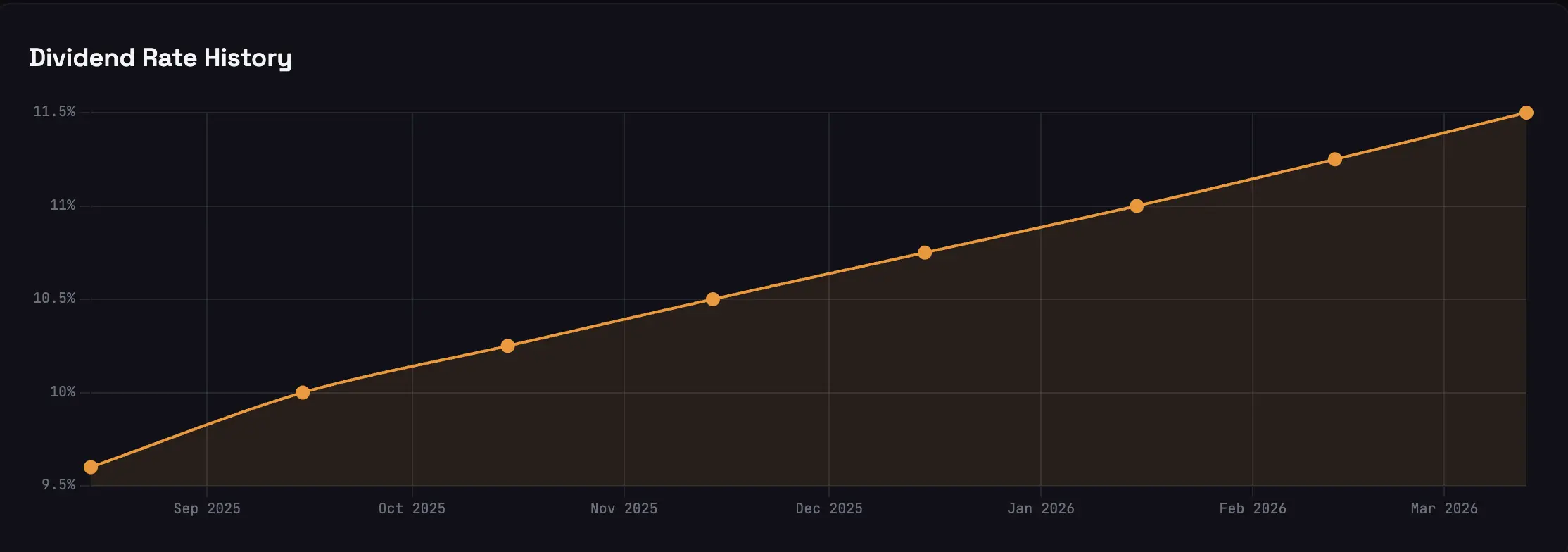
To enhance STRC’s appeal, Strategy has made eight dividend adjustments, raising the annualized yield from 9.6% to 11.5%. Compared to traditional high-yield assets like high-yield bonds, deposits, and money market funds, which generally hover around 4% to 6%, STRC’s fixed income returns are more competitive.
These features make STRC more attractive to buyers. For most traditional funds, Bitcoin’s volatility is too high, lacking cash flow and not fitting asset allocation frameworks; MSTR adds premium and leverage, offering higher yield elasticity but also amplifying risks. Previously, several U.S. public pension funds experienced significant paper losses holding MSTR.
In contrast, STRC offers a more acceptable compromise: Bitcoin as the underlying asset, near-par pricing, and stable, predictable monthly cash flows. Additionally, the preferred stock structure ranks higher than common stock in liquidation, providing some safety margin.
The launch of STRC also reflects a shift in Strategy’s financing logic.
As MSTR’s premium narrows, the Bitcoin flywheel driven solely by issuing common stock has hit a bottleneck. Strategy previously even promised not to issue common stock easily when mNAV is below 2.5 times.
STRC has become a “new magic” for Strategy to maintain Bitcoin accumulation speed in a bear market. But problems also arise: preferred stocks entail fixed dividend payments. Expanding STRC scale alone would directly increase leverage.
To address this, Strategy employs a dual ATM approach—one with more volatility but higher potential (common stock), and the other with stable, high dividends (preferred stock). By issuing both STRC and MSTR simultaneously, it raises funds to buy Bitcoin while replenishing equity capital, controlling leverage as the asset scale expands. When this financing mechanism operates continuously, STRC absorbs liquidity from the fixed-income market, giving Strategy a relatively independent ongoing buy-in outside the crypto cycle.
However, high dividends come with costs. The latest STRC issuance added about $135 million annually in dividend burden, with Strategy’s annual dividend expenditure now exceeding $1.08 billion. Although Strategy has about $2.25 billion in cash reserves to cover at least two years of dividends, pressure remains.
If Bitcoin prices remain stagnant long-term, and STRC must keep raising yields to stay attractive, financing costs will continue to rise, gradually squeezing space. The repeated dividend hikes indicate an ongoing need for increased incentives.
Nevertheless, STRC is unlikely to experience a UST-style collapse. It does not have on-chain automatic liquidation, flash loan runs, or instant redemption mechanisms. It remains a traditional credit product issued by Strategy, with all adjustments (like dividend increases or delayed payments) controlled actively by the company. Its underlying support is Bitcoin, not infinitely dilutable tokens. This means that even in extreme scenarios, risks are more likely to manifest as slow bleeding.
Overall, STRC has successfully opened a channel to convert traditional fixed-income capital into Bitcoin spot demand. While the sustainability of its high-yield model remains to be seen, this new flywheel has already started turning.


