Blockchain systems are built around transparency, where all transaction data is publicly visible by default. This includes address relationships and the flow of funds. In certain scenarios, however, this level of openness can lead to privacy exposure, asset visibility, and data being analyzed or traced. As a result, it can limit the broader adoption of blockchain technology.
Against this backdrop, Zcash has emerged as a leading privacy coin. By introducing zero knowledge proof technology, it enables transaction data to remain hidden without compromising verifiability. Its design not only expands the functional boundaries of cryptocurrencies but also serves as a key example of privacy protection and cryptographic innovation in blockchain systems.
What Is Zcash (ZEC)?
As a privacy focused cryptocurrency that is built on zero knowledge proof technology. Zcash's primary goal is to preserve decentralization and verifiability while protecting transaction privacy. The project originated as an enhancement to the Bitcoin protocol, introducing privacy preserving techniques so that transaction details are no longer fully exposed.
Zcash’s native token, ZEC, is used to pay transaction fees and transfer value across the network. Unlike traditional blockchains, Zcash offers an optional privacy model, allowing users to choose between transparent and private transactions depending on their needs. This flexibility makes the system more adaptable to different use cases.
Zcash Core Technology: How Zero Knowledge Proofs Enable Privacy
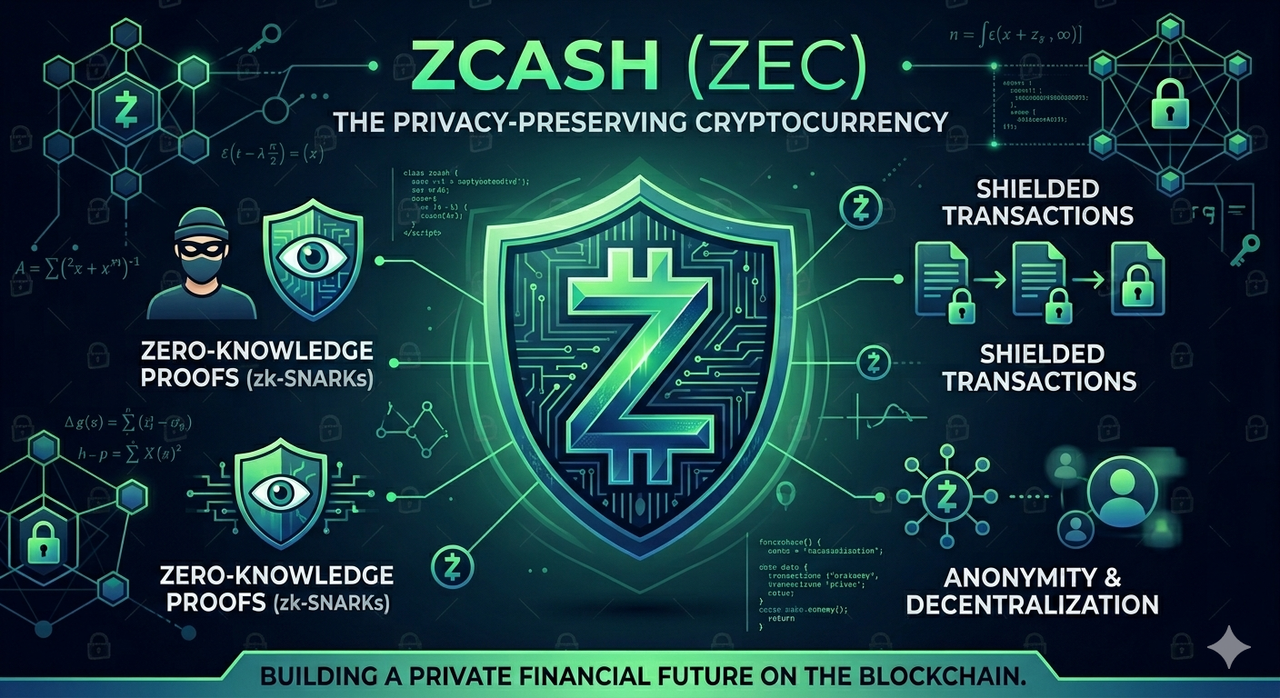
Zcash’s privacy capabilities rely on zero knowledge proof technology, particularly zk SNARKs. This method allows a transaction to be verified without revealing any underlying data, essentially proving that something is true without disclosing the details.
Within Zcash, zk SNARKs are used to confirm transaction validity, including verifying that funds exist, balances are correct, and no double spending occurs. Unlike traditional blockchains where all transaction details must be public, this approach maintains both privacy and network security.
This innovation made Zcash one of the earliest blockchain systems to apply advanced cryptography in a practical setting, helping drive the broader adoption of zero knowledge proofs across multiple fields.
Zcash Transaction Types: Transparent vs Private Addresses
Zcash supports two types of addresses, transparent addresses, known as t addresses, and private addresses, known as z addresses.
Transparent addresses function similarly to those on traditional blockchains, where all transaction data is publicly visible. In contrast, private addresses leverage zk SNARKs to fully conceal transaction details.
With these two address types, Zcash supports multiple transaction combinations, including fully public, fully private, and mixed interactions. This design allows users to adjust their level of privacy based on specific needs and use cases.
Zcash Network Structure and Roles
The Zcash network is maintained by multiple participants, including nodes and miners. Nodes are responsible for validating transactions and propagating data, while miners use a proof of work mechanism to produce new blocks and secure the network.
For private transactions, zk SNARK proofs are submitted to the network and verified by nodes. Although the transaction data itself remains hidden, the verification process is still independently executed, ensuring system integrity and consistency.
This structure allows Zcash to integrate privacy features while retaining a familiar blockchain operating model.
ZEC Issuance and Incentive Model
Zcash’s token, ZEC, is issued through a block reward mechanism similar to Bitcoin mining. Miners receive newly minted tokens as rewards for participating in block production.
In addition, Zcash has implemented a developer reward system to support ongoing protocol development and ecosystem growth. This mechanism is designed to fund long term innovation while maintaining network sustainability.
Overall, Zcash combines a traditional cryptocurrency issuance model with a structured development incentive system.
Zcash Use Cases and Value
Zcash is not limited to anonymous payments. Its core value lies in enabling on-chain privacy protection.
For individuals, Zcash can conceal account balances and transaction histories, enhancing financial privacy and security. In business contexts, it can prevent sensitive transaction data from being analyzed by competitors or third parties.
As zero knowledge proof technology continues to evolve, Zcash is also being used in broader research areas such as privacy preserving computation, identity verification, and secure data sharing.
Zcash Advantages and Limitations
Zcash’s main strength lies in its robust privacy protection and advanced cryptographic design. With zk SNARKs, transactions can be verified without exposing any information, which is a significant advancement in blockchain systems.
However, this technology also introduces complexity. Generating private transactions requires higher computational resources and more capable hardware. Additionally, privacy features may face regulatory challenges in certain jurisdictions.
As a result, Zcash must balance privacy, performance, usability, and compliance.
Zcash vs Monero: A Comparison of Privacy Coins
Zcash and Monero are both leading privacy coins, but they take fundamentally different technical approaches.
Zcash relies on zero knowledge proofs to achieve privacy, allowing transactions to be fully hidden while still verifiable, with optional privacy as a key feature. Monero, on the other hand, uses ring signatures and obfuscation techniques, making all transactions private by default.
These approaches represent two distinct philosophies, precise privacy based on mathematical proofs, and obfuscation based privacy built on anonymity sets. This difference affects their performance, traceability, and usage patterns.
Common Misconceptions About Zcash
Zcash is often misunderstood as being fully anonymous in all cases. In reality, privacy is optional, and only transactions using private addresses are shielded.
Another misconception is that privacy coins are completely untraceable. While Zcash offers strong privacy protection for shielded transactions, transparent transactions remain publicly visible.
It is also important to note that privacy does not mean a lack of security. Zcash’s privacy model is grounded in rigorous cryptographic proofs, meaning its security relies on mathematics rather than trust.
Conclusion
By integrating zero knowledge proof technology, Zcash provides a solution that balances privacy and verifiability within blockchain systems. Its optional privacy model gives users the flexibility to choose how transactions are conducted, expanding the potential use cases of cryptocurrencies.
As a leading privacy coin, Zcash holds a unique position in the digital asset space and continues to play an important role in advancing the intersection of cryptography and blockchain technology.
FAQs
What is the difference between Zcash and Bitcoin?
Zcash builds on Bitcoin by adding privacy features that allow transaction data to be hidden, whereas Bitcoin transactions are public by default.
Is Zcash completely anonymous?
Only transactions using private addresses, or z addresses, are anonymous. Transactions using transparent addresses remain public.
What are zk SNARKs?
zk SNARKs are a type of zero knowledge proof used to verify transaction validity without revealing underlying data.
Do you need a special wallet to use Zcash?
Wallets that support private transactions must be compatible with zk SNARKs. Some basic wallets may only support transparent transactions.
Are Zcash private transactions more resource intensive
Yes, generating zero knowledge proofs typically requires more computational resources, although verification is relatively efficient.
Does Zcash support smart contracts?
Zcash is primarily designed for privacy focused payments and is not centered around smart contract functionality.