In the context of Real-World Assets (RWA), “which assets are supported” is not just about assembling a product list—it’s a question of system architecture. Whether an asset can be included in a platform like XT depends on the clarity of its ownership structure, the reliability of its information sources, its custodial form in the real world, and whether its rights can be standardized for on-chain representation. In short, XT does not support every real-world asset, but only those that can be institutionalized, technologically mapped, and brought into circulation via tokenization.
This is why stocks and ETFs are at the center of tokenization discussions: both already possess highly standardized structures. Stocks represent company ownership; ETFs represent shares in a basket of assets. These asset classes have well-established systems for registration, custody, and valuation in traditional finance, which makes on-chain mapping much more feasible.
Which Assets Does XT Support: From Verifiability to Mappability
XT supports assets that meet three core criteria: verifiability, custody, and mappability.
- Verifiability: Assets must have their authenticity and ownership status confirmed through legal, accounting, or market frameworks.
- Custody: Assets must be under institutional control and segregated management.
- Mappability: The asset’s rights structure must be convertible to standardized digital units on-chain.
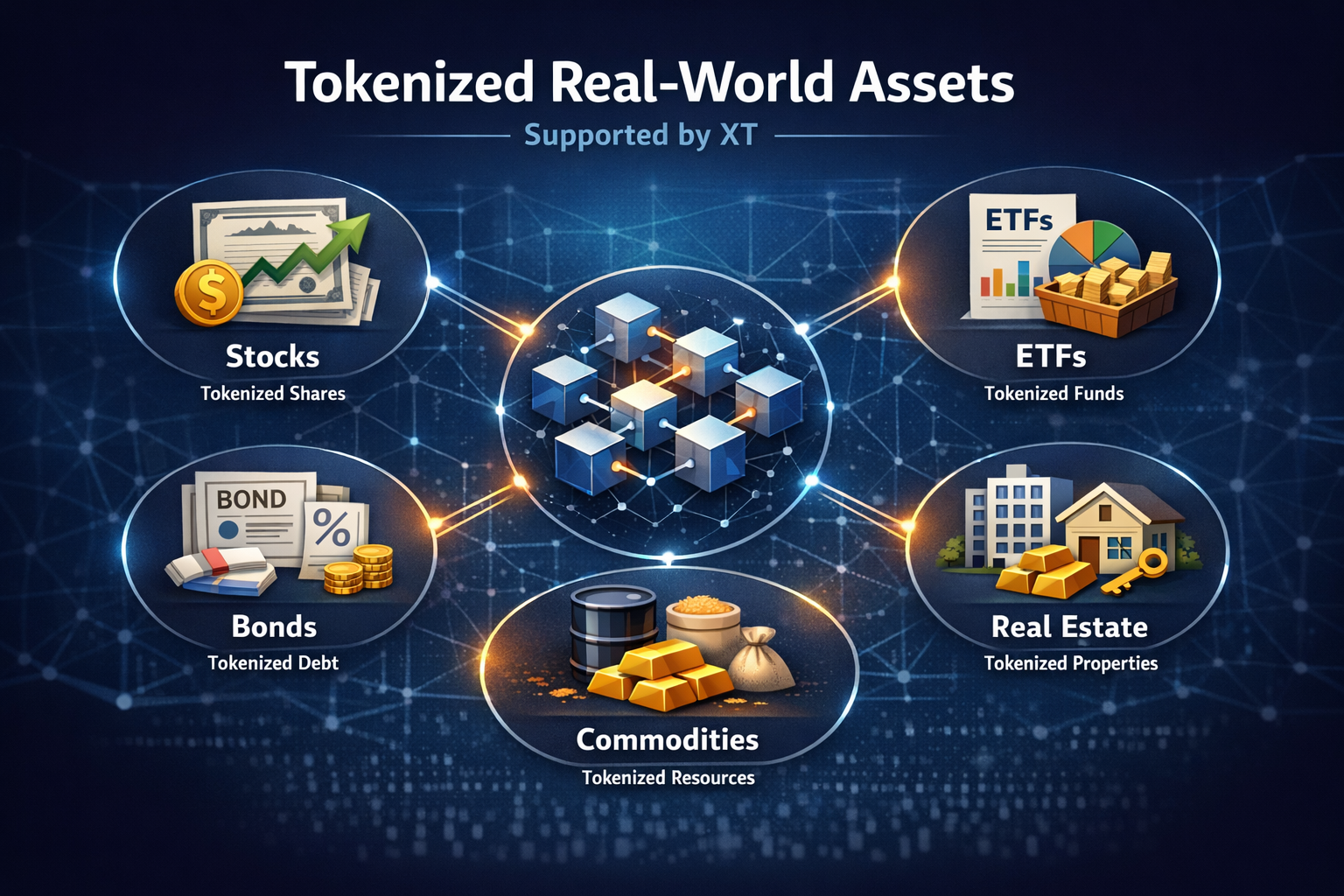
With these requirements, stocks and ETFs are naturally compatible. They have clear issuers, registration systems, trading rules, and disclosure frameworks, making them prime candidates for tokenization. XT may also support bonds, fund shares, commodity interests, real estate income streams, or other divisible assets—if they meet the verifiability, custody, and mappability criteria.
However, “support” does not mean any asset can be freely placed on-chain. To become an on-chain asset, the asset must fit into a stable mapping structure. The more complex the asset, the harder it is to tokenize. Stocks and ETFs, thanks to their standardization, are the most scalable categories for tokenized finance.
Why Stocks and ETFs Are Ideal for Tokenization
Stocks and ETFs offer clear boundaries of rights: stocks typically mean company equity, while ETFs represent shares in a pooled asset portfolio. This makes it straightforward to abstract these rights as digital certificates on-chain.
Both asset classes also have mature price discovery mechanisms. Their prices are public, regularly updated, and governed by established trading rules—so the asset mapped on-chain is transparent and reliable.
Additionally, stocks and ETFs have robust custody and settlement systems in traditional markets. Custodians, brokers, and registration agencies give real-world backing to on-chain mapping. Platforms like XT don’t create assets from scratch; they build digital layers over existing financial structures. The stronger the underlying framework, the lower the cost and risk of tokenization.
Tokenizing stocks and ETFs is not a matter of just “making securities into tokens.” The real value lies in adding new ways to record, transfer, and access traditional assets—without disrupting the underlying financial order.
How Tokenized Stocks Work: From Real-World Rights to On-Chain Representation
Tokenizing stocks means converting real-world stock rights into transferable, identifiable digital units on-chain. The key is not “how to issue a token,” but “how to ensure the token is faithfully and credibly linked to the underlying stock.”
In practice, stocks aren’t placed directly on-chain. Instead, a regulated custodian or intermediary holds the actual shares, and the system issues corresponding digital tokens based on this custody relationship. The token is thus a mapped claim on the underlying stock. This mapping can be one-to-one or fractional, but it must always be backed by real, off-chain holdings.
Custody is essential: without real-world control and segregation, the on-chain token is just a digital entry with no underlying value. XT’s core contribution is connecting real-world asset control, on-chain records, and market logic—so tokenized stocks are both transferable and verifiable.
Tokenization also brings greater flexibility in asset units. Traditional stock trading may be limited by account frameworks, market access, or minimum order sizes. On-chain, asset units can be easily split, transferred, or programmed—changing how users interact with these assets, even if the stock’s nature remains unchanged.
Tokenizing ETFs: On-Chain Representation of Asset Baskets
Tokenizing ETFs is more complex than stocks, as ETFs are baskets of multiple assets. ETF shares are already a standardized expression of a composite asset allocation, so tokenization is “re-representing” ETF shares, not mapping every underlying component individually.
Tokenized ETFs generally track real-world ETF shares, not each constituent asset. In other words, XT’s on-chain representation is of the ETF as a financial product, not its entire underlying portfolio. This approach leverages established market structures, avoiding the need to rebuild asset baskets on-chain.
ETFs are ideal for tokenization because they offer diversification by design. On-chain, ETFs provide exposure to indices, sectors, regions, or strategies, not just single-security risk. They deliver a richer risk-return structure to on-chain markets.
However, tokenizing ETFs also requires handling changes in fund shares, creation/redemption events, and regular updates. On-chain systems may not directly participate in these processes, but their tokenized representations must remain consistent with the underlying product, or else the mapping loses credibility.
Tokenized Stocks vs. Tokenized ETFs: Different Paths for Different Structures
Tokenized stocks and tokenized ETFs are both on-chain representations of RWA assets, but their structures are fundamentally different. Stocks map to single-company rights, while ETFs map to shares in pre-packaged asset pools.
This structural difference impacts the complexity of on-chain mapping. Stocks have a straightforward mapping: each token represents rights to a specific security. ETFs involve an extra layer of abstraction: each token represents a fund share, which itself represents a basket of assets.
Market understanding varies, too. Tokenized stocks are seen as “digital representations of a single company’s equity,” while tokenized ETFs are “digital gateways to diversified investment strategies.” Even within the same system, mapping logic, risk disclosure, and user understanding will differ by asset type.
| Comparison |
Tokenized Stocks |
Tokenized ETFs |
| Mapping Target |
Single Stock Right |
ETF Fund Share |
| Underlying Structure |
Single Security |
Asset Basket |
| Rights Logic |
Direct Mapping |
Composite Share Mapping |
| Information Basis |
Stock Data and Price |
Fund Shares, NAV, Basket Data |
| On-Chain Structure |
Direct |
Abstracted |
| Market View |
Single Asset Exposure |
Diversified Exposure |
The table illustrates: both stocks and ETFs can be supported by XT, but implementation differs. Tokenized stocks focus on precise mapping of a single right; tokenized ETFs focus on standardized representation of composite products. The former is direct; the latter is a blockchain-based restructuring of an existing asset class.
The Significance of Asset Support in XT: Beyond Asset Variety, Toward New Representation
XT’s support for stocks and ETFs is not just about onboarding more asset types. More importantly, it enables new digital expressions of real-world finance. In traditional markets, stocks and ETFs are confined to account, brokerage, and clearing systems. In XT, they become programmable, portable, and interoperable digital assets.
This doesn’t change the asset’s legal status—but it does create new technical possibilities. The goal is not to replicate every aspect of traditional markets, but to create a blockchain-compatible structure layer. This enables new use cases: flexible ownership, transparent records, and tighter system integration.
Thus, the assets supported by XT reflect the boundaries of RWA infrastructure. The more asset types available, the stronger the system’s capabilities in custody, mapping, issuance, and management. Stocks and ETFs are the benchmark for these capabilities.
Limitations: On-Chain Does Not Mean Off-Chain Independence
Tokenized stocks and ETFs enrich on-chain finance, but their existence is not independent of traditional systems. Their on-chain viability depends on real-world custody, registration, compliance, and disclosure.
The stability of on-chain assets is determined not only by blockchain or smart contracts, but also by the robustness of real-world asset control. If real-world custody fails, on-chain mapping loses credibility. For tokenized ETFs, changes in fund structure or disclosure will also impact on-chain accuracy.
Tokenization is not a replacement for traditional finance, but an additional layer. It adds on-chain representation and transferability, but does not eliminate off-chain dependencies. Recognizing this prevents misunderstanding on-chain assets as entirely new or independent categories.
Summary
XT’s support for stocks, ETFs, and other verifiable real-world assets demonstrates its core capability: turning traditional assets into on-chain digital states. Stocks and ETFs are central because their clear structures, mature mechanisms, and standardization make them ideal for tokenization.
Tokenized stocks focus on mapping a single right; tokenized ETFs focus on on-chain representation of standardized composite shares. Both are digital expressions of rights, not substitutes for the underlying assets. The significance of XT and similar infrastructure is in expanding the range of on-chain assets and providing real-world finance with new technical organization—allowing integration with blockchain and the broader digital economy.
FAQ
Does XT support only stocks and ETFs?
No. Stocks and ETFs are typical financial assets, but any asset that is verifiable, custodial, and mappable may be supported.
Does a tokenized stock mean direct ownership of that stock?
Tokenized stocks map to the underlying stock’s rights and depend on real-world custody and control—not just the on-chain token.
Is a tokenized ETF the same as placing all underlying components on-chain?
No. Tokenized ETFs usually map to real-world ETF shares, not each individual underlying asset.
Why are stocks and ETFs easier to tokenize?
Because their ownership, custody, trading, and disclosure frameworks are mature—making them better suited for on-chain mapping.
What are the key criteria for XT to support an asset?
Verifiable authenticity, clear ownership, real-world custody, and a rights structure that can be standardized and mapped on-chain.
Are tokenized stocks and ETFs completely independent of traditional finance?
No. Their on-chain existence still depends on real-world assets, custody, and regulatory frameworks—they function as a coordinated on-chain/off-chain system.