As Web3 applications rapidly evolve, on-chain data processing has emerged as a foundational element of blockchain infrastructure. Whether it’s monitoring DeFi protocol operations, analyzing user behavior, or issuing risk alerts, high-performance data indexing is essential. While traditional query tools can provide access to on-chain data, they often suffer from latency issues, limiting their effectiveness in real-time monitoring.
Sentio delivers a real-time data indexing solution designed for immediate responsiveness. By continuously monitoring blockchain events and processing data without delay, Sentio empowers developers to receive instant feedback whenever on-chain data changes. This capability is critical for real-time monitoring and auto alert scenarios.
What Is Real-Time On-Chain Data Indexing?
Real-time on-chain data indexing is the process of instantly capturing, parsing, and processing relevant blockchain data as soon as an event occurs, then rapidly delivering it to the application layer. The primary objective is to minimize the time between data generation and its availability, enabling instant monitoring and rapid response.
Traditional on-chain data architectures typically require data synchronization, organization, and storage before it can be queried—an approach better suited for historical analysis, but inadequate for real-time needs. Real-time indexing, by contrast, is event-driven: the system begins processing data immediately upon detecting a trade or status change on-chain.
For protocols that demand immediate reactions to on-chain changes, real-time data indexing not only enhances data visibility but is also integral to effective risk control and operational efficiency.
How Does Sentio Monitor On-Chain Events?
Sentio’s real-time indexing starts by monitoring on-chain events. Blockchain Smart Contracts continuously generate event logs—including trade executions, status changes, and fund transfers. Sentio persistently listens for these events and instantly initiates downstream processing the moment new events are detected.
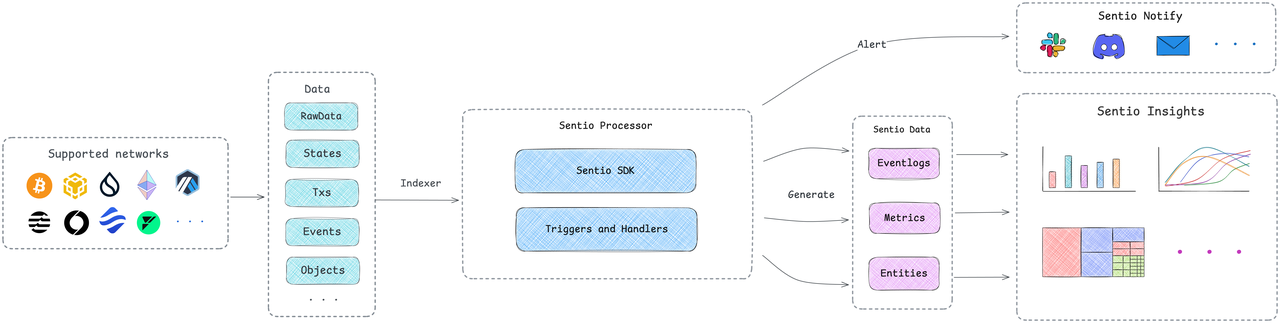
This monitoring mechanism functions as a continuously running data capture layer, connecting to the blockchain network and tracking event changes in target contracts. When a specified event occurs, the system rapidly collects the relevant log data and proceeds to parsing.
With this persistent monitoring, Sentio can capture raw data the moment an on-chain state changes, providing the foundation for real-time analytics.
How Is On-Chain Data Parsed and Processed?
When an on-chain event is detected, Sentio parses and structures the raw log data. Blockchain event logs are typically stored in low-level encoded formats, which are unsuitable for direct analysis and must be converted into readable data.
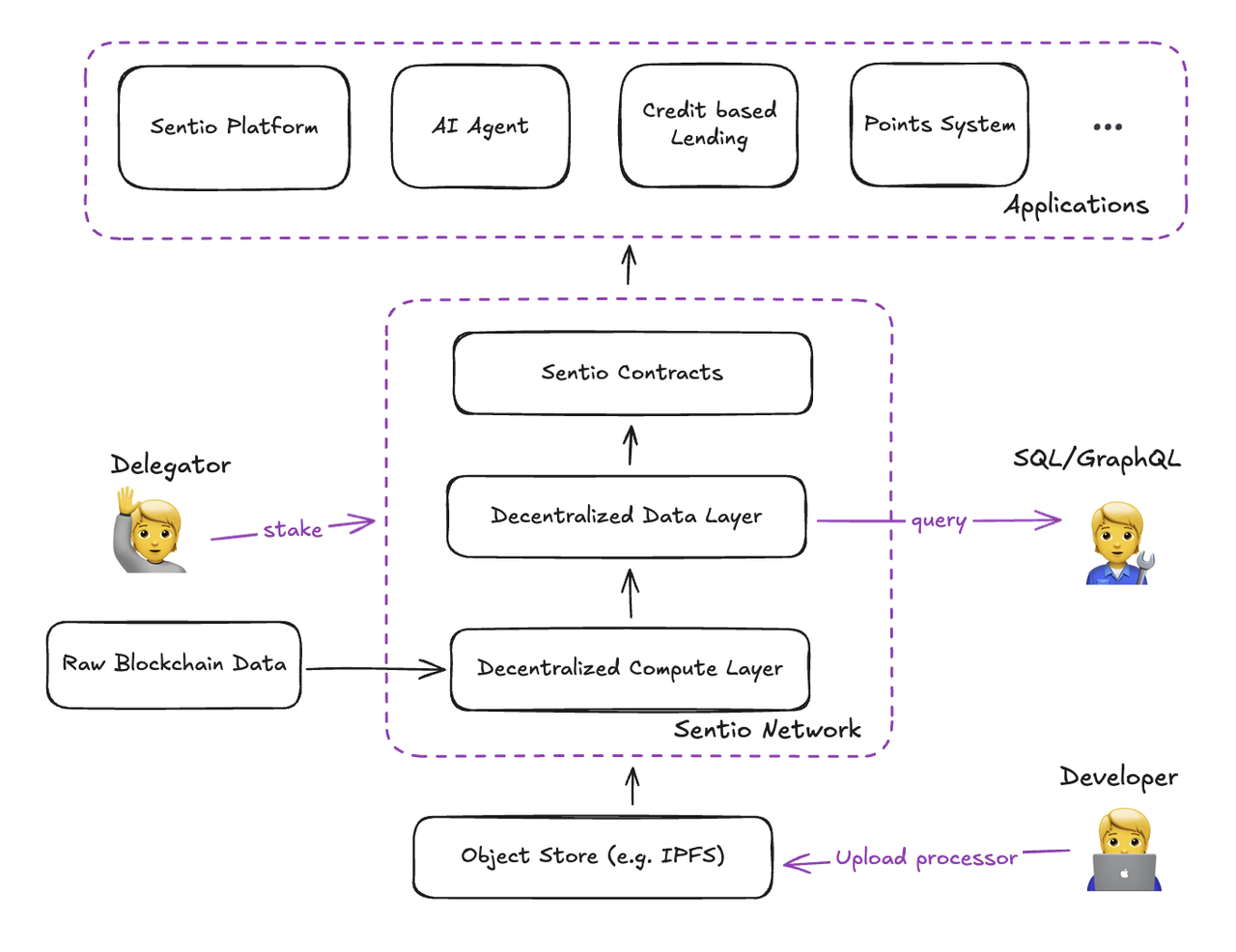 Sentio Network Architecture. Image source: Sentio
At this stage, the system identifies the event type and extracts key fields such as address details, transaction amounts, and status parameters. The data is then standardized for metric calculation and visualization.
This process transforms complex on-chain logs into structured data, allowing developers to access actionable insights without handling raw blockchain data directly. The result is higher data usability and reduced development complexity.
How Does Sentio Deliver Real-Time Data Output?
After parsing, Sentio outputs processed data in real time to dashboards or alerting systems, allowing developers to instantly track on-chain changes.
Real-time output typically takes two forms: live updates of data metrics (such as trading volume or address activity), and auto alert notifications, where the system triggers warnings when monitored metrics hit predefined thresholds.
This real-time output capability turns on-chain data into a proactive information stream that can drive business decisions. For applications requiring immediate action, this dramatically increases data responsiveness.
Why Is Real-Time Indexing Superior to Traditional Indexing for Web3 Applications?
Traditional indexing is designed primarily for data queries, organizing on-chain data into accessible interfaces—a method suitable for historical analysis but hampered by synchronization and update delays in fast-moving environments.
Real-time indexing is event-driven, processing data the moment blockchain events occur, which drastically reduces latency. For scenarios like DeFi protocol monitoring, security alerts, and operational analytics, this low-latency approach is essential.
As Web3 applications demand ever-faster response times, real-time indexing is becoming the foundation of on-chain data infrastructure, enhancing both data timeliness and protocol monitoring capabilities.
What Use Cases Are Best for Sentio’s Real-Time Indexing?
Sentio’s real-time data indexing is ideal for scenarios where sensitivity to on-chain changes is critical.
In DeFi protocols, real-time indexing enables teams to track fund flows, trading activity, and liquidity shifts, ensuring they always have an up-to-date view of protocol health. If abnormal trades occur, the system can instantly detect and alert the team.
In security monitoring, real-time indexing helps spot unusual fund movements or contract behaviors, strengthening risk response.
For operational analytics, real-time indexing supports monitoring user activity, trading trends, and key business metrics, delivering immediate insights for protocol optimization.
All these scenarios rely on rapid on-chain data processing—Sentio’s real-time indexing mechanism is purpose-built for this need.
What Is the Value of Sentio’s Real-Time Data Indexing?
Sentio’s real-time indexing dramatically improves on-chain data responsiveness, enabling developers to receive immediate feedback after events occur. This not only enhances the experience of working with on-chain data but also underpins real-time monitoring and auto alerting capabilities.
Compared to traditional indexing, real-time indexing reduces latency, boosts monitoring efficiency, and allows on-chain data to drive business decisions faster. For Web3 applications that need real-time awareness, this is a game-changer.
As on-chain use cases grow more complex, real-time data processing is emerging as a key competitive advantage in Web3 infrastructure—and Sentio’s real-time indexing is a leading example of this trend.
Conclusion
Sentio’s real-time data indexing mechanism delivers low-latency data processing by persistently monitoring on-chain events, parsing and structuring data, and delivering live output. This allows developers to quickly turn complex blockchain events into actionable insights, supporting protocol monitoring, security alerts, and operational analytics.
With the growing demand for real-time data in Web3, real-time indexing is now a core part of on-chain data infrastructure. Sentio enhances data visibility and responsiveness, offering an efficient solution for real-time monitoring.
FAQs
What is Sentio’s real-time data indexing mechanism?
Sentio’s real-time data indexing mechanism refers to the instant listening, parsing, and output of data after on-chain events, enabling low-latency data monitoring.
How does Sentio obtain on-chain data?
Sentio continuously monitors Smart Contract event logs to capture, parse, and process on-chain data.
What’s the difference between real-time indexing and traditional indexing?
Traditional indexing supports data queries, while real-time indexing focuses on immediate event-driven processing—making it better for real-time monitoring.
What use cases are best for Sentio’s real-time indexing?
It’s best suited for DeFi protocol monitoring, security alerts, and on-chain operational analytics—any scenario requiring rapid response to blockchain data changes.







