As zero-knowledge proofs (ZK) increasingly become a core technology for blockchain scalability and verifiable computation, the demand for proving power is growing exponentially. From ZK Rollups to verifiable AI, more applications now rely on high-performance proof generation. However, ZK proving is inherently computationally intensive, and traditional approaches that depend on a single GPU or centralized services struggle to support large-scale adoption.
In this context, ZK Prover networks like Cysic serve as a foundational layer of compute infrastructure. They not only handle proof generation tasks but also optimize resource allocation through scheduling and CYS based incentives. In other words, Cysic functions as a “compute layer for the ZK era,” where its efficiency and cost structure directly influence the pace of ecosystem growth.
Cysic Architecture Overview: A Four-Layer Model
From a structural perspective, Cysic can be understood as a four-layer computational network. At the top is the task scheduling layer, which receives user requests and distributes computing tasks. Beneath it sits the Prover network, responsible for generating proofs. Next comes the verification layer, which ensures the correctness of proofs. Finally, the market and settlement layer handles pricing and incentive distribution.
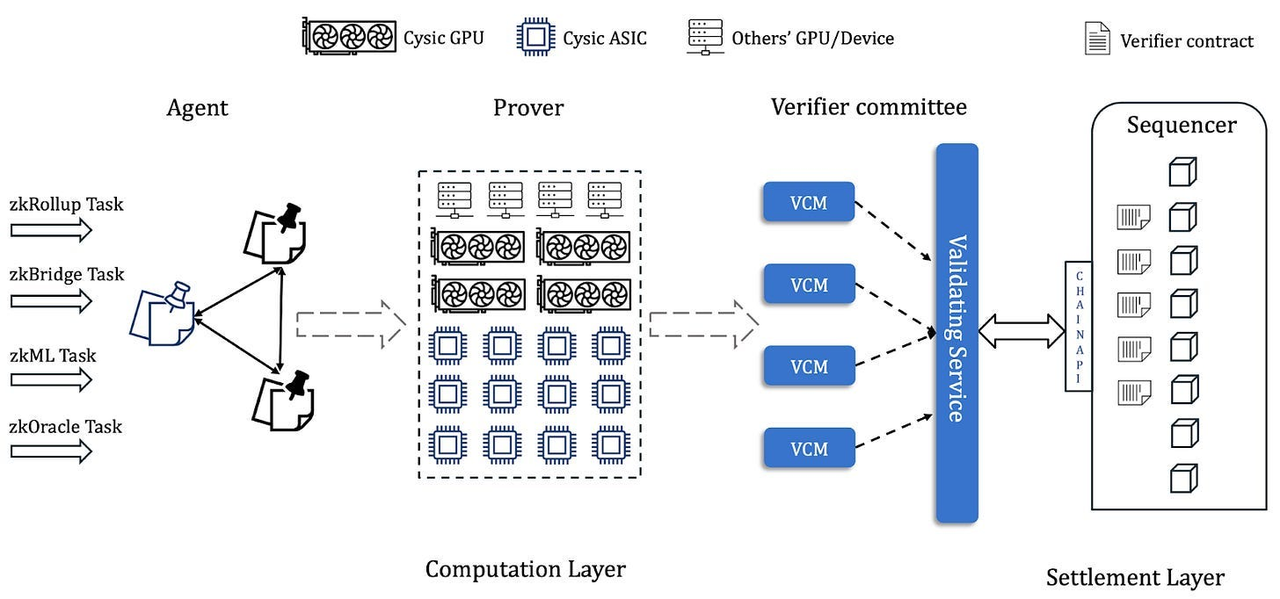
Together, these four layers form a complete closed-loop system. ZK proofs are no longer isolated computations but become “computational commodities” that can be distributed, executed, and traded across the network. This modular design allows Cysic to achieve high scalability without compromising security.
Proof-of-Compute Consensus Explained
One of Cysic’s core mechanisms is Proof-of-Compute, a consensus model built around measurable computational contribution. Unlike traditional blockchains that rely on hash competition (PoW) or staking (PoS), Proof-of-Compute focuses on whether nodes have completed real, meaningful computational tasks.
Under this system, Prover nodes demonstrate their contribution by executing ZK proof generation tasks. Rewards are only granted once the generated proofs are successfully verified. This ensures that computational resources are directed toward useful work rather than wasted on arbitrary competition.
At its core, Proof-of-Compute transforms computational output into the foundation of consensus. This tightly aligns network incentives with real-world application demand, significantly improving overall resource efficiency.
Task Scheduling: Cysic’s Core Advantage
Within the system, task scheduling plays a decisive role in both performance and cost. ZK proof tasks vary widely in complexity and resource requirements, so assigning them to the right nodes is critical.
Cysic’s scheduling system evaluates factors such as node performance, network latency, historical reliability, and execution cost to dynamically allocate tasks. This approach minimizes resource waste while maintaining high-quality execution at lower cost.
Unlike traditional cloud computing systems, Cysic’s scheduling is not entirely centralized. Instead, it incorporates market dynamics and incentive mechanisms, encouraging nodes to continuously optimize their performance. The result is a self-improving compute network that evolves over time.
The Cysic Prover Network: How Compute Power Is Organized
Cysic’s computational power comes from a distributed network of Prover nodes, contributed by both individuals and institutions. These nodes connect to the network, receive tasks, and use their hardware to generate proofs.
In practice, node capabilities vary. GPU-based nodes offer flexibility, while ASIC-based nodes deliver superior efficiency for specific workloads. Cysic’s scheduling system coordinates these different resources, enabling them to work together seamlessly.
This structure resembles traditional distributed computing, but with the added strength of token-based incentives. As demand grows, these incentives help expand the supply of compute power across the network.
How Cysic Improves Efficiency and Reduces Costs
To address the high cost of ZK proving, Cysic introduces optimizations at multiple levels. At the hardware level, ASICs significantly boost efficiency for specialized computations. At the system level, parallel processing and batch execution increase throughput.
Task scheduling also plays a major role in cost reduction. By assigning workloads to the most cost-effective nodes, the network minimizes waste while maintaining correctness. As the network scales, these optimizations compound, creating strong economies of scale.
Overall, Cysic’s cost advantage does not rely on a single innovation. Instead, it emerges from the combined effect of hardware improvements, intelligent scheduling, and network design.
Core Advantages and Applications of Cysic
Cysic’s strengths lie in its architectural design and technical approach. By turning ZK proof generation into a networked process and integrating specialized hardware, it achieves a strong balance between performance and cost. Its decentralized design also reduces reliance on single providers, improving system resilience.
On the application side, Cysic can provide critical compute support for ZK Rollups, enhancing Layer 2 scalability. It is equally valuable in privacy-preserving computation and verifiable AI, where both efficiency and trust are essential. As ZK adoption continues to expand, demand for such infrastructure is expected to grow steadily.
Conclusion
At its core, Cysic represents a systematic rethinking of how ZK proofs are generated. Through Proof-of-Compute consensus, an advanced scheduling system, and a distributed Prover network, it transforms a traditionally expensive and inefficient process into a scalable compute service.
In this model, proofs are no longer just technical outputs. They become resources that can be produced, distributed, and traded. As the convergence of ZK and AI accelerates, networks like Cysic are likely to become a key pillar of future Web3 infrastructure.
FAQs
What is Proof-of-Compute?
Proof-of-Compute is a consensus mechanism based on computational contribution, where nodes earn rewards by completing valid compute tasks.
What does Cysic’s scheduling system do?
It assigns compute tasks to the most suitable nodes to optimize both efficiency and cost.
How do Prover nodes participate in the network?
They connect to the network, provide compute power, and earn rewards by completing proof generation tasks.
How does Cysic reduce ZK computation costs?
By combining ASIC hardware, parallel processing, and optimized scheduling mechanisms.
What is Cysic’s core innovation?
It transforms ZK proofs into schedulable and tradable compute resources, executed through a decentralized network.