Gate ETH Staking: How GTETH Redefines Yield and Liquidity

Last Updated 2026-03-25 02:45:37
Reading Time: 4m
This article offers a comprehensive analysis of Ethereum’s staking mechanism after its shift to PoS and illustrates how GTETH leverages a liquid staking model to resolve the conventional lock-up problem. By doing so, it enables investors to earn yields while maintaining asset flexibility, paving the way for more efficient asset allocation strategies.

The Significance of Ethereum’s Consensus Mechanism Transformation

The Significance of Ethereum’s Consensus Mechanism Transformation

Ethereum’s shift from Proof of Work (PoW) to Proof of Stake (PoS) has fundamentally changed the network’s operational model. The legacy system, which depended on competition for computing power to maintain security, is now being replaced by a mechanism centered on asset staking.

In this new framework, ETH holders can participate in network validation by staking their assets and earn rewards according to protocol rules. ETH is no longer just a static asset—it has become “working capital” that continually generates returns and is further integrated into the blockchain economy.

The Constraints of Traditional Staking: The Trade-Off Between Yield and Liquidity

While staking offers investors stable returns, it comes with a clear limitation—asset lock-up.

Typically, once ETH is staked, it must go through an unlocking process before it can be reused. In volatile markets, this restriction can hinder the efficient allocation of assets. For example:

  • Funds cannot be converted instantly when short-term opportunities arise.

  • It’s difficult to adjust positions promptly during periods of heightened price volatility.

  • Long-term lock-ups reduce overall portfolio flexibility.

As a result, the market is searching for solutions that can balance both yield and liquidity.

GTETH: Unlocking Staked Asset Mobility

To address the lock-up challenge, liquid staking has emerged as a mainstream solution, and GTETH was developed in this context.

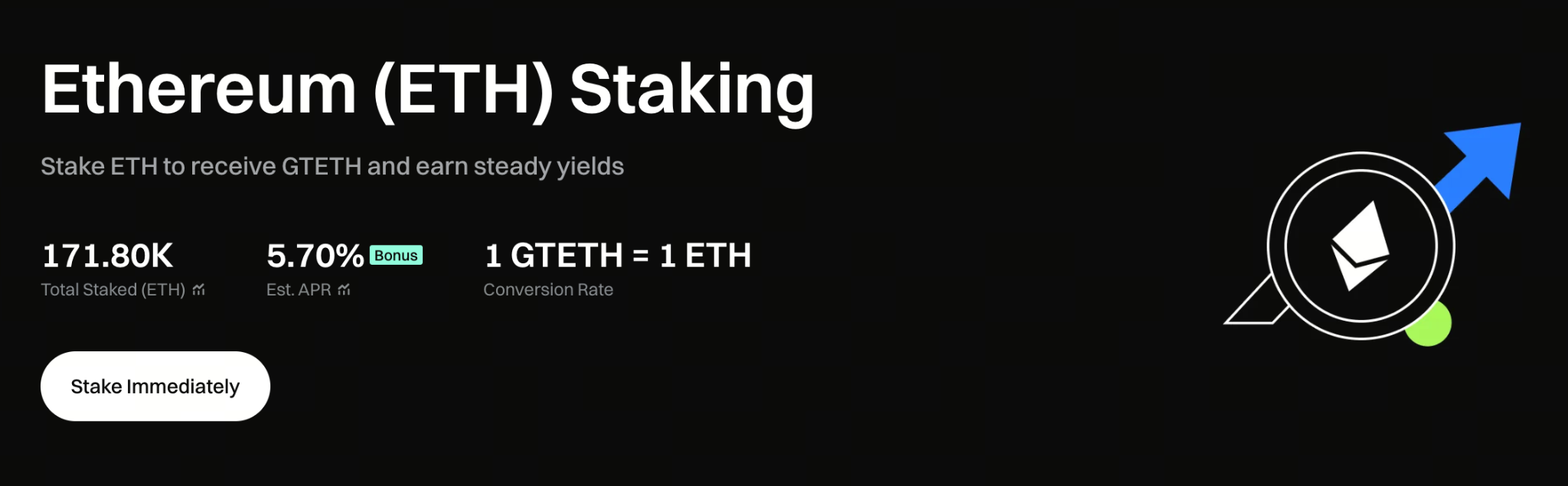
When users stake ETH, the system issues GTETH at a 1:1 ratio as a certificate of staking rights. This means users can participate in staking while still holding a tradable asset. Unlike models that rely on distributing additional rewards, GTETH’s yield is typically reflected in its changing value, with returns accumulating over time.

Lowering Barriers—Enabling More Users to Stake

Previously, becoming an Ethereum validator required significant capital and technical expertise, such as node deployment and maintenance. For most users, these requirements were difficult to meet.

With platform-based services, the staking process is greatly simplified. Users only need to deposit ETH to participate in yield distribution, without managing technical details. GTETH uses a 100% ETH reserve-backed model, with each token representing actual staked assets, making the structure more transparent and easier to understand.

GTETH Yield Breakdown

GTETH returns mainly come from two sources:

  • On-chain validation rewards: Staked ETH participates in block production and network maintenance. The system issues rewards according to protocol rules, which are reflected in GTETH’s value.

  • Platform incentives: During special campaigns, the platform may offer additional rewards to enhance overall returns.

Note that yield rates are not fixed and may be influenced by the following factors:

  • Changes in total network staking

  • Block production efficiency

  • Network performance

Additionally, the platform typically charges a service fee to support node operations and system stability.

Start earning on-chain rewards with Gate ETH staking: https://www.gate.com/staking/ETH?ch=ann46659

Strategic Flexibility with Liquid Staking

Compared to traditional staking, the key advantage of liquid staking is that assets remain in active use.

With GTETH, users can:

  • Maintain asset flexibility while earning staking rewards

  • Adjust investment allocations based on market conditions

  • Incorporate GTETH into their overall portfolio

This approach transforms staking from a simple lock-up yield into an asset that supports diverse strategies.

Capital Efficiency in Volatile Markets

The crypto market is highly volatile, with both opportunities and risks. If capital is locked for long periods, it can limit decision-making flexibility. By converting staking rights into tradable tokens, GTETH allows investors to earn on-chain yields while maintaining asset mobility. This design increases capital efficiency and aligns with today’s fast-paced market.

Summary

As the blockchain market matures, investors are no longer forced to choose between yield and liquidity—they want both. By tokenizing staking rights and providing a redemption mechanism, GTETH enables ETH to participate in network operations while preserving liquidity. This model not only enhances capital efficiency but also makes staking a more flexible asset management tool. In an environment of rapid market change, strategies that capture both yield and flexible capital allocation will become mainstream, with liquid staking as a key trend.

Author:  Allen
Disclaimer
* The information is not intended to be and does not constitute financial advice or any other recommendation of any sort offered or endorsed by Gate.
* This article may not be reproduced, transmitted or copied without referencing Gate. Contravention is an infringement of Copyright Act and may be subject to legal action.

Related Articles

What is Fartcoin? All You Need to Know About FARTCOIN
Intermediate

What is Fartcoin? All You Need to Know About FARTCOIN

Fartcoin (FARTCOIN) is a representative meme coin within the Solana ecosystem based on an AI-driven narrative. Its core concept originated from an experiment aimed at exploring the "boundaries between AI Agents and humor." More than just a digital asset with social attributes, the project deeply couples absurd humor culture with on-chain financial logic by integrating autonomous AI interaction models.
2026-04-04 22:01:19
Gold Price Forecast for the Next Five Years: 2026–2030 Trend Outlook and Investment Implications, Could It Reach $6,000?
Beginner

Gold Price Forecast for the Next Five Years: 2026–2030 Trend Outlook and Investment Implications, Could It Reach $6,000?

Analyze current gold price trends alongside authoritative five-year forecasts, integrating an evaluation of market risks and opportunities. This gives investors insight into the potential trajectory of gold prices and the main drivers expected to shape the market over the next five years.
2026-03-25 18:13:30
AI-Native Settlement Layers: How United Stables Is Building the Next Financial Rail
Beginner

AI-Native Settlement Layers: How United Stables Is Building the Next Financial Rail

Stablecoins were originally designed as dollar substitutes within exchanges, primarily used for asset pricing and trade settlement. As on-chain financial ecosystems have matured, their role has expanded beyond simple payments to include collateral assets, cross-chain liquidity mediums, and unified settlement units. In particular, as AI systems and automated agents begin to participate directly in economic activity, demand has risen sharply for programmable value units capable of instant settlement. This shift is pushing stablecoins toward the role of foundational financial infrastructure.
2026-03-25 03:16:17
Aster vs Hyperliquid: Which Perp DEX Will Prevail?
Beginner

Aster vs Hyperliquid: Which Perp DEX Will Prevail?

Aster and Hyperliquid are the two representative protocols of the "purpose-built L1 path" within the current decentralized perpetual exchange (Perp DEX) sector. As a pioneer in the field, Hyperliquid has built a deep liquidity moat through its highly mature order book architecture and strong community consensus. Conversely, Aster, as a rising challenger, seeks to leapfrog the competition in high-performance trading through more aggressive multi-chain aggregation logic, private transaction modules, and an underlying execution environment optimized for 2026 market demands.
2026-03-24 11:58:33
Aerodrome Tokenomics: How ve(3,3) Powers Base's Most Profitable DEX
Beginner

Aerodrome Tokenomics: How ve(3,3) Powers Base's Most Profitable DEX

AERO is the native token of Aerodrome Finance, a core decentralized exchange and liquidity protocol in the Base ecosystem. It is primarily used for liquidity incentives and ecosystem operations. veAERO is a governance NFT that users receive by locking AERO, representing both voting power and the right to share protocol revenue. Through a dual track structure of AERO as a utility token and veAERO as a governance credential, Aerodrome separates liquidity usage value from long term governance power, allowing participants to act as liquidity providers, governance decision makers, and revenue sharers within the same system.
2026-03-25 06:40:31
Hybrid Collateral Stablecoins: Inside United Stables' Stability and Yield Architecture
Beginner

Hybrid Collateral Stablecoins: Inside United Stables' Stability and Yield Architecture

In the early stages of the crypto market, traditional stablecoins mainly relied on single-reserve or single-collateral models. Their primary focus was price stability and payment convenience, which allowed them to become foundational tools for on-chain trading and capital flows. As the market has entered a more mature financial phase, however, this structure has begun to reveal limitations, including high concentration risk and the difficulty of balancing liquidity with yield. These constraints have driven the evolution toward multi-layer collateral and portfolio-based designs, such as the dual-layer hybrid collateral architecture proposed by United Stables, which seeks to redefine the underlying logic of stable assets.
2026-03-25 03:17:39





