From Allocation to Execution: How Leveraged ETFs Evolved into Trading Instruments

2026-01-05 01:49:18
As market cycles speed up and volatility becomes standard, ETFs are evolving from passive allocation vehicles into strategic trading tools. This article explores how shifts in market structure have positioned leveraged ETFs as a middle ground between spot and derivatives trading. Using Gate Leveraged ETFs as a case study, we detail their operational mechanisms, rebalancing logic, and cost structure. We also provide an in-depth analysis of the strengths and limitations of leveraged ETFs across various market conditions, equipping traders with the insights needed to accurately assess their risk profiles and identify appropriate application scenarios.

How ETFs Are Being Redefined

Traditionally, ETFs have been recognized as instruments that reduce trading frequency within investment portfolios. Their main role has been to diversify risk and smooth volatility, allowing investors to earn average returns over time. However, as markets move toward higher-frequency volatility and rapid price swings, the old approach of trading patience for returns no longer meets the needs of traders who now value speed and efficiency.

The focus of capital flows has shifted from how long assets are held to how quickly traders can react. In this new landscape, ETFs are evolving beyond passive allocation tools. They’re being reengineered and repurposed as direct trading vehicles for strategy execution.

Leveraged ETFs: The Middle Ground Between Spot and Futures

In short-term markets, standard single-exposure products often can’t amplify trading insights enough, while full-fledged futures trading demands a steep learning curve and constant risk management. Leveraged ETFs bridge this gap. They maintain the familiar spot trading experience but deliver greater capital impact from price swings. For many traders, leveraged ETFs aren’t meant to replace other tools—they serve as a strategic amplifier, balancing efficiency with complexity.

Gate Leveraged ETF Token Design Approach
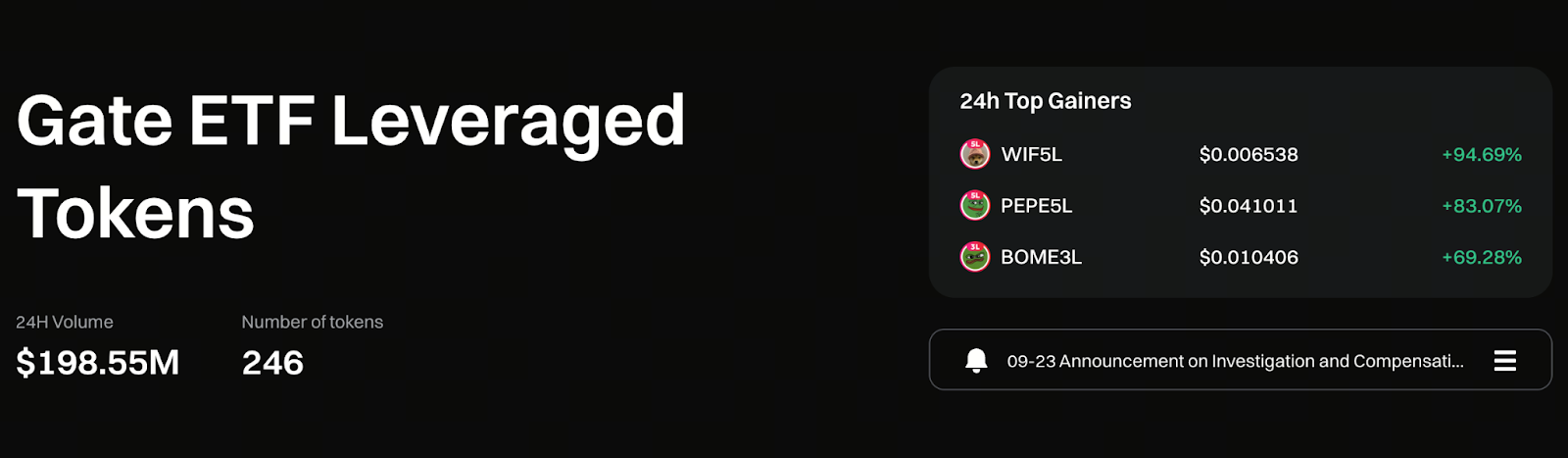
Gate Leveraged ETF tokens derive their exposure from corresponding perpetual contract positions, but the system manages this layer entirely. For users, the experience feels much like simple token trading, not futures trading.

During trading, users don’t need to manage:

  • Margin and maintenance calculations
  • Forced liquidation risk
  • Loan and funding rate changes
  • Position adjustments and rebalancing timing

Start trading Gate ETF leveraged tokens now: https://www.gate.com/leveraged-etf

Why Leverage Ratios Remain Stable Over Time

Leveraged ETFs are dynamic by design. To keep exposure within the intended leverage range, the system routinely rebalances and adjusts underlying contract positions. These processes happen behind the scenes but are crucial for product stability.

Leveraged ETFs are more than simple price multipliers—they’re dynamic, continuously adjusted strategy systems. Their performance depends on market trends and volatility patterns, letting traders focus on the core: market direction and timing entries and exits.

Amplifying Market Moves Without Engaging in Futures

For many traders, the stress doesn’t come from leverage itself but from the real-time, unforgiving risk controls of futures trading. Leveraged ETFs don’t eliminate risk—they transform it into a more intuitive form, with price changes directly impacting the token’s net asset value. This approach removes the threat of liquidations or forced closures, allowing traders to concentrate on trend analysis and capital allocation.

When Trends Are Clear, Efficiency Is Maximized

In trending or one-directional markets, leveraged ETFs reflect price changes in multiples, allowing capital to work harder in the same timeframe. With the rebalancing mechanism, these products can sometimes deliver a compounding effect during strong trends.

Because their trading logic closely mirrors spot transactions, leveraged ETFs are often used as a transitional tool before adopting more advanced leverage strategies. They let traders test their risk tolerance without taking on the full risk management burden of futures.

Key Structural Limitations to Recognize

Leveraged ETFs don’t outperform in every market condition. In sideways or choppy markets, the rebalancing mechanism can gradually erode net asset value, leading to outcomes that differ from intuition.

Moreover, final returns aren’t simply the underlying asset’s movement multiplied by the leverage factor. Trading costs, volatility, and adjustment paths all play a role. As a result, leveraged ETFs are generally not recommended for long-term holding.

Why There’s a Daily Management Fee

Gate Leveraged ETFs charge a daily management fee of 0.1% to cover the essential costs of ongoing operation, including:

  • Perpetual contract opening and closing fees
  • Funding rate costs
  • Hedging and position adjustment expenses
  • Slippage from rebalancing

These fees are not extra add-ons—they’re fundamental to maintaining the structural stability of leveraged ETFs over time.

The Right Way to Use Leveraged ETFs

Leveraged ETFs are not passive investment vehicles. They’re strategy execution modules best suited for traders with clear market outlooks, defined entry and exit plans, and the ability to handle short-term volatility—not for buy-and-hold investing. Only by fully understanding their structure, costs, and use cases can traders unlock the capital efficiency benefits of leveraged ETFs.

Summary

Leveraged ETFs don’t make trading easier; they make strategy implementation more direct. They amplify both price swings and the significance of every decision. For traders who can read market trends and manage risk proactively, Gate Leveraged ETFs are powerful tools for maximizing capital efficiency. But overlooking their structural features and cost implications can expose traders to risks beyond their expectations.

Author: Allen
Disclaimer
* The information is not intended to be and does not constitute financial advice or any other recommendation of any sort offered or endorsed by Gate.
* This article may not be reproduced, transmitted or copied without referencing Gate. Contravention is an infringement of Copyright Act and may be subject to legal action.

Share

Crypto Calendar
OM Token Göçü Sona Erdi
MANTRA Chain, kullanıcıları OM token'larını 15 Ocak'tan önce MANTRA Chain ana ağına taşımaları için bir hatırlatma yayınladı. Taşıma işlemi, $OM'nin yerel zincirine geçişi sırasında ekosistemdeki katılıma devam edilmesini sağlar.
OM
-4.32%
2026-01-14
CSM Fiyat Değişikliği
Hedera, Ocak 2026'dan itibaren KonsensüsSubmitMessage hizmeti için sabit USD ücretinin $0.0001'den $0.0008'e yükseleceğini duyurdu.
HBAR
-2.94%
2026-01-27
Vesting Kilidi Gecikti
Router Protocol, ROUTE tokeninin Hakediş kilidinin 6 aylık bir gecikme ile açılacağını duyurdu. Ekip, projenin Open Graph Architecture (OGA) ile stratejik uyum sağlamak ve uzun vadeli ivmeyi koruma hedefini gecikmenin başlıca nedenleri olarak belirtiyor. Bu süre zarfında yeni kilit açılımları gerçekleşmeyecek.
ROUTE
-1.03%
2026-01-28
Tokenların Kilidini Aç
Berachain BERA, 6 Şubat'ta yaklaşık 63,750,000 BERA tokenini serbest bırakacak ve bu, mevcut dolaşımdaki arzın yaklaşık %59.03'ünü oluşturacaktır.
BERA
-2.76%
2026-02-05
Tokenların Kilidini Aç
Wormhole, 3 Nisan'da 1.280.000.000 W token açacak ve bu, mevcut dolaşımdaki arzın yaklaşık %28,39'unu oluşturacak.
W
-7.32%
2026-04-02
sign up guide logosign up guide logo
sign up guide content imgsign up guide content img
Sign Up

Related Articles

What is MetFi? All You Need to Know About METFI (2025 Update)
Intermediate

What is MetFi? All You Need to Know About METFI (2025 Update)

MetFi is a decentralized metaverse and web3 incubator that utilizes NFTs to share investment returns with MetFi NFT holders and members of its community. As of 2025, MetFi trades at $0.225266 USD with a $47.7M market cap, offering AI-driven trading, blockchain learn-to-earn games, and ERC-404 airdrops through its Marine Moguls project for early claim rights to promising Web3 startups.
2025-06-17 11:02:54
Every U.S. Crypto ETF You Need to Know About in 2025
Intermediate

Every U.S. Crypto ETF You Need to Know About in 2025

In 2025, crypto ETFs expanded to alternative assets such as Solana, XRP, and DOGE, with mainstream asset management firms rushing to submit applications. This article provides a detailed analysis of the current status of ETF applications, the likelihood of approval, and their potential impact, outlining the key path for crypto assets to integrate into the traditional financial system.
2025-04-18 06:47:05
What are Leveraged ETF Tokens?
Beginner

What are Leveraged ETF Tokens?

Leveraged ETF tokens are derivatives that can multiply profits through leverages without the risk of liquidation. Leveraged ETF tokens can be traded the same way as spot products and generate leveraged gains, just as in contract trading. Users will never be confronted with a liquidation even if the market is mispredicted, which significantly lowers the barrier for ordinary users.
2022-11-21 09:38:56
Gate Research: BTC Hits New Highs, Bitwise Files Solana ETF, Stablecoin Exceeds $190B
Advanced

Gate Research: BTC Hits New Highs, Bitwise Files Solana ETF, Stablecoin Exceeds $190B

This week, BTC prices hit multiple new highs, reaching a 7-day peak of $94,643.6, with buying pressure continuing to strengthen. ETH showed relative weakness, with a weekly decline of 4.93%, remaining in a weak oscillating trend overall. Crypto asset management company Bitwise registered a Solana ETF in Delaware, USA, following its earlier application for an XRP ETF. USDT's market cap surpassed $130 billion, marking a historical high and reflecting increased capital inflow into the crypto market. Cryptocurrency lending platform Polter Finance suffered a hacker attack, resulting in a $12 million loss. Meanwhile, the crypto gambling platform Monkey Tilt completed a $30 million financing round, led by Pantera Capital.
2024-11-22 01:15:31
Bitcoin Spot ETF Vs. Bitcoin Futures ETF: What's the Difference?
Intermediate

Bitcoin Spot ETF Vs. Bitcoin Futures ETF: What's the Difference?

Learn the difference between Bitcoin Spot ETFs and Bitcoin Futures ETFs that allow buyers to invest in Bitcoin without signing up for an exchange or dealing with crypto wallets.
2023-12-15 16:48:12
Gate Research: Multiple Blockchains & DeFi Protocols Reach Record TVL; Nasdaq Files for LTC, XRP ETFs
Advanced

Gate Research: Multiple Blockchains & DeFi Protocols Reach Record TVL; Nasdaq Files for LTC, XRP ETFs

Gate Research Daily Report: February 11, in the past 24 hours, Bitcoin price increased 1.75%, remaining in a stable consolidation range; Ethereum price rose 1.84%, forming a descending triangle. Soneium TVL exceeded $33 million, reaching an all-time high. BOB Chain TVL increased 50.78% in a day, surpassing $247 million. Pendle TVL reached 1.95 million ETH, setting a new record. Nasdaq submitted trading applications for CoinShares LTC ETF and XRP ETF. Democratic Representative Maxine Waters introduced a stablecoin regulation bill. Bitcoin financial services firm Fold expanded its partnership with Visa.
2025-02-11 15:22:25