NAVX vs ATOM: Comparing Two Leading Navigation Systems for Autonomous Vehicles

2025-11-20 09:12:34
Altcoins
Blockchain
Cosmos
Crypto Insights
DeFi
Article Rating : 3.6
half-star
0 ratings
The article presents a detailed comparison between NAVX and ATOM, two leading cryptocurrencies influencing the autonomous vehicle navigation systems market. It evaluates their historical price trends, supply mechanisms, institutional adoption, and technological ecosystems. Key concerns such as investment strategies, market, and technical risks are addressed, helping investors decide which token offers better value. Aimed at both new and experienced investors, it provides actionable insights into short-term and long-term investment strategies, emphasizing NAVX's growth potential in DeFi and ATOM's established ecosystem with strong interoperability features. Relevant keywords include NAVX, ATOM, investment comparison, and cryptocurrency market analysis.
NAVX vs ATOM: Comparing Two Leading Navigation Systems for Autonomous Vehicles

Introduction: Investment Comparison between NAVX and ATOM

In the cryptocurrency market, the comparison between NAVX and ATOM has been an unavoidable topic for investors. The two not only show significant differences in market cap ranking, application scenarios, and price performance, but also represent different positioning in crypto assets.

NAVX (NAVX): Since its launch, it has gained market recognition for its position as the first Native One-Stop Liquidity Protocol on Sui.

ATOM (ATOM): Introduced in 2019, it has been hailed as the "Internet of Blockchains," and is one of the cryptocurrencies with high global trading volume and market capitalization.

This article will comprehensively analyze the investment value comparison between NAVX and ATOM, focusing on historical price trends, supply mechanisms, institutional adoption, technological ecosystems, and future predictions, attempting to answer the question most concerning investors:

"Which is the better buy right now?"

I. Price History Comparison and Current Market Status

  • 2024: NAVX reached its all-time high of $0.428 on March 29, 2024.
  • 2024: NAVX hit its all-time low of $0.01 on June 19, 2024.
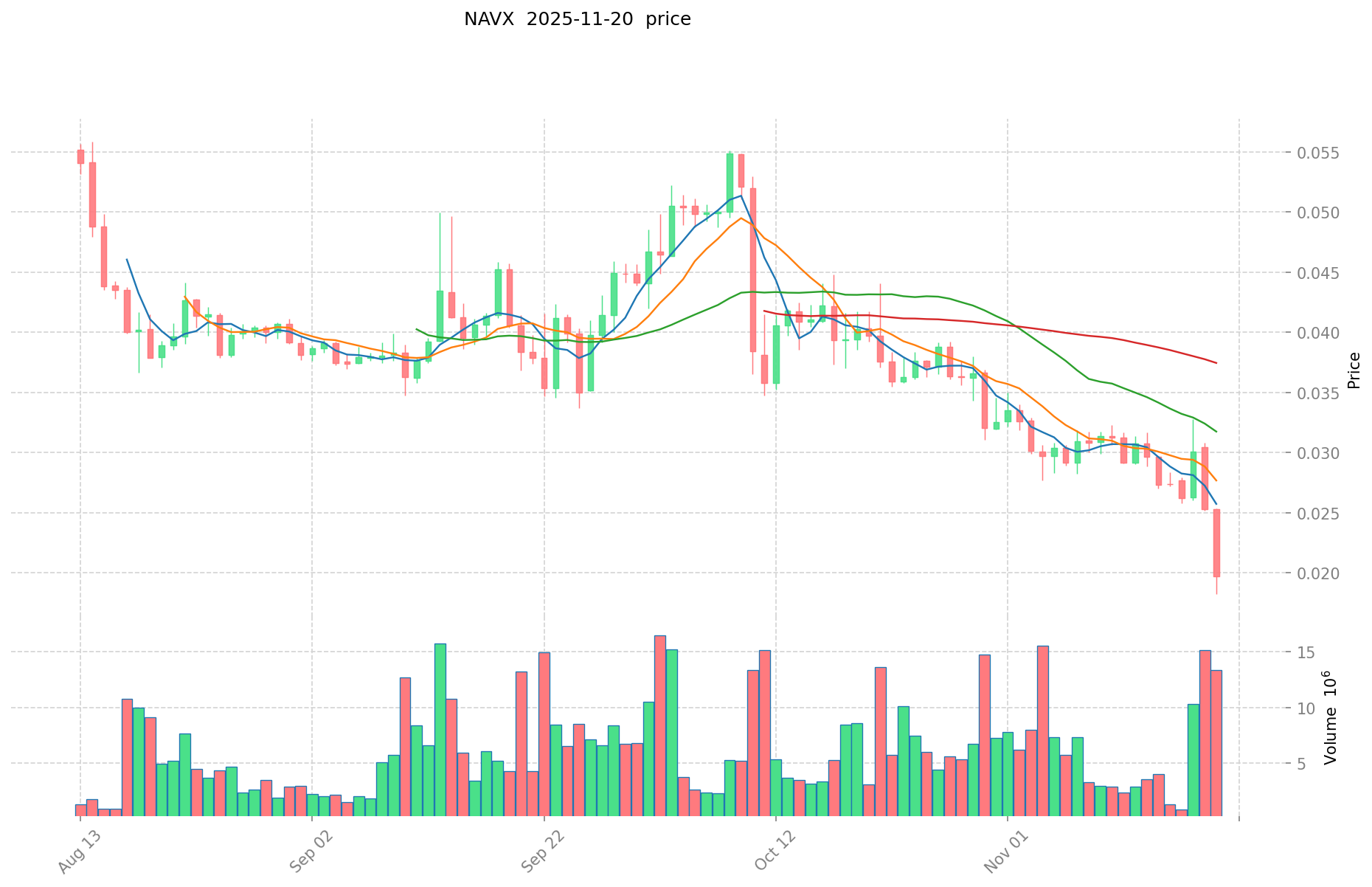
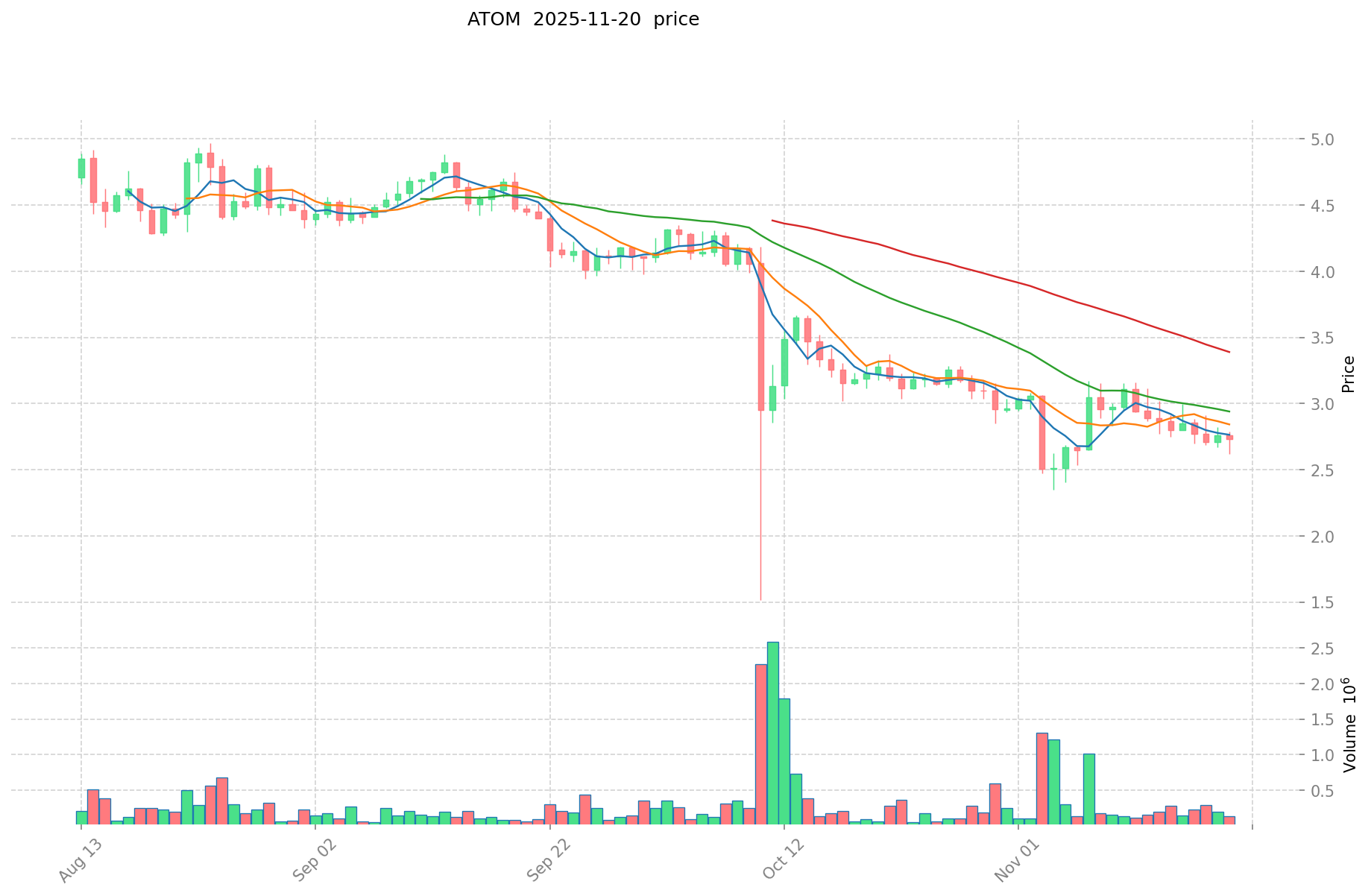
  • Comparative Analysis: In this market cycle, NAVX has experienced significant volatility, dropping from its peak of $0.428 to its current price of $0.01836, while ATOM has shown more stability.

Current Market Situation (2025-11-20)

  • NAVX current price: $0.01836
  • ATOM current price: $3.076
  • 24-hour trading volume: NAVX $410,103.34 vs ATOM $1,421,045.76
  • Market Sentiment Index (Fear & Greed Index): 11 (Extreme Fear)

Click to view real-time prices:

price_image1 price_image2

II. Core Factors Influencing NAVX vs ATOM Investment Value

Supply Mechanisms Comparison (Tokenomics)

  • NAVX: Initial supply of 250 million tokens with a maximum supply of 1 billion tokens. Built-in burn mechanism during the minting process, with 25% of transaction fees being burned.
  • ATOM: Inflationary model with target inflation rate between 7-20%. New tokens are continuously generated to secure the network through staking.
  • šŸ“Œ Historical Pattern: Deflationary mechanisms like NAVX's burn feature typically support price stability during market downturns, while ATOM's inflationary model encourages active participation in network security.

Institutional Adoption and Market Applications

  • Institutional Holdings: ATOM has gained more institutional traction with support from exchanges like Binance and Coinbase, while NAVX is still building institutional relationships.
  • Enterprise Adoption: ATOM has broader enterprise applications through the Cosmos ecosystem's interoperability features, connecting multiple blockchains. NAVX focuses on DeFi applications within the Sei Network.
  • Regulatory Attitudes: Both tokens operate in similar regulatory environments, with neither facing specific regulatory challenges currently.

Technical Development and Ecosystem Building

  • NAVX Technical Upgrades: Integration with Sei Network's Parallel-EVM offers high performance and Ethereum compatibility. Recent focus on optimizing cross-chain bridge security.
  • ATOM Technical Development: Continuous enhancement of the Inter-Blockchain Communication (IBC) protocol, enabling secure cross-chain transactions across the Cosmos ecosystem.
  • Ecosystem Comparison: ATOM has a more established ecosystem with numerous connected blockchains and DeFi protocols. NAVX is newer but growing rapidly within the Sei Network environment, particularly in DeFi and trading applications.

Macroeconomic Factors and Market Cycles

  • Inflation Performance: ATOM's staking rewards potentially offset inflation impacts, while NAVX's deflationary mechanism could provide better store of value during inflationary periods.
  • Macroeconomic Monetary Policy: Both assets show sensitivity to Federal Reserve decisions and interest rate changes, typical of the broader crypto market.
  • Geopolitical Factors: ATOM's interoperability features may provide advantages during periods of regional regulatory crackdowns, offering alternative routing for transactions.

III. 2025-2030 Price Predictions: NAVX vs ATOM

Short-term Forecast (2025)

  • NAVX: Conservative $0.0117-$0.0183 | Optimistic $0.0183-$0.0235
  • ATOM: Conservative $2.11-$3.06 | Optimistic $3.06-$3.33

Mid-term Forecast (2027)

  • NAVX may enter a growth phase, with prices expected in the range of $0.0135-$0.0281
  • ATOM may enter a bullish market, with prices expected in the range of $2.93-$3.84
  • Key drivers: Institutional capital inflow, ETFs, ecosystem development

Long-term Forecast (2030)

  • NAVX: Base scenario $0.0335-$0.0355 | Optimistic scenario $0.0355-$0.0375
  • ATOM: Base scenario $4.84-$7.17 | Optimistic scenario $7.17-$7.50

View detailed price predictions for NAVX and ATOM

Disclaimer

NAVX:

幓份 é¢„ęµ‹ęœ€é«˜ä»· é¢„ęµ‹å¹³å‡ä»·ę ¼ é¢„ęµ‹ęœ€ä½Žä»· ę¶Øč·Œå¹…
2025 0.0235392 0.01839 0.0117696 0
2026 0.02201283 0.0209646 0.01467522 14
2027 0.02815021665 0.021488715 0.01353789045 17
2028 0.03449905749675 0.024819465825 0.02159293526775 35
2029 0.037370669692702 0.029659261660875 0.020761483162612 61
2030 0.035525863617396 0.033514965676788 0.023125326316984 82

ATOM:

幓份 é¢„ęµ‹ęœ€é«˜ä»· é¢„ęµ‹å¹³å‡ä»·ę ¼ é¢„ęµ‹ęœ€ä½Žä»· ę¶Øč·Œå¹…
2025 3.33758 3.062 2.11278 0
2026 4.1277291 3.19979 2.4318404 4
2027 3.8469475275 3.66375955 2.93100764 19
2028 5.182387883475 3.75535353875 2.2907656586375 22
2029 5.228578732001625 4.4688707111125 2.904765962223125 45
2030 7.176112587904452 4.848724721557062 3.92746702446122 57

IV. Investment Strategy Comparison: NAVX vs ATOM

Long-term vs Short-term Investment Strategies

  • NAVX: Suitable for investors focusing on DeFi potential and ecosystem growth within the Sei Network
  • ATOM: Suitable for investors seeking interoperability and broader blockchain ecosystem exposure

Risk Management and Asset Allocation

  • Conservative investors: NAVX: 20% vs ATOM: 80%
  • Aggressive investors: NAVX: 40% vs ATOM: 60%
  • Hedging tools: Stablecoin allocation, options, cross-currency portfolios

V. Potential Risk Comparison

Market Risk

  • NAVX: Higher volatility due to smaller market cap and newer ecosystem
  • ATOM: Exposure to broader crypto market trends and competition from other interoperability solutions

Technical Risk

  • NAVX: Scalability, network stability within the Sei Network
  • ATOM: Network congestion during high-traffic periods, potential vulnerabilities in cross-chain communication

Regulatory Risk

  • Global regulatory policies may impact both, with ATOM potentially facing more scrutiny due to its wider adoption and cross-chain functionality

VI. Conclusion: Which Is the Better Buy?

šŸ“Œ Investment Value Summary:

  • NAVX advantages: Deflationary mechanism, potential for rapid growth within Sei Network ecosystem
  • ATOM advantages: Established ecosystem, strong interoperability features, institutional adoption

āœ… Investment Advice:

  • New investors: Consider a higher allocation to ATOM for its established track record and broader ecosystem
  • Experienced investors: Balanced approach with exposure to both, leveraging NAVX's growth potential and ATOM's stability
  • Institutional investors: Focus on ATOM for its liquidity and established market presence, with a smaller allocation to NAVX for diversification

āš ļø Risk Warning: The cryptocurrency market is highly volatile, and this article does not constitute investment advice. None

VII. FAQ

Q1: What are the main differences between NAVX and ATOM? A: NAVX is a newer token focused on DeFi within the Sei Network, with a deflationary mechanism. ATOM is more established, powering the Cosmos ecosystem with interoperability features and an inflationary model.

Q2: Which token has shown better price stability? A: ATOM has demonstrated more price stability compared to NAVX, which has experienced significant volatility since its launch.

Q3: How do the supply mechanisms of NAVX and ATOM differ? A: NAVX has a maximum supply of 1 billion tokens with a built-in burn mechanism, while ATOM has an inflationary model with a target inflation rate between 7-20%.

Q4: Which token has greater institutional adoption? A: ATOM has gained more institutional traction, with support from major exchanges like Binance and Coinbase, while NAVX is still building its institutional relationships.

Q5: What are the key technical developments for each token? A: NAVX is integrating with Sei Network's Parallel-EVM for high performance, while ATOM is continuously enhancing its Inter-Blockchain Communication (IBC) protocol.

Q6: How do the long-term price predictions compare? A: By 2030, NAVX is predicted to reach $0.0335-$0.0375, while ATOM is expected to reach $4.84-$7.50 in the base scenario.

Q7: What investment strategy is recommended for each token? A: NAVX may be suitable for investors focusing on DeFi potential within the Sei Network, while ATOM is appropriate for those seeking exposure to a broader blockchain ecosystem.

Q8: What are the primary risks associated with each token? A: NAVX faces higher volatility due to its smaller market cap, while ATOM is exposed to broader crypto market trends and potential congestion issues during high-traffic periods.

* The information is not intended to be and does not constitute financial advice or any other recommendation of any sort offered or endorsed by Gate.
Related Articles
AERO vs ATOM: Comparing Two Cutting-Edge Processor Architectures for Mobile Devices

AERO vs ATOM: Comparing Two Cutting-Edge Processor Architectures for Mobile Devices

This article provides a comprehensive comparison between AERO and ATOM, focusing on their investment value within the cryptocurrency market. It analyzes historical price trends, market position, supply mechanisms, institutional adoption, and technological ecosystems to address key investor concerns about choosing the better investment option. By exploring market data and offering strategic insights into risk management and asset allocation, readers can determine which token aligns with their investment goals. Ideal for investors seeking a detailed evaluation of AERO and ATOM, especially in the context of potential returns and risks in their portfolios.
2025-10-16 00:55:20
VTHO vs ATOM: A Comparative Analysis of Two Blockchain Ecosystems and Their Potential for Long-Term Growth

VTHO vs ATOM: A Comparative Analysis of Two Blockchain Ecosystems and Their Potential for Long-Term Growth

The article "VTHO vs ATOM: A Comparative Analysis of Two Blockchain Ecosystems and Their Potential for Long-Term Growth" offers a detailed evaluation of the investment prospects for VTHO and ATOM, focusing on historical price trends, supply mechanisms, institutional adoption, technological ecosystems, and macroeconomic factors. It tackles the critical question of which token presents a better investment opportunity, catering to different types of investors - from new to institutional. The piece unfolds systematically, starting with an investment comparison, followed by pricing history, core factors affecting investment value, price prediction from 2025 to 2030, investment strategies, risk assessments, and concluding with FAQs that address key distinctions, performance, and adoption insights.
2025-10-20 00:17:39
How Does Cryptocurrency Fund Flow Impact Exchange Holdings and On-Chain Metrics?

How Does Cryptocurrency Fund Flow Impact Exchange Holdings and On-Chain Metrics?

This article analyzes the impact of cryptocurrency fund flows on exchange holdings and on-chain metrics, focusing on significant net inflows to Gate reaching $1.2 billion in Q4 2025. It highlights how this movement shapes investor sentiment, with concentration among top NTRN addresses influencing price volatility and governance structure. The text explores increased on-chain locked tokens and their implications for network security and cross-chain functionality. Institutional accumulation patterns underscore strategic confidence despite market volatility, signaling medium to long-term recovery prospects.
2025-11-23 09:07:35
2025 NTRN Price Prediction: Future Market Trends and Investment Potential Analysis

2025 NTRN Price Prediction: Future Market Trends and Investment Potential Analysis

The article "2025 NTRN Price Prediction: Future Market Trends and Investment Potential Analysis" explores the dynamics and investment strategies surrounding Neutron (NTRN) within the Cosmos ecosystem. It provides a detailed overview of NTRN's market position, historical pricing trajectory, and current status, emphasizing its crucial role in cross-chain applications. Key factors influencing future prices, including supply mechanisms and ecosystem growth, are analyzed alongside practical investment strategies and risk management techniques. This comprehensive guide addresses investor inquiries about NTRN's viability, price predictions, and strategic approaches through the lens of market data and sentiment, encouraging informed decision-making while leveraging Gate's platform for trading and data analysis.
2025-09-30 10:43:01
YB vs ATOM: The Battle of Digital Asset Platforms Shaping the Future of Finance

YB vs ATOM: The Battle of Digital Asset Platforms Shaping the Future of Finance

This article delves into the investment comparison of YieldBasis (YB) and Cosmos (ATOM), exploring their historical price trends, supply mechanisms, and technological ecosystems. It examines key factors influencing their market performance and offers insights into future price predictions. By addressing crucial investment inquiries like "Which is the better buy?" it aims to guide investors in asset allocation and risk management strategies. Suitable for both new and experienced investors, the article highlights YB's appeal in DeFi and ATOM's cross-chain interoperability advantages. Key insights cater to readers seeking a thorough decision-making framework.
2025-11-18 05:12:15
SLN vs ATOM: Comparing Two Popular XML-based Chemical File Formats for Molecular Modeling

SLN vs ATOM: Comparing Two Popular XML-based Chemical File Formats for Molecular Modeling

This article provides a comprehensive comparison of SLN and ATOM, two prominent XML-based chemical file formats for molecular modeling. It addresses key investment considerations, including historical price trends, supply mechanisms, institutional adoption, and technological ecosystems. By evaluating price predictions and investment strategies, it serves both new and experienced investors. The piece also outlines potential risks, helping readers make informed decisions. Core themes like interoperability, token supply, and ecosystem development are emphasized for clarity. Access real-time updates and predictions through the referenced Gate links.
2025-11-27 12:12:39
Recommended for You
What Is WNCG Compliance and Regulatory Risk in 2026?

What Is WNCG Compliance and Regulatory Risk in 2026?

# What Is WNCG Compliance and Regulatory Risk in 2026? This comprehensive guide examines the critical compliance challenges and regulatory risks facing WNCG, the Nine Chronicles governance token, in 2026. The article addresses fragmented global regulatory frameworks, gaming token classification ambiguities, KYC/AML compliance gaps, and transparency deficits affecting investor protection. Designed for WNCG holders, developers, and crypto investors, this analysis provides essential guidance on navigating jurisdictional requirements across the US, EU, and international markets. Readers will understand how regulatory shifts impact token utility, trading accessibility on platforms like Gate, and cross-border transaction restrictions. The guide equips stakeholders with actionable compliance insights and risk mitigation strategies necessary for sustainable engagement with the WNCG ecosystem in an evolving regulatory landscape.
2026-01-04 09:44:58
How Active Is WNCG Community and Ecosystem in 2026: Twitter Followers, Developer Contribution, and DApp Growth

How Active Is WNCG Community and Ecosystem in 2026: Twitter Followers, Developer Contribution, and DApp Growth

# How Active Is WNCG Community and Ecosystem in 2026: Overview This comprehensive analysis examines WNCG's community vitality and ecosystem maturity through three critical dimensions: social media engagement, developer contribution, and DApp adoption. The article evaluates Twitter/Telegram follower growth, GitHub activity metrics, and cross-chain ecosystem expansion to assess Nine Chronicles' competitive positioning within blockchain gaming. Designed for investors, developers, and community members, this guide reveals how interaction frequency, protocol development progress, and multi-chain deployment collectively drive WNCG ecosystem growth. By tracking 233% GitHub commit growth, 100+ operational DApps, and strong DAO governance participation, readers gain actionable insights into Nine Chronicles' sustainable expansion trajectory and market relevance in 2026. The article combines quantitative metrics with strategic analysis to help stakeholders make informed decisions about WNCG ecosystem participation and
2026-01-04 09:42:50
What is GoPlus Security (GPS) token: whitepaper logic, use cases, and technical innovation explained
What is GoPlus Security (GPS) token: whitepaper logic, use cases, and technical innovation explained

# GoPlus Security (GPS) Token: Comprehensive Web3 Protection Framework This article explores GoPlus Security's decentralized protection infrastructure designed to address the $3.1 billion Web3 vulnerability challenge. It examines the decentralized security API architecture enabling real-time smart contract analysis across 30+ blockchains, multi-chain use cases spanning DeFi protection and NFT safety verification, and advanced risk-scoring algorithms powering transaction screening. The guide details how GPS integrates with major platforms on Gate and evaluates ecosystem adoption trends. Ideal for developers, traders, and investors seeking institutional-grade security solutions, this resource provides actionable insights into GPS token economics, integration milestones, and Web3's evolving security landscape.
2026-01-04 09:40:44
What Is a Bitcoin (BTC) Wallet Address?

What Is a Bitcoin (BTC) Wallet Address?

# How to Locate Your BTC Wallet Address This comprehensive guide demystifies Bitcoin wallet addresses for beginners and experienced users alike. Learn how BTC wallet addresses function as your public identifier on the blockchain, explore three main address formats (Legacy, SegWit, and Bech32), and understand their key differences in fees and efficiency. The article walks you through obtaining a wallet address, managing multiple addresses, and best practices for secure Bitcoin transactions. Whether you're sending funds via Gate or receiving payments, this resource clarifies address compatibility, permanence, and critical security distinctions between public addresses and private keys. Perfect for anyone seeking to confidently navigate Bitcoin transactions while protecting their assets.
2026-01-04 09:40:23
WAGMI Meaning

WAGMI Meaning

# Understanding WAGMI: What It Means in the Crypto World **Article Introduction:** This guide explores WAGMI ("We're All Gonna Make It"), a powerful rallying cry uniting cryptocurrency communities worldwide. Learn how this motivational acronym embodies collective optimism and resilience during market volatility, while comparing it with related crypto terminology like NGMI and GMI. Whether you're trading on Gate or exploring blockchain investments, understanding WAGMI culture strengthens community engagement and decision-making. Discover why crypto enthusiasts use these abbreviations to foster unity, maintain confidence through price fluctuations, and symbolize shared belief in long-term success. This article equips both newcomers and experienced investors with essential Web3 vocabulary and the mindset behind crypto communities' most inspiring mantras.
2026-01-04 09:39:01
How to Compare Crypto Competitors: Market Share, Performance, and User Base Analysis in 2026

How to Compare Crypto Competitors: Market Share, Performance, and User Base Analysis in 2026

# How to Compare Crypto Competitors: Market Share, Performance, and User Base Analysis in 2026 This comprehensive guide helps investors, traders, and analysts evaluate cryptocurrency platforms through critical performance metrics. Covering market cap dominance, daily trading volume, and user growth trends, this analysis reveals how Binance maintains institutional leadership while emerging platforms gain traction through lower fees and compliance-first architectures. Discover key performance indicators—transaction speed, fee structures, and security features—that distinguish top competitors like Gate in the 2026 crypto landscape. Learn how to assess blockchain project adoption using on-chain metrics, holder addresses, and active user data from analytics platforms. Whether comparing established leaders or emerging cryptocurrencies, this resource provides actionable frameworks for comprehensive competitive analysis, regulatory considerations, and long-term development potential evaluation.
2026-01-04 09:38:14